Home » Jazz Articles » Compare & Contrast » Oliver Lake: Upwards & Outwards
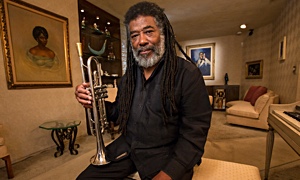
Oliver Lake: Upwards & Outwards
It's not as if in the nineteen years separating these two albums Oliver Lake has jumped aboard some passing conservative bandwagon.
 Oliver Lake has always had an innate grasp of musical tradition that extends beyond jazz to encompass other areas of African American musical expression, and the effect of this on his music has always been beneficial. Allied to this have been two other virtues, namely his abiding fascination with the work of Eric Dolphy, perhaps unsurprisingly not a highly influential figure, and an instrumental conception deep enough to enable him to appreciate the diversity inherent in the alto sax, the soprano sax and the flute, his three instruments of choice.
 Such is the diversity of the two albums discussed here that the only thing that unites them is Lake's leadership. Clevont Fitzhubert (A Good Friend Of Mine) finds him at the head of a bass-less quartet that produces distinctly organic music. Solos, where they're taken, are more like flourishes than extended expositions of instrumental technique, and in a sense the work of the Joe Harriott quintet of the late fifties and early sixties is evoked despite the differences of approach.
The absence of a bass would appear to leave pianist Donald Smith and drummer Pheroan Ak Laff with a lot of ground to cover, but such is the ingenuity of Lake's compositions that the ear is gently coerced into making the adjustment. Sop best exemplifies this, with Ak Laff's parade ground snare drum work acting as a kind of pulse around which the group coalesces and from which it takes its cues. The result is a group performance in the best sense of the term. Here as elsewhere trumpeter Baikida Carroll shows his grasp of the group conception at work here. Tap Dancer appears to be built around the drums, and such is the deftness of Ak Laff's work that the spirit of Bojangles Robinson isn't far away.
By contrast, the music on Talkin' Stick comes across as more conservative. However, the fact of the matter is that it's also another facet of Lake's inclusive approach to his art. Any small group including pianist Geri Allen is unlikely to want for identity, and sure enough the music here is ripe with an exploratory feel despite its adherence to values more longstanding than those on Clevont...
 Lake's astringent alto sax tone is perhaps better captured here, and the dynamic contrast between his work and that of vibes player Jay Hoggard is at its most notable on Reminds Me , where Hoggard doesn't cover anywhere near as much territory as Lake but succeeds, perhaps because of this, in bringing an entirely different slant to the composition.
Hard Blues , from the pen of Lake's long-time compatriot Julius Hemphill, has its mood established from the first notes of bassist Belden Bullock's intro, and the group shows a grasp of Hemphill's compositional nuances. Lake plays the soprano sax here, and not for the first time on record his command of that slippery horn is heard to be such that it would be demeaning to describe it as his second instrument.
It's not as if in the nineteen years separating these two albums Oliver Lake has jumped aboard some passing conservative bandwagon. In that time he has made no great commercial advance -as is shown by the fact that these albums were both recorded for small, one- or two- person operations. What he has done, and again these two albums are ample evidence of it, is stuck to his own artistic guns. Fads may come and go, but Oliver Lake has turned his career into an expression of artistic individuality. He has also, though not through calculation, become one of the most expressive instrumentalists in the music.
Oliver Lake Quartet: Clevont Fitzhubert - A Good Friend Of Mine (Black Saint, 120054-2)
Oliver Lake Quintet: Talkin' Stick (Passin' Thru, 41213)
 FOLLOW Nic Jones
and get notified whenever a new article published.
FOLLOW Nic Jones
and get notified whenever a new article published.
Nic gets a positive sense of wonder from the most worthwhile music.
About Oliver Lake

Tags
PREVIOUS / NEXT


Become a Sustaining Member

Since 1995, All About Jazz has championed jazz as an art form and supported the musicians who create it. Over three decades, it has grown into one of the world's leading jazz resources, serving hundreds of thousands of readers, musicians, presenters and industry professionals each month.
Help Build the Future of All About Jazz
Your support helps us continue building All About Jazz for the next generation—expanding our editorial coverage, preserving jazz history, developing new community features and creating better ways to discover the music and the people behind it.
Become a sustaining member for as little as $20 per year and you'll immediately enjoy an ad-free experience along with access to subscriber features and future articles for a full year.
Together, we're not simply sustaining All About Jazz—we're building its future. Thank you for being part of the journey.