Home » Jazz Articles » Book Review » Northern Sun, Southern Moon: Europe
Northern Sun, Southern Moon: Europe
 Mike Heffley
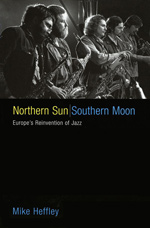
 Northern Sun, Southern Moon: Europe's Reinvention of Jazz
Yale University Press
ISBN: 0300106939
400 pages
2005
While improvised music in Europe has certainly had a storied history, despite being decidedly more "condensed" temporally than its American counterpart, this history is something that has often been overlooked in the canon of English-language jazz studies (in fact, European jazz is significantly overlooked in European musicology, probably more so than in America). To be sure, this is often a result of the perception that European jazz has nothing to do with slavery and the tradition of oppression that spawned the blues and jazz in America—yet this reasoning leaves to the side a case for Europe's own cultural heritage, tumultuous ethnic divisiveness, and rich aesthetic tradition as spawning that very same "cry" that imbues Afro-American musical culture.
Noted jazz critic and ethnomusicologist Mike Heffley has, in Northern Sun, Southern Moon, given an English-language voice to both the body of music and the body of criticism that has surrounded improvisational work in Germany (Western and Eastern), France, England, Holland, Poland, the Czech Republic, Scandinavia and Russia over the past fifty years. Yet unlike some of his contemporaries, Heffley goes beyond immediate aesthetic criticism of the music and the immediate sociopolitical factors it has reacted against, choosing instead to invoke Baroque traditions to discuss jazz as an art stemming from both reconstruction and fervor. To be sure, much of western literature and the Continent's men of arts and letters (Theodor Adorno, for one) have had a tremendous disdain for jazz and improvisational music, even as it may be used as a model for socio- cultural and aesthetic ideas.
Heffley is well-versed in modern philosophy, as his use of Husserl's diagram of time and memory shows (Chapter Six, based on an analysis of Alexander von Schlippenbach's "Sun ), particularly interesting as it discusses a music rooted in the experiential, expansive notion of time that subsumes memory to direct, physical experience. Time, as it applies to the directness of lived time as well as time in a cultural-evolutionary sense, is what Heffley uses to tie in European free improvisation with the other folk- and art-musics of the world: namely, that in expressing cultural memory via the "cry," this music carries with it a direct aesthetic experience that is completely its own and not beholden to anything outside itself. Northern Sun, Southern Moon has perfectly captured one of the joyous ironies in ethnomusicology.
 FOLLOW Clifford Allen
and get notified whenever a new article published.
FOLLOW Clifford Allen
and get notified whenever a new article published.
Clifford Allen wishes he could've shared a loft at 27 Cooper Square in 1966.
Tags
PREVIOUS / NEXT


Become a Sustaining Member

Since 1995, All About Jazz has championed jazz as an art form and supported the musicians who create it. Over three decades, it has grown into one of the world's leading jazz resources, serving hundreds of thousands of readers, musicians, presenters and industry professionals each month.
Help Build the Future of All About Jazz
Your support helps us continue building All About Jazz for the next generation—expanding our editorial coverage, preserving jazz history, developing new community features and creating better ways to discover the music and the people behind it.
Become a sustaining member for as little as $20 per year and you'll immediately enjoy an ad-free experience along with access to subscriber features and future articles for a full year.
Together, we're not simply sustaining All About Jazz—we're building its future. Thank you for being part of the journey.