Home » Jazz Articles » Album Review » Marion Brown: Live in Europe 1968 & 1972
Marion Brown: Live in Europe 1968 & 1972
Brown's discography, though relatively modest compared to some of his contemporaries, contains several essential recordings. He recorded two albums for ESP-Disk and three for Impulse!, including Three for Shepp (1967), and later released the landmark Afternoon of a Georgia Faun (ECM, 1970). His distinctive alto saxophone can also be heard on Coltrane's monumental Ascension (Impulse!, 1966). Like Ayler and Dolphy, Brown struggled to find consistent opportunities in the United States. Unlike them, however, he survived the turbulent 1960s and continued creating music well into his later years, passing away in 2010 at the age of 79.
Modern listeners have benefited from an ongoing reassessment of Brown's legacy, aided in no small part by archival releases from NoBusiness Records. Previous discoveries have included Live at the Black Musicians' Conference, 1981 (2018), a duo recording with pianist Dave Burrell, and The Group Live 1986 (2012), featuring an all-star ensemble that included Ahmed Abdullah, Andrew Cyrille, Billy Bang, Fred Hopkins and Sirone.
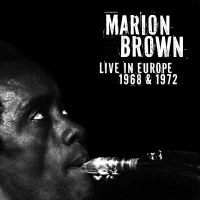
To that growing body of work, NoBusiness adds Live in Europe 1968 & 1972, a collection drawn from performances in France. The March 16, 1968 recordings feature Brown alongside vibraphonist Gunter Hampel, bassist Barre Phillips and drummer Steve McCall. Completing the set are two extended duo performances with McCall, recorded on August 22, 1972, at the Festival de Châteauvallon.
The quartet recordings showcase a fully-realized ensemble sound. Brown composed all of the material except for Hampel's "Epiphanie," and the music embodies one of the alto saxophonist's greatest strengths: balancing the freedom of the avant-garde with an unwavering sense of melody and pulse. In Brown's hands, those qualities are never contradictory. The opening "Current Events" writhes and surges with kinetic energy, generating momentum that propels each soloist forward. Brown's alto possesses a distinctive combination of fragility and authority, a slightly brittle tone that nevertheless commands attention.
Hampel's vibraphone serves as an ideal counterpart. Its shimmering resonance grounds the music while adding a luminous quality to the quartet's sound. Phillips and McCall provide a flexible rhythmic framework, allowing the music to move freely while maintaining a strong sense of direction. The result is avant-garde jazz that remains remarkably accessible, driven as much by lyricism as by experimentation.
The two duo performances with McCall reveal another side of Brown's artistry. Beginning as intimate exchanges between saxophone and percussion, the pieces gradually evolve into something closer to conversation than performance. At points, Brown sets aside his horn to play hand percussion, underscoring his longstanding interest in ethnomusicology and non-Western musical traditions. Here, sound functions not merely as music but as communication, an exchange of ideas, textures and rhythms that transcends conventional improvisation.
Live in Europe 1968 & 1972 serves as both an important historical document and a reminder of Brown's singular voice. While his contemporaries often pursued transcendence through intensity, Brown found it through nuance, balance and deep listening. These performances capture an artist who was never interested in overwhelming his audience, but rather in inviting them into a richer, more expansive musical world. More than 50 years later, the recordings still sound fresh, reaffirming Brown's place among the most thoughtful and original architects of modern jazz.
 FOLLOW Mark Corroto
and get notified whenever a new article published.
FOLLOW Mark Corroto
and get notified whenever a new article published.
Mark misses his dogs Louie & Freddy, but endeavors daily to find and listen to new and interesting sounds.
Track Listing
Current Events; Epiphanie; 61 To Erie Basin; Djinji's Corner; Afternoon Of A Georgia Faun.
Personnel


Additional Instrumentation
Gunter Hampel: vibraphone.
Album information
Title: Live in Europe 1968 & 1972 | Year Released: 2026 | Record Label: NoBusiness Records
About Marion Brown
Tags
PREVIOUS / NEXT

Become a Sustaining Member

Since 1995, All About Jazz has championed jazz as an art form and supported the musicians who create it. Over three decades, it has grown into one of the world's leading jazz resources, serving hundreds of thousands of readers, musicians, presenters and industry professionals each month.
Help Build the Future of All About Jazz
Your support helps us continue building All About Jazz for the next generation—expanding our editorial coverage, preserving jazz history, developing new community features and creating better ways to discover the music and the people behind it.
Become a sustaining member for as little as $20 per year and you'll immediately enjoy an ad-free experience along with access to subscriber features and future articles for a full year.
Together, we're not simply sustaining All About Jazz—we're building its future. Thank you for being part of the journey.