Home » Jazz Articles » Album Review » Horace Tapscott with the Pan Afrikan Peoples Arkestra: L...
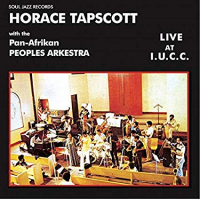
Horace Tapscott with the Pan Afrikan Peoples Arkestra: Live at I.C.U.U.
Tapscott, who was born in Houston, Texas, relocated to the Watts neighborhood of Los Angeles at nine. It had a profound effect on his life and music as the early part of his career coincided with the 1965 Watts Rebellion which left dozens of African American residents dead at the hands of police and military. Hundreds of structures, residential and commercial, burned to the ground including many local jazz venues. Tapscott had founded the artist group Underground Musicians Association (UGMA) in 1963 and he took on the role of activist and mentor, bringing his "spiritual" jazz to community youth, and offering jazz as a creative outlet to that same community. It was from Tapscott's own neighborhood that members of the Pan Afrikan Peoples Arkestra (PAPA) were often nurtured. His outreach program extended from churches to prisons, and his personal associations included Don Cherry, Sun Ra, Arthur Blythe, Lawrence "Butch" Morris, David Murray, and members of the controversial Black Panther Party.
Live At I.U.C.C. (Immanuel United Church of Christ) was recorded at that PAPA home-base where, from 1972 to 1981, they performed on the last Sunday of every month. Seven of the eight tracks on this two-CD set are double-digit in length, two surpassing the twenty-minute mark. Those epic pieces, "Macrame" and "Village Dance," are the dual centerpieces of the album. They typify Tapscott's penchant for large-ensemble blending of avant-garde and hard-swing, in an approachable, infectious manner. Much of the horn-driven music is led by tenor saxophonist Sabir Mateen, who wrote two of the compositions. "Future Sally's Time" (by Arthur Blythe and Stanley Crouch) is Tapscott's showcase piece, as he opens with a solo and irregularly weaves his pointed lines through the dense group play. The pianist's own "L.T.T." demonstrates a disciplined approach which still leaves room to soar into otherworldliness.
In 1998 Tapscott's physical health was in decline and he had been diagnosed with palsy. Still, he continued to amaze audiences as he played concerts with only his right hand. In February 1999, when Tapscott could no longer play, a tribute concert was arranged. Billy Higgins, Pharoah Sanders, Gerald Wilson, Tapscott's Pan-Afrikan Peoples Arkestra, and many others played to a crowd of more than one-thousand. Few in the audience knew Tapscott had died just before midnight, aged sixty-four. In South Central LA, he was known by everyone. It is about time the rest of us got on board.
 FOLLOW Karl Ackermann
and get notified whenever a new article published.
FOLLOW Karl Ackermann
and get notified whenever a new article published.
New York based contributor. Author of: "A Map of Jazz: Crossroads of Music and Human Rights" and keynote speaker/host of Pearson Jazz Foundation's International Jazz Day event (2018, 2019)
Track Listing
Disc 1: Macrame; Future Sally's Time; Noissessprahs; McKowsky's First Fifth. Disc 2: Village Dance; L.T.T.; Desert Fairy Princess; Lift Every Voice.
Personnel

Horace Tapscott
pianoJohn Williams: baritone saxophone (1-2 to 2-3); Alan Hines: bass: (1-1 to 2-3); Roberto Miranda: bass (1-2 to 2-2); Billy Hinton: drums (tracks: 1-2 to 2-2); Adele Sebastian: flute (1-2 to 2-3); Aubrey Hart: flute (1-2 to 2-2); Daa'oud Woods: percussion (1-2 to 2-3); Horace Tapscott: piano; Billy Harris: (1-2 to 2-3); Sabir Mateen: tenor saxophone; Lester Robertson: trombone.
Album information
Title: Live at I.C.U.U. | Year Released: 2019 | Record Label: Soul Jazz Records
About Horace Tapscott
Tags
PREVIOUS / NEXT


Become a Sustaining Member

Since 1995, All About Jazz has championed jazz as an art form and supported the musicians who create it. Over three decades, it has grown into one of the world's leading jazz resources, serving hundreds of thousands of readers, musicians, presenters and industry professionals each month.
Help Build the Future of All About Jazz
Your support helps us continue building All About Jazz for the next generation—expanding our editorial coverage, preserving jazz history, developing new community features and creating better ways to discover the music and the people behind it.
Become a sustaining member for as little as $20 per year and you'll immediately enjoy an ad-free experience along with access to subscriber features and future articles for a full year.
Together, we're not simply sustaining All About Jazz—we're building its future. Thank you for being part of the journey.