Home » Jazz Articles » Album Review » Ari Hoenig: Lines of Oppression
Ari Hoenig: Lines of Oppression
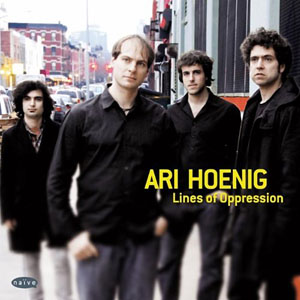
Not that the concept is new, but Hoenig has honed a bit of showmanship shtick into something musical, taking it to the next step on his own Lines of Oppression, where he becomes the lead instrument on Bobby Timmons' classic "Moanin'"—nearly beyond belief, as he ekes notes as blue as they'd sound on a horn. Settling back into a more conventional role as purveyor of a loose swing groove, he passes the baton to guitarist Gilad Hekselman, who demonstrates increasing distance from his earlier touchstone, Kurt Rosenwinkel, with carefully chosen notes, overdriven but in a warm, almost ethereal way. Pianist Tigran Hamasyan's next, and though capable of lithe flights of fancy—and a musical mélange that often brings his own Armenian roots into the equation—in the context of this blues, he demonstrates a deeper appreciation of the tradition, starting with Count Basie-like economy, but gradually picking up steam as his solo, an encyclopedia of jazz piano, gradually unfurls.
There's also a reading of Thelonious Monk's oft-covered "Rhythm-a-ning," delivered with Carl Stalling-like wryness before breaking into a middle section where Hekselman and Hamasyan go at it, head-to-head, for one of the album's more exciting moments. Monk's influence is also felt on a trio version of "How High the Moon," featuring Hamasyan and bassist Chris Tordini, who subs for regular bassist Orlando le Fleming here and on two other tracks, including the pianist's idiosyncratic, rock-edged set-closed, "Higher to Hamasyan."
The rest of the album comes from Hoenig's pen, accounting for two-thirds of its 60-minute duration, the majority of that slice occupied by just two compositions—the quirkily polyrhythmic title track, featuring an early bar-raising solo from Hekselman, and the even knottier "Arrows & Loops," with its preponderance of accented shots amidst a dervish-like melody, leading to Hamasyan's set-defining solo, a combination of choppy voicings and fluid, serpentine melodies. "Wedding Song" proves Hoenig isn't averse to lyricism, though its bittersweet melody seems paradoxical to the song's title.
Whether taking the lead on "Rhythm"—his a capella solo and vocalizations a North American variant on the Indian konnakol tradition—or acting as perpetual rhythmic instigator, Hoenig leads his group democratically, not unlike his work with Pilc and Moutin. Lines of Oppression may feature Hoenig's name on the marquee—and it's clearly his vision driving the group's overall direction—but it's unequivocal that this is a quartet of equals, driven moment-by-moment by the unfettered expressionism of everyone involved.
 FOLLOW John Kelman
and get notified whenever a new article published.
FOLLOW John Kelman
and get notified whenever a new article published.
With the realization that there will always be more music coming at him than he can keep up with, John wonders why anyone would think that jazz is dead or dying.
Track Listing
Lines of Oppression; Arrows and Loops; Wedding Song; Rhythm; Rhythm-a-ning; Moanin'; Love's Feathered Nails; Ephemeral Eyes; How High the Moon; Higher to Hayastan.
Personnel

Ari Hoenig
drumsAri Hoenig: drums, vocals; Tigran Hamasyan: piano, vocals, beat box; Gilad Hekselman: guitar, vocals; Orlando Le Fleming: bass (1, 3, 5-8); Chris Tordini: bass (2, 9, 10), vocals.
Album information
Title: Lines of Oppression | Year Released: 2011 | Record Label: Self Produced
About Ari Hoenig
Tags
PREVIOUS / NEXT

Ari Hoenig Concerts

Become a Sustaining Member

Since 1995, All About Jazz has championed jazz as an art form and supported the musicians who create it. Over three decades, it has grown into one of the world's leading jazz resources, serving hundreds of thousands of readers, musicians, presenters and industry professionals each month.
Help Build the Future of All About Jazz
Your support helps us continue building All About Jazz for the next generation—expanding our editorial coverage, preserving jazz history, developing new community features and creating better ways to discover the music and the people behind it.
Become a sustaining member for as little as $20 per year and you'll immediately enjoy an ad-free experience along with access to subscriber features and future articles for a full year.
Together, we're not simply sustaining All About Jazz—we're building its future. Thank you for being part of the journey.