Home » Jazz Articles » Jazz Fiction » Last Song for Valentine Part 4-4: My Funny Valentine
Last Song for Valentine Part 4-4: My Funny Valentine
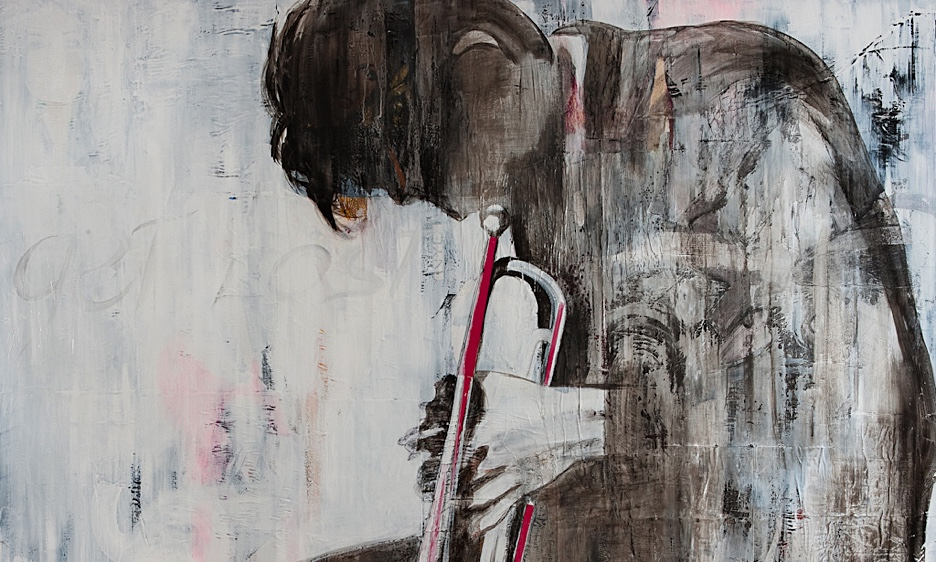
The first thing Cory heard when he stumbled into Café Picasso was the familiar voice of his drummer, Pearl, getting into an argument with two other musicians. They were all laughing loudly, but he could tell by the tone that it was also serious. Pearl caught his eyes and exclaimed: "Cory! Just the man I need. Come on over here! These rookies are trying to school me on Monk. What do you say!" I tried to explain that 'Round Midnight' is the greatest Monk composition, and this one claims it's 'Ruby My Dear,' and that one says 'Straight, No Chaser.' Come on, settle the argument!"
"I'm sorry to say so, but you guys are all wrong. If I had to choose only one composition by Monk it would be 'Well, You Needn't.'" "Well, You Needn't," one of the young musicians said with a grin. "You can pick that one AND 'Ruby My Dear' and then MAYBE you would be getting it right." "Yeah, that is if he added 'Straight No Chaser,'" the other one teased.
"You see what I'm fighting here Cory? No respect. What happened to the idea of the sages passing their wisdom to the young ones? Total anarchy. I'm stuck and need you to back me up on this, and then in walks Cory and says something else. Are you nutty? No, seriously. What is it that you like about that tune?"
Cory took a chair and sat down. "You see, the thing I like about that tune is that it has all of Monk's personality in it. That playful phrase. That could only come from Monk. It's his humor. So many pianists have tried to do the serious Monk and they succeed with their skewed chords and angular harmonies, but there is no humor. It's serious like going into a museum and looking at all those fine paintings. But do you ever see people laughing in a museum?
Yeah, of course 'Round Midnight is a perfect ballad. Probably no one wrote a ballad that's better. Monk is deep, mysterious, beautiful and dangerous like walking at the edge of a cliff, but he is also just fun. You know what I mean? Just fun!"
"Yeah, yeah. Of course." They all nodded. "Still," one of the young ones said. "I think 'Straight, No Chaser' has a better melodic line and it also has the humor you are talking about." "Yeah," Cory replied. "It's all there. There is so much in Monk."
They continued talking about the legends that had built the music. Cory told an anecdote he had read in the liner notes of a Fred Anderson album. They were written by another saxophonist, Ken Vandermark. Vandermark described how Anderson, this great saxophonist, was listening to Coleman Hawkins and reacted by saying: "Hawk played so much." That was really what it was all about. Getting as much life into the music as possible. Anderson did that. Hawk did that.
"Did you know that Hawk actually played a solo piece called Picasso?" Cory pointed at the reproductions of Picasso's paintings that hung around the café. Hawk was a painter just like Picasso. He just used his horn instead of a brush. They had the same sense of form. The ability to shape lines into complex cubistic patterns, but It's not just form. With Hawk you also get a story. The feeling of emotional development. A life lived in music.
Cory was so excited that he didn't notice when all the others suddenly turned around. A woman had entered the café. She swayed through the room with her long black hair. Her movements were like a dance and she approached the table determinedly.
"Cory, I'm sorry to interrupt you. Do you remember we have a date?" The others burst out laughing. "Looks like your lady friend is coming here to get you," Pearl said slyly.
"I'm sorry everyone. This is Valentine. An old friend of mine. I'll have to leave you now. Have a good one." "Yeah, you too Cory," Pearl said. "Nice meeting you Valentine."
They found a place in the café far removed from Pearl and his friends. Cory took Valentine's jacket and they sat down.
"I never thought I would see you again," Cory said. "What's the occasion?" "It's the records. It has to stop." "It's been two months since I sent you the last one. Why do you reach out now?" "I don't know. I've been thinking about it, and I need our story to end and now just seemed like the right time." Valentine paused and looked at him with a smile he couldn't decipher. "By the way, I like the record. You are moving in many different directions, but I like that you are searching. I'm sure you will find your sound someday."
"So, it's really over now. Can you tell me why?" "I don't know. Sometimes people just drift apart. I needed something from you and you couldn't give it. You still need something from me, but I can't give that anymore, even if it's just listening to your music. My life has changed. I have to move on."
They talked about old memories. About the good times and the bad times. They laughed and cried a bit and suddenly it was over, but before Valentine left, Cory had something to say. "Valentine. I'm sorry I didn't listen. I know that I didn't and now it's too late." "Don't worry," she said. "I have moved on and I'm in a better place now. I'll remember you for the good times." Cory said, "I won't send you any records, but I would appreciate it if you could come to hear me just one last time. I'm playing tonight at Jan's Supper Club. All standards. I think you'll like it." "I don't know. Maybe. I can't promise anything." And just like that, she had vanished into thin air.
When he stood on the stage later in the evening, he looked across the room in Jan's Supper Club as he had done so many times before, but this time he saw her in the corner. He nodded, and she nodded back.
Jan entered the stage beaming. "Good evening everyone. This is my favorite time of the week. Night of the standards. As you probably know, I have a soft spot for standards and nobody plays them better than the guy on this stage. So please welcome Cory Dextrose and his quartet."
Cory heard the moderate sound of applause as he began the melody to "All the Things You Are." He loved to play that tune and continued with other immortal titles: "Over the Rainbow," "Autumn in New York," "Mood Indigo" and many more.
At the end of the concert, he had been called out to do an encore. He looked at the corner and saw that Valentine had left. "Alright, thanks so much. We really appreciate this. We're gonna end with a twist, a so-called contrafact. You know, back in the days, bop musicians used to write new compositions based on the chords of standards. I have also done that, and the tune you're gonna hear is based on "My Funny Valentine." I have called it "Funny, My Valentine."
Cory closed his eyes and drifted away into the melody supported by Pearl's gentle touch with the brushes and Nathan's steady bass. The twinkling sound of the piano lit up the sky and Fox observed Cory who told his story. Valentine had left, but it didn't matter anymore. Some people move on, and you lose them, but they can still be a part of your story. This is what Cory discovered that night. He said goodbye to Valentine, and instead of focusing on himself, he told her story. Her loneliness. Her pain, as seen through the prism of his horn.
There would be many other stories to tell, but right now there was only this one, and as the notes disappeared into the noise of the night, he felt sure that he had something to say. There was a truth hidden in the song, and maybe he would one day learn how to tell it.
Note: The Fred Anderson anecdote about Coleman Hawkins comes from Ken Vandermark's liner notes to Fred Anderson Trio's album Live at the Velvet Lounge, Okka Disk, 1999.
 FOLLOW Jakob Baekgaard
and get notified whenever a new article published.
FOLLOW Jakob Baekgaard
and get notified whenever a new article published.
Jakob is still amazed by the ability of jazz to constantly transform itself as an art form.
About Chet Baker

Tags
PREVIOUS / NEXT


Become a Sustaining Member

Since 1995, All About Jazz has championed jazz as an art form and supported the musicians who create it. Over three decades, it has grown into one of the world's leading jazz resources, serving hundreds of thousands of readers, musicians, presenters and industry professionals each month.
Help Build the Future of All About Jazz
Your support helps us continue building All About Jazz for the next generation—expanding our editorial coverage, preserving jazz history, developing new community features and creating better ways to discover the music and the people behind it.
Become a sustaining member for as little as $20 per year and you'll immediately enjoy an ad-free experience along with access to subscriber features and future articles for a full year.
Together, we're not simply sustaining All About Jazz—we're building its future. Thank you for being part of the journey.