Home » Jazz Articles » Live Review » Kodo at Zellerbach Hall
Kodo at Zellerbach Hall
Courtesy Takashi Okamoto
Zellerbach Hall
Warabe: 2025 One Earth North America Tour
Berkeley, CA
January 25, 2025
Which musical ensemble has performed some four thousand times, spent a third of each year overseas and another third touring around Japan before returning to their home base on the island that gave birth to them, to train and rehearse?
The answer is Kodō. Generally regarded as a Japanese taiko drum ensemble, Kodō is much more complex than that because they also employ instruments from different cultures. As they put it, "Our mission is to explore the limitless possibilities of this taiko drum, using different instruments, incorporating different genres into our art form."
The kanji, which adorn the happi coats they don as well as their lanterns, are intended to have twin meanings: "heartbeat"—because the heart is "the primal source of all rhythm,"and "children of the drum"—a reference to the group's intention to enter a childlike, meditative state when they play their instruments.
Their home base, for over half a century now, has been Sado Island in the Sea of Japan. Set off the coast of the major city of Niigata, which faces the Japan Sea, Sado, the nation's sixth largest island, has been inhabited for many thousands of years. Villages each possess their own unique dances and rituals, and these afford a cornucopia of choices of costumes and dances for the Kodō ensemble, which they can employ as a foundation for their original compositions and choreography. However, their cultural and musical influences are not limited to Japan. Kodō employ instruments such as the steel pan (the Trinidadian drum made from oil barrels) played onstage by phenomonal Kodō veteran Eiichi Saito), along with a variety of percussion and other instruments.
As the curtain came up at the opening of the first of their two performances at University of California's Zellerbach Hall, a transcendent bath of red light silhouetted the group. The elegant and impressive first number was a dance choreographed by Koki Miura and arranged by Yuta Sumiyoshi,
This lovely piece featured chanting dancers. Donning sheaves of bamboo, secured to a frame on their back, they leaned over as they dramatically slapped them on the stage. This enthralling introduction to the evening originated not in Sado, but from what was once another remote region of Japan: Iwate in Honshu Island's far northern Aomori prefecture. Known as Shishi-odori ("deer dance"), it has many variations. While its origin remains clouded in mystery, one conjecture maintains that it was created as a memorial to hunted and executed deer. The troupe's slapping of these sheaves to the ground reflects the traditional belief that this act purges evil spirits.
Of the eleven stellar numbers, one humorous interlude delighted the audience by offering a whimsical and playful version of Sado's Shishimai dance. "The Lion" was fabricated in 2012 by a Kabuki prop firm. Talented dancers Chihiro Watanabe and Hana Ogawa had Sado villagers mentor them in the style, which they have taken to an even higher level.
Pieces performed also reflected the folk dance and music of areas such as Tokyo prefecture's remote Miyake-jima, a sparsely populated tiny island with a very active volcano, and Saitama's Chichibu, the origin of the original version of the "Yatai-bayashi" ("Festival Cart Orchestra"), which featured two of the women playing a bamboo Balinese gamelan instrument that they obtained from their long-time collaborators Suar Agung.
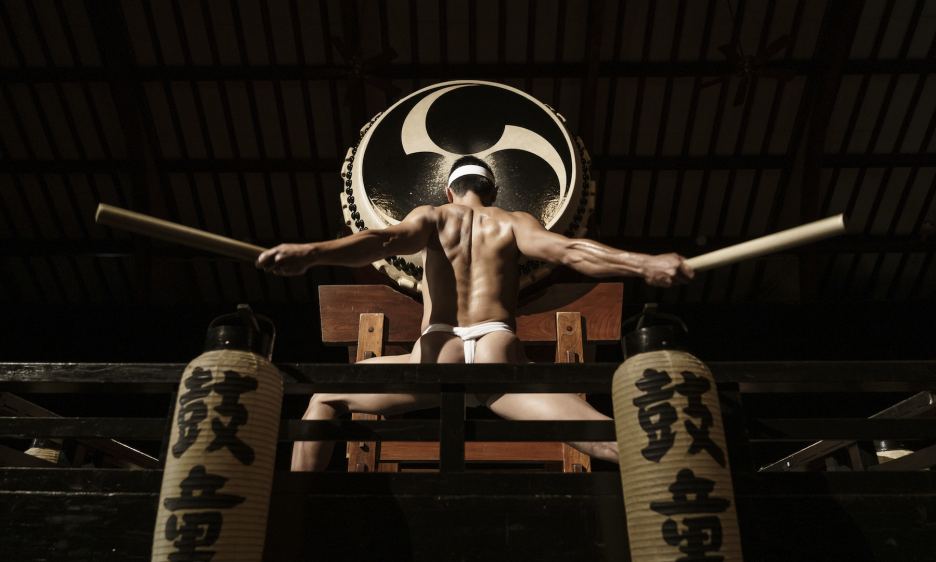
For the two visually compelling pieces which ended the evening ("O-daiko" and the finale of "Yatai-bayashi," an elaboration of the Yatai-bayashi from Chichibu in Saitama) , "O-daiko" ("Large Taiko"), a large wooden stand, supporting the drum and drummer and adorned with lighted lanterns, was wheeled out before being flanked by smaller but still imposing taiko drums along each side. Men, clad in only white fudoshi (Japanese loincloths), sat sideways to the audience facing their drums. O-daiko master Seita Saegusa sat crosslegged on a large, square cedar stand, facing the enormous and imposing drum, as a thunderous storm of drumming commenced, thrilling the audience.
Although the O-daiko has many different origin tales, it is believed to have originated with gagaku, Japanese court music, where the large drum employed was known as dadaiko. Saegusasa's playing of this humongous taiko reflects a style which first came into fashion in the 1950s. The mitsudomoe (symbol), painted on the O-daiko's, face can have numerous meanings, but the Kodō troupe prefers to interpret it as "the wish for the drums to be spread and shared widely."
The troupe is doing a great job of revitalizing and renewing Japanese folkloric culture. Much of their discipline, coordination and elegance of style can be attributed to their ascetic communal lifestyle on Sado, where they pursue an athletic regimen to train. Adopting an international attitude and openness combined a sense of tradition have doubtless also helped foster their international appeal. Japan has been shedding its traditions increasingly rapidly as it has absorbed other influences. Kodō provides an intriguing dynamic, colorful and rhythmical counterweight to this alarming trend of cultural loss. Long may they flourish!
 FOLLOW Harry S. Pariser
and get notified whenever a new article published.
FOLLOW Harry S. Pariser
and get notified whenever a new article published.
Harry S. Pariser is a writer, author, artist and photographer in San Francisco, California.
About Onna-Kodomo
Tags
PREVIOUS / NEXT


Become a Sustaining Member

Since 1995, All About Jazz has championed jazz as an art form and supported the musicians who create it. Over three decades, it has grown into one of the world's leading jazz resources, serving hundreds of thousands of readers, musicians, presenters and industry professionals each month.
Help Build the Future of All About Jazz
Your support helps us continue building All About Jazz for the next generation—expanding our editorial coverage, preserving jazz history, developing new community features and creating better ways to discover the music and the people behind it.
Become a sustaining member for as little as $20 per year and you'll immediately enjoy an ad-free experience along with access to subscriber features and future articles for a full year.
Together, we're not simply sustaining All About Jazz—we're building its future. Thank you for being part of the journey.
Near
California Concerts