Home » Jazz Articles » Album Review » Ella Fitzgerald: Ella Fitzgerald Live at Falkoner Theatr...
Ella Fitzgerald: Ella Fitzgerald Live at Falkoner Theatre Copnhagen 1966
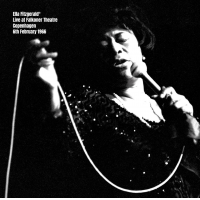
The tape emanates from a Danmarks Radio broadcast, mono, introduced on air by broadcaster Børge Roger Henrichsen and filed in a Danish producer's private archive, where it was earmarked for the trash bin.
The man behind Ella was Norman Granz. Strangely, Granz has never been adequately recognised for the work that he did for jazz.. He started the JATP (Jazz At The Philharmonic) concerts. He resolutely, in the nineteen forties, refused to present concerts to segregated audiences. He insisted that his jazz artists should be treated with the kind of dignity that was given to Leonard Bernstein or Jascha Heifetz.
Granz realised that Ella had a depth and versatility that her previous label had not used. He signed her to his Verve label in 1955. The most enduring legacy of the Granz-Fitzgerald partnership was the American Songbook series—a monumental sequence of albums in which Fitzgerald devoted entire albums to the work of individual composers: Cole Porter, Rodgers, Duke Ellington, Irving Berlin, George and Ira Gershwin, Harold Arlen, Jerome Kern, and Johnny Mercer. These albums were meticulously produced and placed Ella in an entirely new artistic context. The series is widely considered one of the greatest achievements in modern American music.
Norman Granz continued to have a profound and transformative influence on Ella Fitzgerald's career, shaping her into the artist the world came to regard as the "First Lady of Song." His impact operated on multiple levels—artistic, commercial, and deeply personal..
Granz did not simply manage Fitzgerald—he reimagined what her career could be. He elevated her from a beloved but somewhat narrowly defined singer into a towering, universally acclaimed artist. The Songbook albums alone would have been enough to secure her immortality, but combined with his personal loyalty, his civil rights advocacy, and his insistence on surrounding her with only the finest musicians, Granz's influence on Fitzgerald was arguably the single most important professional relationship of her life. She herself said as much on numerous occasions.
In 1966, Granz caught two jazz luminaries at a fascinating moment. Duke Ellington and his Orchestra, an institution of peerless sophistication, while Ella Fitzgerald, by that year, was transitioning from her "Songbook" era into a looser, bolder, and more experimentally modern phase of her live career.
The concert splits itself structurally to cater to Fitzgerald's range. On the blazing Ellingtonian bookends, she is backed by the brass of the almost Duke Ellington Orchestra (no Duke) but with Johnny Hodges, Cootie Williams, and Paul Gonsalves. Ellington is not at the piano. He hands accompaniment duties over to the Jimmy Jones Trio (dubbed "Ella's Trio").
Perhaps the emotional center of the concert is "Something to Live For." In her performance, Fitzgerald avoids sentimentality entirely. Her reading of the Billy Strayhorn-Duke Ellington ballad is restrained, almost conversational, allowing the song's melancholy beauty to emerge naturally. Every phrase feels carefully weighed, yet nothing sounds calculated. The performance illustrates a maturity that separates Fitzgerald from many contemporaries.
The absolute jewel of the ballad set, however, is "Lover Man." Over Jones' sparse, elegant chord voicings, Fitzgerald delivers an achingly tender, restrained performance. Where other singers lean heavily into the melodrama of dejection, Ella plays with microtones, gently delaying her phrasing just behind the beat. Her vocal delivery acts like liquid silk, smoothing out the jagged edges of the melody and proving that her emotional depth was every bit the equal of her pyrotechnic scatting.
Cole Porter's "Let's Do It" serves as a vehicle for live spontaneity. Rarely singing a written note, she completely rewrites Porter's melody. She leans heavily on bassist Joe Comfort, sliding between registers and breaking single syllables into cascading multi- note runs. It is witty, slightly subverted, and incredibly loose—the sound of an artist completely comfortable taking high-wire risks without a net.
During the mid-1960s, she increasingly incorporated newer material into her performances, Antonio Carlos Jobim's "Só Danço Samba" demonstrates her adaptability. Rather than treating bossa nova or contemporary pop as foreign idioms, she absorbs them into her own musical language. The rhythmic ease of "Só Danço Samba" is particularly impressive. Fitzgerald never sounds as though she is trying to imitate Brazilian singers; instead, she translates the style through her own jazz sensibility.
The sheer joy of singing is ever present. "Sweet Georgia Brown" is Fitzgerald improvising with sheer confidence. "How High The Moon," the longest track, is even wilder, more free-flowing, freewheeling, exploring more vocal depth and reaching more heights, more uninhibited.
Fitzgerald's authority came from technical mastery. Her intonation throughout the performance is nearly flawless, but technical perfection never becomes sterile. Instead, she uses her extraordinary control as a foundation for rhythmic play, melodic invention, and conversational phrasing. The result is a performance that feels simultaneously disciplined and free.
What makes her singing significant at this time in Fitzgerald's career is that it captures her during a transitional period. The great Songbook recordings of the 1950s had already secured her reputation, but by 1966, she was increasingly defined by live performance. In Copenhagen, one hears an artist who no longer needs to prove anything. The voice remains remarkably agile, but the deeper achievement lies in her interpretive confidence. She bends songs to her personality rather than adapting herself to them. The result is music that feels both effortless and authoritative. Quite simply, this rediscovered concert is Ella Fitzgerald at her best.
 FOLLOW Jack Kenny
and get notified whenever a new article published.
FOLLOW Jack Kenny
and get notified whenever a new article published.
Jack was turned on to jazz by a mixture of Stan Getz, Lee Konitz and Earl Bostic.
Track Listing
Satin Doll; Hey Little Girl; Something To Live For; Let’s Do It; Sweet Georgia Brown; How High The Moon; Lover Man; Só Danço Samba; I’m Just A lucky So And So; Mack The Knife.
Personnel

Ella Fitzgerald
vocals
Jimmy Jones
pianoJoe Comfort
bass
John Lamb
bass
Sam Woodyard
drums
Gus Johnson
drums
Paul Gonsalves
saxophone, tenor
Johnny Hodges
saxophone, alto
Russell Procope
clarinet
Jimmy Hamilton
clarinet
Harry Carney
saxophone, baritone
Cootie Williams
trumpetHerbie Jones
trumpet
Cat Anderson
trumpet
Mercer Ellington
trumpetLawrence Brown
trombone
Buster Cooper
tromboneChuck Connors
tromboneAlbum information
Title: Ella Fitzgerald Live at Falkoner Theatre Copnhagen 1966 | Year Released: 2026 | Record Label: Gearbox Records
About Ella Fitzgerald
Tags
PREVIOUS / NEXT
Become a Sustaining Member

Since 1995, All About Jazz has championed jazz as an art form and supported the musicians who create it. Over three decades, it has grown into one of the world's leading jazz resources, serving hundreds of thousands of readers, musicians, presenters and industry professionals each month.
Help Build the Future of All About Jazz
Your support helps us continue building All About Jazz for the next generation—expanding our editorial coverage, preserving jazz history, developing new community features and creating better ways to discover the music and the people behind it.
Become a sustaining member for as little as $20 per year and you'll immediately enjoy an ad-free experience along with access to subscriber features and future articles for a full year.
Together, we're not simply sustaining All About Jazz—we're building its future. Thank you for being part of the journey.