Home » Jazz Articles » Live Review » Drum Tao at Zellerbach Hall
Drum Tao at Zellerbach Hall
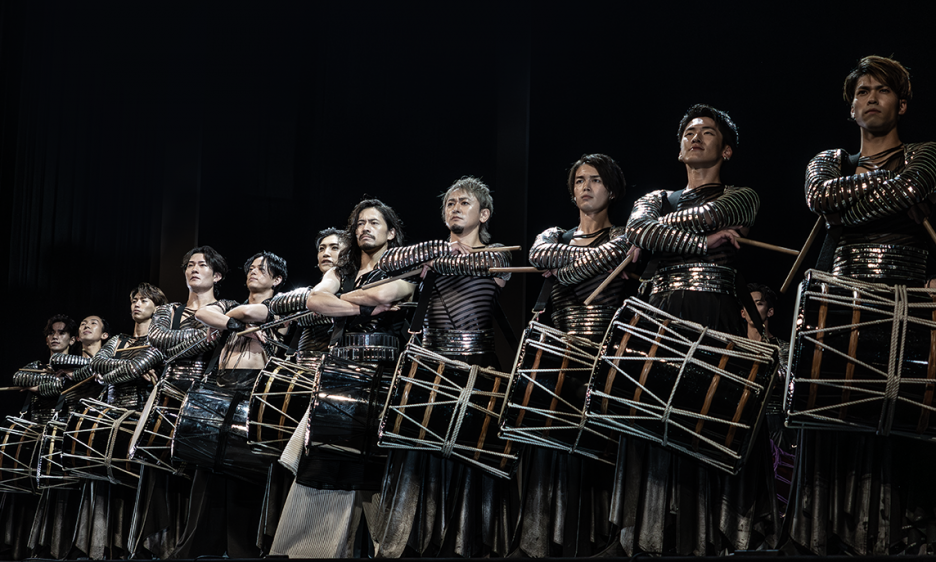
Courtesy Drum Tao
Zellerbach Hall
CalPerformances Berkeley, CA
March 21, 2026
Way back in 1993, Taro Harasaki had an epiphany. He had just exited Mystère, the Cirque du Soleil show then running in Las Vegas. The performance had made a huge impression on him. "I can do this in Japan," he thought. His concept was to marry Kumi-daiko (組太鼓, literally "set of drums"), a small-group Taiko drum performance first developed in 1951, to polished performance and choreography along with visual projections. Decades of hard work and determination brought his concept to fruition, but Drum Tao has flourished. Headquartered at the TAO no Oka center in Aso Kuju National Park in Oita-ken, Japan. Drum Tao currently has three groups of performers: the stationary show (which performs in Japan), the touring show (which performs internationally), and the recruits in training.
Every morning at 5:30 AM it is rise and shine and train and practice. A 13-km (eight-mile) run is followed by an hour of endurance where trainees play their taiko nonstop. The training continues until around 10 PM. It takes from one to three years to ready oneself for the high standards required by onstage performance.
The curtains opened at Zellerbach Hall at UC Berkeley to reveal taiko, shamisen, and shinobue (flute) players at the ready. The eleven performers (mostly men) were clad in fashionable garb designed by 85-year-old designer Junko Koshino. The performance began with "Forest" and continued through 16 more numbers, divided into two sets. To its credit, Drum Tao uses no recorded or synthesized music. All sounds are generated by live performers on miked acoustic instruments, an assortment predominated by a wide variety of taiko (太鼓)—from the gigantic odaiko to the very portable shima.
Throughout the show, props such as taiko drums were speedily wheeled out for set changes. Speed and the high level of artistry displayed were breathtaking. Projections—ranging from geometric shapes to floating kanji to waterfalls—provided the backdrop. These were created by the Team Labo in Tokyo's Chiyoda district, and some were more successful in providing suitable ambience than others.
There were dramatic moments—such as a solitary drummer playing onstage, a competition between two players, some lovely flute, and other episodes of theatricality. Hand clapping, shamisen, koto, and even umbrellas were featured in the performance.
During a pause near the end of this hyperactive whirlwind, one performer came out and addressed the audience in English: "We have merchandise. We don't want to bring it home." He then introduced another performer wearing a front-and-back sandwich board and then showed us an enlarged version of the sticker that patrons would obtain if they scanned the RFID chip and, perhaps, posted on one of the seven different "socials" listed.
This humorous interlude led to the final piece, which featured members dancing with gigantic "Drum Tao" flags—first one flag, then two, and then three, as a shamisen player rocked out. Yosakoi—the elaborate final dance based on the dance style first introduced in 1954—saw performers moving through the aisles as the spectacle drew to its dramatic conclusion.
 FOLLOW Harry S. Pariser
and get notified whenever a new article published.
FOLLOW Harry S. Pariser
and get notified whenever a new article published.
Harry S. Pariser is a writer, author, artist and photographer in San Francisco, California.
About Drum
Tags
PREVIOUS / NEXT
Become a Sustaining Member

Since 1995, All About Jazz has championed jazz as an art form and supported the musicians who create it. Over three decades, it has grown into one of the world's leading jazz resources, serving hundreds of thousands of readers, musicians, presenters and industry professionals each month.
Help Build the Future of All About Jazz
Your support helps us continue building All About Jazz for the next generation—expanding our editorial coverage, preserving jazz history, developing new community features and creating better ways to discover the music and the people behind it.
Become a sustaining member for as little as $20 per year and you'll immediately enjoy an ad-free experience along with access to subscriber features and future articles for a full year.
Together, we're not simply sustaining All About Jazz—we're building its future. Thank you for being part of the journey.