Home » Jazz Articles » Live Review » Donny McCaslin Group: Half Moon Bay, CA, September 11, 2011
Donny McCaslin Group: Half Moon Bay, CA, September 11, 2011
Douglas Beach House
Half Moon Bay, California
September 11, 2011
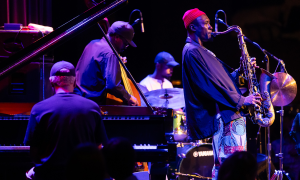
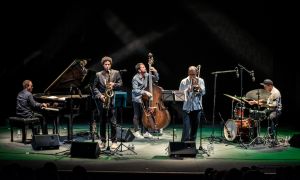
From New York City, the Donny McCaslin Group arrived at the Douglas Beach House with everything ready to go. The group consisted of tenor saxophonist McCaslin, pianist Uri Caine, bassist Fima Ephron and drummer Mark Guiliana. McCaslin's latest album, Perpetual Motion (Greenleaf, 2011) formed the foundation for a tour whose California leg was scheduled to end with the Monterey Jazz Festival. It was a pleasure to have McCaslin's group stop off at the Douglas Beach House, and provide a taste of this powerful album.
Inspired by the funk/rock band Tower of Power, from the very first bars of the opening "Energy Generation," the venue was shaken with what can only be called a rock-ish style of jazz. McCaslin blew strong on his tenor with fast, upbeat forays woven throughout the tune. When deep within his music, seemingly wrapped up in it, he bobbed, wove and swayed with it, enunciating passages here and there with his body as well as his horn. Caine melded in harmony with McCaslin, knocking out a hard, driving underbelly to the leader's wailing sax. As this aptly named tune came to a close the music swung back around with passages reminiscent of its powerful beginning.
With such energy filled jazz setting the pace and intensity of the late afternoon, McCaslin's second tune the title track to Perpetual Motion, was a changeup of sorts, with long sustained notes followed by quick jabs on his sax as he then he ripped and soared back up his instrument. Energy dominated as Guiliana blew his sticks in a hard hitting display of power across his drum kit, at other times shifting into more delicate jazz. Of the drummer, bassist Avishai Cohen has written, "As a musician, he is open to all music, and is capable of playing any style he wishes with great depth and dedication." Ephron followed, just beneath the drums and, as the tune rolled to a close, McCaslin brought it together with a delicacy that contrasted beautifully with to the rest of the piece.
This smooth and easy ending segued perfectly with the next piece , dedicated to McCaslin's wife, called "Firefly." In contrast to the high energy pieces that opened the concert, here McCaslin was able to show off the softer side of his music. Ephron opened it with a beautiful, long introductory melody until, softly and beneath the bass, McCaslin came in, followed by Caine and, finally, Guiliana, just on cymbals. With all four of the band members playing, the tune built toward a fiery fury and then sank back down into the softness of McCaslin's sax. Long sustained notes highlighted the piece.
According to Dave Brubeck, one of the more important elements in any concert or CD is the sequence of the pieces played, the particular pattern that they present as a whole. McCaslin's sequencing was superb, opening with a strong piece, moving into a second strong piece but with delicate passages woven within and then playing with the delicacy of the feminine. Through his sax, McCaslin demonstrated a versatility, one that is often rare, but he makes clear that he can carry it off with a high degree of finesse—even reaching, at times, out toward the fringes, where sax legend Kidd Jordan plays. Altogether, this positions McCaslin as one of today's leading musicians and band leaders in this rock-edged style of jazz.
Throughout the concert, McCaslin's group played with this energy, molding it into some of the best post-bop music ever heard at the Bach Dancing and Dynamite Society (otherwise known as the Douglas Beach House). The audience showed its appreciation through sincere applause throughout the concert—and, in the final cascading, crashing end to the last number of the night, "Memphis Redux," the audience stood and gave the group a hearty, heartfelt ovation.
 FOLLOW Bill Leikam
and get notified whenever a new article published.
FOLLOW Bill Leikam
and get notified whenever a new article published.
His jazz interviews have been published in 28 languages.
About Donny McCaslin

Tags
PREVIOUS / NEXT

Become a Sustaining Member

Since 1995, All About Jazz has championed jazz as an art form and supported the musicians who create it. Over three decades, it has grown into one of the world's leading jazz resources, serving hundreds of thousands of readers, musicians, presenters and industry professionals each month.
Help Build the Future of All About Jazz
Your support helps us continue building All About Jazz for the next generation—expanding our editorial coverage, preserving jazz history, developing new community features and creating better ways to discover the music and the people behind it.
Become a sustaining member for as little as $20 per year and you'll immediately enjoy an ad-free experience along with access to subscriber features and future articles for a full year.
Together, we're not simply sustaining All About Jazz—we're building its future. Thank you for being part of the journey.