Home » Jazz Articles » Live Review » Day 4 - Festival International de Jazz de Montreal, July 1, 2006
Day 4 - Festival International de Jazz de Montreal, July 1, 2006
Yes, dear readers your correspondent survived the trip to and from the States (making two 6 hours drives within 24 hours). The return to active duty at the festival after that was easy.
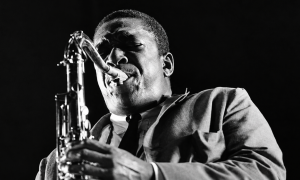
If there is one thing particularly commendable about jazz festivals, it is the opportunity to hear legends play in close proximity. Even in New York, some of the elders of the music only come around infrequently. On Day 4, Montreal was given the embarrassment of riches that was performances (a few hours apart) by saxophonists Wayne Shorter and Yusef Lateef.
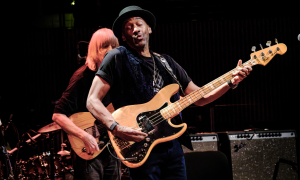
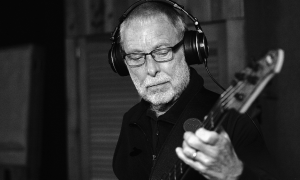
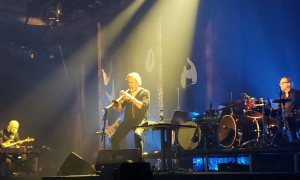
Shorter's set was another trip back to the Theatre Maisonneuve (where it seems the best performances of the 2006 edition are happening). He was there with his regular quartet of Danilo Perez (piano), John Patitucci (bass) and Brian Blade (drums). Prior to their set, the Festival presented an opening act: the Chet Doxas Quartet.

There can be few more intimidating jobs than opening up for Wayne Shorter, particularly with a band of the same instrumentation. However, even though tenor saxophonist Doxas is in his mid 20s, he is a well-known player in Montreal and Canada and thus his slot was deserved and a nice local touch. Doxas, along with bandmates bassist Zack Lober (who this correspondent saw in the middle of nowhere in Brooklyn earlier this year with a fantastic all Canadian bass quartet), drummer and brother Jim Doxas and pianist John Roney, performed three tunes in a 30 minute set. The material was drawn from Doxas' leader debut on the Canadian label Justin Time, Sidewalk Etiquette, and showed remarkable maturity. Containing interesting metrical shifts and energetic dynamic variations, as well as effective use of space, Doxas' quartet probably owed much to the band that would follow. A touching moment was the enthusiastic applause given to this local player (who no doubt will soon get his own slot at the Festival) and his thanks to the Wayne Shorter Quartet for allowing them to play.

When the Wayne Shorter Quartet played in Montreal in 2002 (when the buzz in the audience was the death of Joe Henderson), the group was a remarkable advancement of the concepts that Shorter had been working on for decades in different groups. Thinking back to that stage of the group, it is fascinating to see how much they develop from year to year, concert to concert. Tunes and melodic concepts are strung together into 30 or 40 minute medleys creating a real challenge for audience members used to discretely presented compositions and their attendant forms. One listener made the astute remark that the younger "rhythm section had a telepathic communication while the older Shorter, in a professorial way, commented on the proceedings. Shorter's band can be frustrating to those on either extreme side of the spectrum. Free jazzers will reject the inclusion of forms, even if the resultant improvisations are sublime while trad fans will wonder where the heads are and who is soloing when. But for those, like your correspondent, looking to bridge those two worlds, Shorter's group hopefully will be a template for years to come. But this implies some sort of defined and deliberate purpose. There are cooks who can follow a recipe precisely but are unable to improvise. Shorter and Co. are masters of varying heat and subtle flavorings, all added on whims with care and intelligence. The food they serve is complex and delicate, remaining long on the palette. In a bit of irony, the group is often referred to as the Footprints Quartet and indeed they used to perform the classic Shorter piece. It has fallen out of their repertoire as it is far too structured for the music they play now.
After dinner at La Paryse, a great burger joint and one of many fine restaurants in the culinary city, it was time for a trip back to the Gesu Creative Center for Yusef Lateef and the Belmondo Brothers. (see delicious sign posted by the bar in the lobby).

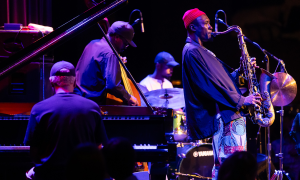
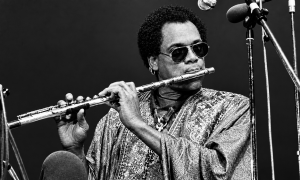
The siblings, Stephane (trumpets, flugelhorns, shells, etc.) and Lionel (flute, tenor and soprano saxophones), spent their childhood listening to the renowned Lateef and were able to record a double record with him last year (which seems not to be available in the States). The evening's performance was a stripped down affair (the album had numerous guests) with Lateef and the Belmondos joined by piano, bass and drums. This kind of show, which unfolded slowly and organically, was what your correspondent expected from shows at Gesu, its intimacy making the music enveloping. The first two tunes were done as a medley that spanned over 40 minutes and consisted of a oozing Eastern melody (Lateef and Lionel Belmondo doubling each other on flute) and developing as theme-and- variations and a brooding blues with two tenors and a bass trombone. On the second portion, Lateef's playing, which on flute had been mysteriously soothing, became primal and earthy on tenor. If it is a wonder to see the almost 73-year old Shorter still playing at an unbelievable level, Lateef, at almost 86, is even more of a wonder. His tenor is strong and completely modern and the rapture of the Belmondos during his solo was evident. The remainder of the set - two tunes and an encore - was more traditional post-bop, almost swinging, but taken out by liberal use of unconventional wind instruments by Stephane Belmondo and Lateef, who is know for this. Another highlight of the set was a beautiful, if eerie, piano/Lateef tenor duet segment.
Jazz is the only musical form extant which is constantly celebrating its past and its "elder statesmen . When this celebration comes in the form of inventive and progressive players like Shorter and Lateef, still pushing the boundaries of the music they have been playing for multiple decades, it is easy to see why.
Photo Credit
Andrey Henkin
 FOLLOW A. Henkin
and get notified whenever a new article published.
FOLLOW A. Henkin
and get notified whenever a new article published.
Tags
PREVIOUS / NEXT

Become a Sustaining Member

Since 1995, All About Jazz has championed jazz as an art form and supported the musicians who create it. Over three decades, it has grown into one of the world's leading jazz resources, serving hundreds of thousands of readers, musicians, presenters and industry professionals each month.
Help Build the Future of All About Jazz
Your support helps us continue building All About Jazz for the next generation—expanding our editorial coverage, preserving jazz history, developing new community features and creating better ways to discover the music and the people behind it.
Become a sustaining member for as little as $20 per year and you'll immediately enjoy an ad-free experience along with access to subscriber features and future articles for a full year.
Together, we're not simply sustaining All About Jazz—we're building its future. Thank you for being part of the journey.