Home » Jazz Articles » Live Review » Babel Music 2026
Babel Music 2026
Courtesy Inner Spaces
Marseille, France
March 19-21 2026
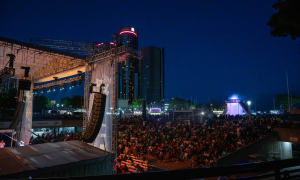
In the end, the Dock des Suds venue didn't get demolished soon after the 2025 Babel Music weekender. Instead, it has been reborn (and re-bought) as Le Plateforme, looking pretty much unchanged. Therefore Babel (previously known as Babel Med, with a history stretching back two decades) maintained its habitual structure and atmosphere. This prime global music festival operates on multiple levels, balancing local artists (particularly the Occitan language folk purveyors) and a kaleidoscopic spread of international visitors (often leaning towards North Africa and the Middle East acts). Babel Music customarily opens with a showcase-type night, employing three or four venues and forcing tough choices of timings and distances in the selection of favoured acts (this can be just a vibe-pulling rather than a deep choice, as many of the bands will be unfamiliar to the punter). The two main weekend evenings then gravitate towards Le Plateforme, with its pair of stages, one larger, the other more intimate. Here, the experience is easier, as the two rooms lie just short steps apart.
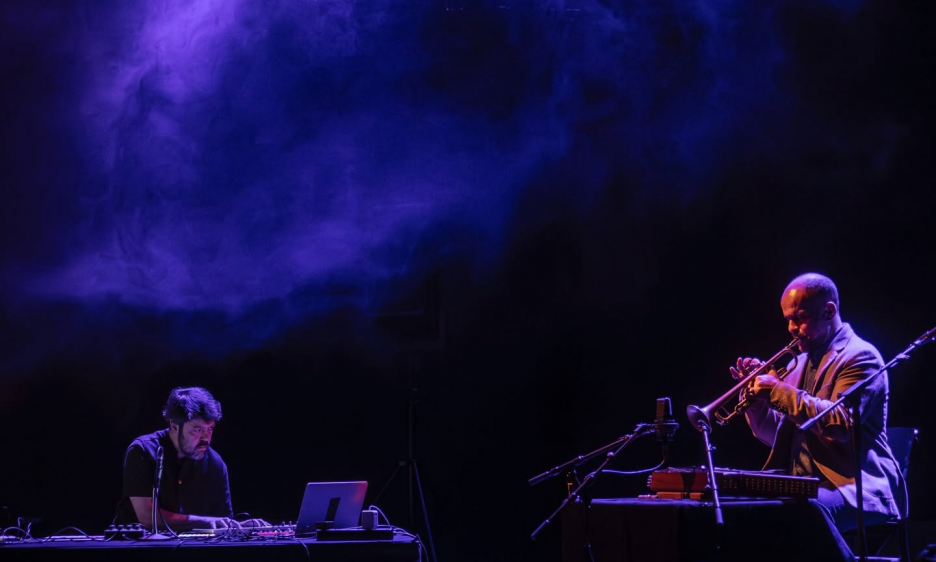
It was a wise choice to begin the first evening at the Cité de la Musique theatre. Its performances involved Inner Spaces and Tengerton, in a highly contrasting double bill. The New York trumpeter Amir ElSaffar teamed up with the Italian electronicist Lorenzo Bianchi Hoesch (currently dwelling in Paris, and an IRCAM dude). These instrumental masters imposed a serene, darkened sense of concentration, ElSaffar also playing the santur (in the hammered dulcimer family), and singing profoundly into the imaginary caverns surrounding these sonic entanglements. Bianchi dealt with the 'human' side of electronics, his sounds rich and warm, pliable and subject to direct soft-control. The duo's live sound is superior to their recordings, perhaps partly because the audience can view the pair's subtle manipulations, and also revel in the eight-channel multi-speaker castings in spontaneous real-time, as the setting affects the responses, the space becoming a player. Spatial is the place. Bianchi mixed on the hoof, separating the components cleanly and clearly, from warped trumpet snatches to spurting beats. ElSaffar moved seamlessly between instruments and voice, choosing the right outlet at the appropriate time, often coating his lines with a strong Iraqi maqam feel. A pulsing modular momentum assisted this evocative, cinematic sense.
Following a beer-and-nibbles social scene (there were many delegate-types in the house), the remarkable Tengerton ensemble continued the evening's wonders. While this Mongolian combo do involve certain meditational aspects, much of their set was dedicated to a very rousing evocation of the clippety-clop steppes of their homeland. It was a very similar performance to that of their Hamburg show a few months earlier, at the Arctic Voices festival. This gig, though, benefitted from a much closer connection between the players, in this subtly-lit theatre of intimacy. Their massive strength lies in their row of morin khuur cello-like instruments, their driving attack and their striking harmonic resonances. The set was also relatively short, but possessing the advantage of a compact display of their strengths. They had a singer (Erdenetsetseg Khenmedekh) and a flautist (Erkhes Otgonbayar) guesting, and compared to that other set, the Tengertons had to ditch most of the amusing verbal explanations, choosing to roll eternally across the galloped lands.
A walk to Alcazar was called for: another, more spacious concert theatre. Here we had La Litanie des Cimes, collaborating with the Malian praise singer Mah Damba. This trio is headed up by the high profile French violinist Clément Janinet, partnered by Bruno Ducret (clarinet) and Elodie Pasquier (cello). Janinet also appeared to be playing an axe that looked like a variant on the nyckelharpa, and Ducret also sported a bass clarinet. The material was dominated by a Malian sound, but also included a strong set of French folk mannerisms, filled with compelling riffs.
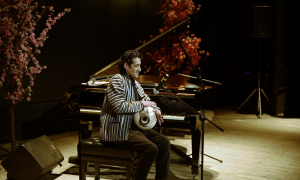
L'Antidote converge from Eastern parts, uniting the Lebanese pianist Rami Khalifé, the Albanian cellist Redi Hasa and the Iranian percussionist and saz player Bijan Chemirani, to explore a domain of sensitive acoustic composition. They began the evening at Le Plateforme, investing folk forms with a neo-classical air, playing with their surrounding space, and savouring the creation of calming atmospheres. Their group music has room for individual expression. There's a highly augmented drum set, with ghatam, calabash and bendir, along with low basslines on the cello and grandiose reverb on the piano, Khalifé liking to put his left hand under its lid. There were serious levels of groove power, considering the acoustic heart of this threesome, while Chemirani thwoomed his frame drum deeply, and Hasa sometimes considered his cello to be guitar-like. All three prefer to take the core somewhere else. Twenty minutes in, they delivered their fastest tune so far, prodding the crowd into fast handclapping.
On Saturday, from the same stage, the Cocanha duo explored a similar heightening of folk acoustics, emerging from around the Marseille area, and singing in the local Occitan language. Their sources are ancient, but their stance is one of modernised punk energy, slicing-up and amplifying their zither-like sonics into chunks of power-strum, harnessing the aggressive buzz of their strings. The song arrangements are ultra-dynamic, Cocanha projecting their strong essences right to the rear of this sizable hall, the words apparently dealing with topical issues of our present days. This is one of the most impressive (newish) French folk acts to hit the stage in recent years.
Super Parquet possess an acoustic heart as well, but their hiking up into the hard electronic zone is way more extreme, as these Auvergne dudes also inhabit the sphere of bangin' techno and propulsive ethno-trance, submerging in a pool of repeat motion, a hard attack of folk-pomp. Relentless bass whoomerama made a tough Steve Reich repeat progression, exhaustingly sustained. Such intensification melded well with the bleating amassing of cabrette goat-pipes, although at one point the Parquets suddenly snapped into acoustic mode, as tromping circle-dances broke out amongst the audience of this smaller cabaret room, including the bar staff, in a French frenzy of Wicker Man equivalence, a maximalist dervish spiralling. There was an overloaded Philip Glass folk magnificence, as the pipes and strings swirled in devilish harmony, well into the decibel danger zone. Old ravers had twitchback attacks.
 FOLLOW Martin Longley
and get notified whenever a new article published.
FOLLOW Martin Longley
and get notified whenever a new article published.
Martin Longley also writes for Jazzwise, Songlines, Downbeat, We Jazz, Qwest TV, The New York City Jazz Record & The Brooklyn Rail
About Amir ElSaffar

Tags
PREVIOUS / NEXT
Become a Sustaining Member

Since 1995, All About Jazz has championed jazz as an art form and supported the musicians who create it. Over three decades, it has grown into one of the world's leading jazz resources, serving hundreds of thousands of readers, musicians, presenters and industry professionals each month.
Help Build the Future of All About Jazz
Your support helps us continue building All About Jazz for the next generation—expanding our editorial coverage, preserving jazz history, developing new community features and creating better ways to discover the music and the people behind it.
Become a sustaining member for as little as $20 per year and you'll immediately enjoy an ad-free experience along with access to subscriber features and future articles for a full year.
Together, we're not simply sustaining All About Jazz—we're building its future. Thank you for being part of the journey.
Near
Marseilles Concerts