Home » Jazz Articles » Album Review » Art Blakey And His Jazz Messengers: Art Blakey And The J...
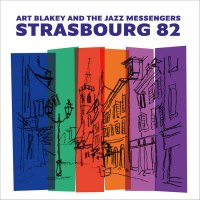
Art Blakey And His Jazz Messengers: Art Blakey And The Jazz Messengers Strasbourg 82
The lineup included two holdovers from the previous iteration: bassist Charles Fambrough and tenor saxophonist Billy Pierce, who also served as the band's musical director. Fambrough's aggressive playing style is a perfect fit for Blakey's dynamic drumming, particularly on his own composition, "Little Man."
The surprise highlight is the feature for pianist Johnny O'Neal on the ballad "Old Folks." He plays with an unusual blend of grace and fervor. O'Neal's solo is inventive and, unusually for that period in modern jazz, contains echoes of Teddy Wilson in the way he emphasizes the melody and enhances the inherent swing of the piece. While his primary influences were Oscar Peterson and Art Tatum (O'Neal later portrayed Tatum in the Ray Charles biopic, Ray 2004 Universal Pictures), this solo reveals a deep connection to the classic swing era. His percussive style on faster pieces, such as "Along Came Betty," suits the band's hard-driving nature, as he skillfully builds his solos.
The new frontline of Blanchard and Harrison breathed new life into the ensemble. Harrison, in particular, was steeped in the culture of New Orleans, having started in the city's second-line tradition at the age of two under his father, Big Chief Donald Harrison Sr. Harrison's searing alto sound became a key feature of this new Messengers lineup.
Trumpeter Terence Blanchard recounted his audition process: "We [Blanchard and Harrison] auditioned in the band at Fat Tuesday's. We would listen to tapes and learn the melodies and the changes and then come back and sit in. One night we played a whole set while Wynton and Branford sat in the back. And then Art said, 'You are a Jazz Messenger now.' And what was wild was that he said, 'I do not want you to give a shit about Freddie Hubbard Woody Shaw, Miles Davis, Dizzy Gillespie, none of them. I just want you to be in this band and work hard at being the best you can be.' He was naming all my heroes! He wanted me to understand that I could not be them. There was no sense for me to try. I just had to be myself."—Terence Blanchard, quoted by Michael Bourne in Down Beat, May 1994, p.18.
The audience's roar of approval as the band launched into the opening bars of "Moanin'" clearly showed their appreciation for the reprise of a classic Blakey staple. Donald Harrison delivers an energetic and vital solo before Terence Blanchard soars.
"Along Came Betty" is another selection of a similar vintage. The band plays it with verve and swagger, with Harrison taking the honors. He seems to relish the spotlight, delivering a solo full of freshness and vivacity. Blanchard's approach, which is often more abstract than his predecessor, Wynton Marsalis, brings new concepts to the changes of the piece.
The track "Eighty-One," written by Wayne Shorter for Miles Davis's Second Great Quintet, provides a clear link to the broader jazz scene of the early 1980s and gives the music a modernist edge. This piece, being modal rather than having a conventional bop framework, gave the younger musicians space to explore. Blanchard and Harrison roam freely and get exploratory in their solos, while Fambrough's bass anchors the group in this modern milieu. Harrison's playing is harsh and astringent, while Pierce's solo is more wayward and forward-looking, gradually building intensity, spurred on by Blakey's fierce drumming and O'Neal's Tatum-esque runs.
This album stands as a vital document. The Jazz Messengers had a challenging period in the 1970s, with less frequent recordings and diminished public visibility until the arrival of the Marsalis brothers. The Harrison-Blanchard version of the Messengers provided a necessary transfusion, charting a path forward into the 1980s. This beautifully recorded and presented album represents a crucial moment for one of jazz's most important institutions.
 FOLLOW Jack Kenny
and get notified whenever a new article published.
FOLLOW Jack Kenny
and get notified whenever a new article published.
Jack was turned on to jazz by a mixture of Stan Getz, Lee Konitz and Earl Bostic.
Track Listing
Little Man; Along Came Betty: Fuller Love; Eighty One; I Can’t Get Started; New York; I Didn’t Know What Time It Was; Blues March; Moanin’.
Personnel

Art Blakey
drums
Johnny O'Neal
piano
Donald Harrison
saxophone, alto
Terence Blanchard
trumpet
Bill Pierce
saxophone, tenor
Charles Fambrough
bassAlbum information
Title: Art Blakey And The Jazz Messengers Strasbourg 82 | Year Released: 2025 | Record Label: Gearbox Records
About Art Blakey
Tags
PREVIOUS / NEXT


Become a Sustaining Member

Since 1995, All About Jazz has championed jazz as an art form and supported the musicians who create it. Over three decades, it has grown into one of the world's leading jazz resources, serving hundreds of thousands of readers, musicians, presenters and industry professionals each month.
Help Build the Future of All About Jazz
Your support helps us continue building All About Jazz for the next generation—expanding our editorial coverage, preserving jazz history, developing new community features and creating better ways to discover the music and the people behind it.
Become a sustaining member for as little as $20 per year and you'll immediately enjoy an ad-free experience along with access to subscriber features and future articles for a full year.
Together, we're not simply sustaining All About Jazz—we're building its future. Thank you for being part of the journey.