Home » Jazz Articles » Live Review » Adam O'Farrill's ELEPHANT at BOP STOP
Adam O'Farrill's ELEPHANT at BOP STOP
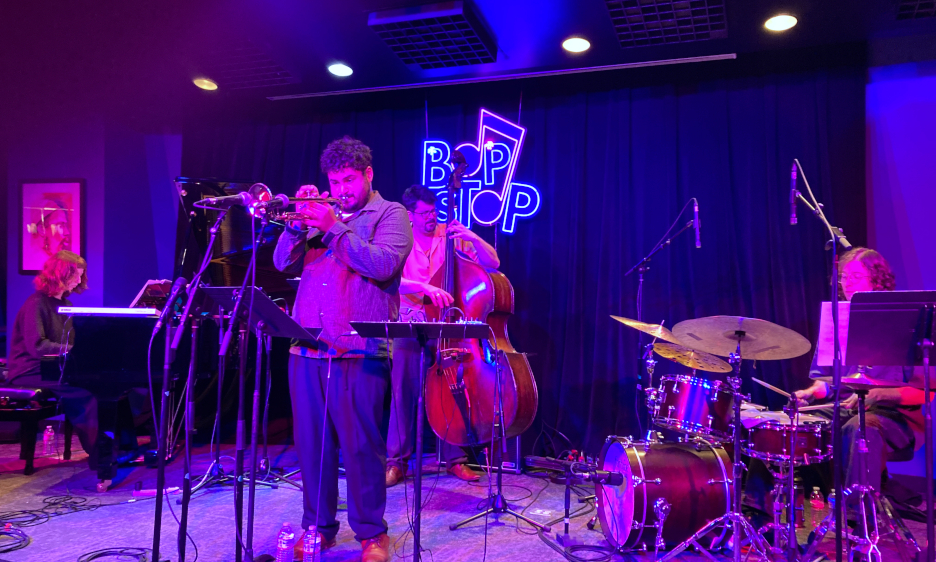
Courtesy John Chacona
ELEPHANT’s music was brainy without being remote and hyper-intellectual. It drew the listener in rather than holding her at a safe distance.
BOP STOP at the Music Settlement
Cleveland, OH
September 9, 2026
What might have been on the minds of listeners who considered attending a concert by Adam O'Farrill's ELEPHANT, but who didn't know quite what to expect?
Since the band had a name and not a generic description (it could have been called the Adam O'Farrill Quartet), would it play rock-inspired music? A little research into the leader's distinguished lineage might have suggested a strong Latin-music influence. The venue, Cleveland's pre-eminent jazz club, suggested a third possibility.
It's not likely that anyone would have expected to hear chamber music. Yet in its subtle give-and-take, conversational approach to ensemble and elevation of collectivity over ego, ELEPHANT brought to mind a top-flight string quartet.
Of course, top-flight jazz groups also have those qualities, too. And given the presence of O'Farrill and drummer Russell Holzman on the stand (the former is the son and grandson of Arturo O'Farrill and Chico O'Farrill, respectively, and the latter's father Adam Holzman was a Miles Davis sideman), a jazz heritage was unavoidable.
The instrumentation said, jazz, too. Except for discreet interjections from a small keyboard and a dramatic switch to Rhodes on "Fukuoka Do Sendai," pianist Yvonne Rogers mostly played the BOP STOP's Steinway grand. Walter Stinson played double bass exclusively and with a big tone that never called attention to itself.
O'Farrill judiciously used effects on his trumpet, but he also employed mutes to vary the ensemble's tonal palette, especially a startlingly vocal Harmon passage on "Dragon Roost Island." The trumpeter has acknowledged Ambrose Akinmusire as an influence, and you can hear him in O'Farrill's self-posession as an instrumentalist and in the inwardness of his compositional voice.
Still, his tone, silvery and shining the top register on "Bibo No Aozora" and jumping octaves on "Thank You Song," glowed with the ingratiating, openhearted lyricism of the great Cuban trumpet masters.
O'Farrill's compositions make liberal use of piano ostinatos, but they were more Meredith Monk than montuno. These Rogers played with a bench jeweler's pinpoint precision. She has the touch of a Murray Perahia and could be seen mouthing something during her solo on "Thank You Song" (Are there lyrics?). The clarity and precision of her approach was the airy space through which the band soared.
Even in furiously grooving sections, Holzman seemed to play something different in every bar. Yet his was an unfussy kind of hyperactivity. Like Rogers, he paid careful attention to matters of density and color. Muting his snare with a towel lent a grim funeral-march cast to the open-horn semaphores on "The Downside of Caves."
The band's rhythmic language was fluid and slippery. Cycles moved against cycles with Stinson sometimes locking in with drums and sometimes with piano. At other times, he was a free agent as all four instruments seemed to occupy their own rhythmic spheres of influence only to come together in contingent concord.
Yet there was nothing arbitrary about any of this. ELEPHANT's music was brainy without being remote and hyper-intellectual. It drew the listener in rather than holding her at a safe distance. O'Farrill had a confidence to share—but not overshare—with his audience.
It was perhaps this quality that most recalled the chamber music ideal. This was a band that was always under control, yet never icily so. O'Farrill is a very intentional composer—and player, too. In ELEPHANT, he has a flexible and compelling band to bring to life some of the most interesting music being made today.
 FOLLOW John Chacona
and get notified whenever a new article published.
FOLLOW John Chacona
and get notified whenever a new article published.
John Chacona is a freelance journalist, content writer and producer in Cleveland.
About Adam O'Farrill

Tags
PREVIOUS / NEXT

Become a Sustaining Member

Since 1995, All About Jazz has championed jazz as an art form and supported the musicians who create it. Over three decades, it has grown into one of the world's leading jazz resources, serving hundreds of thousands of readers, musicians, presenters and industry professionals each month.
Help Build the Future of All About Jazz
Your support helps us continue building All About Jazz for the next generation—expanding our editorial coverage, preserving jazz history, developing new community features and creating better ways to discover the music and the people behind it.
Become a sustaining member for as little as $20 per year and you'll immediately enjoy an ad-free experience along with access to subscriber features and future articles for a full year.
Together, we're not simply sustaining All About Jazz—we're building its future. Thank you for being part of the journey.
Near

Cleveland Concerts