Home » Jazz Articles » Live Review » 30th Annual Detroit International Jazz Festival: In Pictures
30th Annual Detroit International Jazz Festival: In Pictures
Detroit, Michigan
September 4-7, 2009
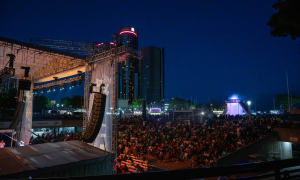
With perfect temperatures and wall-to-wall sunshine, Detroit recently celebrated a tradition that has brought jazz to the city every Labor Day weekend for the past 30 years. Billed as the largest free jazz festival in North America, this year's festivities ran September 4-7 and featured hundreds of performances on four main stages. Add to that other smaller shows, guest lecturers, and historical talks and you have a surefire way to immerse yourself in jazz for an entire weekend. Of course, there were pros and cons to the fest, as comes with any undertaking of this size. Much improved was the scheduling, which allowed for less overlapping of shows, making it easier to take in a larger number of performances. On the other hand, you couldn't help but get a sense of deja vu with more returning acts this year than in recent memory. Names like Sean Jones, Gerald Wilson, Charles McPherson, Marcus Belgrave, and Louis Hayes are familiar ones who have been on the bill several times over the last few years. As such, there seemed to be less diversity than in previous years. John Clayton would carry on the role of Artist in Residence this time around as initiated by fellow bassist Christian McBride last year.
With a theme of "Keepin' Up with the Joneses," homage began Friday evening with a rare set from surviving brother Hank Jones and went on all weekend to include tips of the hat to trumpeter Thad Jones and drummer Elvin Jones, icons spawned from Detroit's legendary jazz scene. Having personally attended this festival for the past 15 years, it's good to see it remain viable thanks to an endowment and grants that support what is surely an impressive budget and costly venture. Here's to another 30 years with a look at some memorable moments from this anniversary year.
Executive director Terri Pontremoli honors Detroit's own Hank Jones during the opening festivities.
Chick Corea, Stanley Clarke, and Lenny White debuted an all-acoustic trio that was a highlight of the festival.
Stanley Clarke left his electric bass at home.
Carl Allen could have easily been called the house drummer for the weekend, appearing with many acts including Hank Jones, Christian McBride, and his own group co-led with Rodney Whitaker.
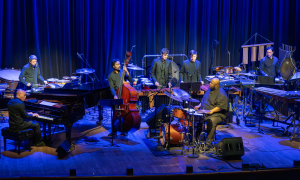
Bassist Christian McBride led his new acoustic ensemble Inside Straight, featuring saxophonist Steve Wilson, pianist Peter Martin, vibraphonist Warren Wolf, and drummer Carl Allen.
An exercise in collective improvisation, Wayne Shorter's set was one that most folks either dug or found monotonous, with no gray area in between.
Brian Blade with Wayne Shorter's Quartet
Now 91-years young, the venerable Gerald Wilson debuted a new commission for the festival, a six-movement piece for his orchestra simply entitled Detroit.
Mixing styles with ease, guitar legend Larry Coryell was heard with a group featuring his equally talented son Julian.
The rising star of the festival, vibraphonist Warren Wolf proved to be a talent worth reckoning. From the mainstream manifesto of Christian McBride's Inside Straight to the hip hop groove of Karriem Riggins's Virtuoso Experience, Wolf was chameleon-like in his ability to add substantially to the mix.
Pianist Geri Allen was part of several acts to be heard over the weekend, but her own trio set was something quite special, featuring tap dancing percussionist Maurice Chestnut.
Vincent Herring carried the torch for Cannonball Adderley as he shared the front line with trumpet Jeremy Pelt in Louis Hayes's tribute band.
Mixing jazz and Latin strains with fluency, bandleader Pete Escovedo provided a closing set that literally brought fans to their feet to heat up a cool Sunday evening.
A wonderful concept brought together trumpeter Sean Jones and a large ensemble with vocal choir to recreate Donald Byrd's experiments from the '60s combining jazz and gospel strains. Choosing the best numbers from the Blue Note albums A New Perspective and I'm Trying to Get Home, the results were nothing less than inspiring and celebratory, making this set a personal favorite.
Photo Credit:
C. Andrew Hovan
 FOLLOW C. Andrew Hovan
and get notified whenever a new article published.
FOLLOW C. Andrew Hovan
and get notified whenever a new article published.
An avid audiophile and music collector, Chris Hovan is a Cleveland-based writer / photographer / musician.
Tags
PREVIOUS / NEXT

Become a Sustaining Member

Since 1995, All About Jazz has championed jazz as an art form and supported the musicians who create it. Over three decades, it has grown into one of the world's leading jazz resources, serving hundreds of thousands of readers, musicians, presenters and industry professionals each month.
Help Build the Future of All About Jazz
Your support helps us continue building All About Jazz for the next generation—expanding our editorial coverage, preserving jazz history, developing new community features and creating better ways to discover the music and the people behind it.
Become a sustaining member for as little as $20 per year and you'll immediately enjoy an ad-free experience along with access to subscriber features and future articles for a full year.
Together, we're not simply sustaining All About Jazz—we're building its future. Thank you for being part of the journey.