Home » Jazz Articles » Music and the Creative Spirit » Unfiltered - Ben Jaffe at Preservation Hall, New Orleans
Unfiltered - Ben Jaffe at Preservation Hall, New Orleans
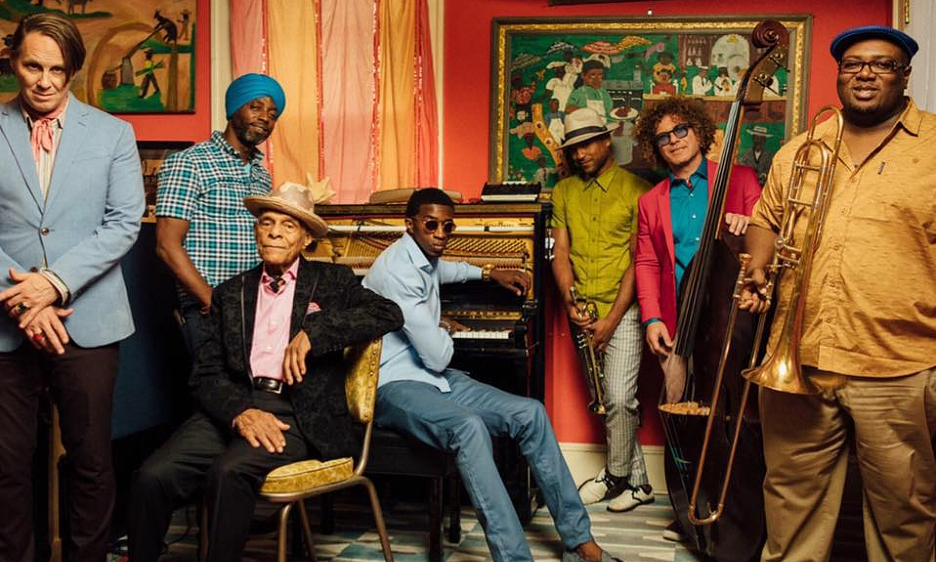
Courtesy Preservation Hall Website
Shy to request two hours (I did, though, just in case), we hooked up for a three-hour-long, at times deeply personal, conversation. Jaffe spoke, recalling what it was like to grow up at Preservation Hall. Often, with a dreamy, far-off look in his eyes partially shaded by his trademark smoky lenses, he recalled his unique upbringing in a nurturing artistic environment of Preservation Hall, an institution founded by his parents in 1961 in the heart of the French Quarter. Living and working in rather open defiance of the New Orleans 'mingling statute' in the segregated South of the early '60s, his parents befriended legendary figures in the history of jazz in New Orleans and all of North America too.
The story about the Hall, as recounted on its website, implies that civil rights was merely a by-product of organizing a place for African-American jazz players to revisit their artistry and resume lost careers. That is the official account.
But according to Jaffe, the initial founding of the Hall was not only about his parents' love for the music but was also politically motivated. Most Jews of that generation were quite vocal in their support of Blacks in their demand for civil rights. Political activism and love of the music together were the impetus to establish what is now a time-honored institution in this city, once the primary port for ships to unload and sell their human cargo in slave markets adjacent to the French Quarter. In response to a direct question if championing civil rights was on his parents' minds when they established the Hall, his response—"Definitely!." He readily volunteered more, requiring no further prodding.
"They also knew that being Jewish in the South could get you killed. They knew what they were doing while organizing these openly integrated music sessions celebrating African-American music. And they understood it had the potential to get 'rowdy,' at least that's how the mainstream mindset at that time might have responded to what they were doing. My father supported what Dr. Martin Luther King represented, and understood there were many who failed to appreciate the image of a dignified black man wearing a suit, along with a pressed white shirt and tie, orating with poetic eloquence about social injustices.
"They understood the inherent dangers too as, after all, the same summer my parents moved to New Orleans, three college students disappeared in Mississippi. None of that was lost on them or, subsequently, on me either.
"I attended a college with activists where, if you're paying attention, there are moments in time when you feel the energy, the pull of certain movements. There was a pull felt by Pete Seeger, that was also pulling on Bob Dylan, Joan Baez , finally gaining momentum and pulling Mahalia Jackson to come to and perform at places like Newport.
"People like my parents even put their families in harm's way. It is something they never talked about; they just acted, and I admire their courage. All my father's friends from university—all were East Coast Jews—went on to Wall Street, or became professionals. [laughs] But my father followed this other path as a patron and preserver of and responsibility to the music and musicians here in New Orleans -a feeling that lives within me as well."
Jaffe said what needed to be said, seldom if ever voiced in the past, and never so openly.
He smiled often, recalling the past while peering into the future with a sound plan for the longevity of The Preservation Hall Foundation designed to educate and culturally enrich the community that depends on philanthropic donations in a town where the moneyed locals are hardly inclined to support, much less contribute. Solely interested in Mardi Gras floats and other related activities, the upper-class white population has no interest in African-American traditions even if the jazz scene is the primary reason for tourists to visit and spend unimaginable sums, putting money directly into the pockets of that same upper class and the city coffers.
We spoke of many things other than politics and the future, including personal musical tastes and colorful characters from elsewhere and New Orleans too. With a positive mindset, with thinly veiled amusement, he addressed my inherent naiveté regarding what and who some of the musicians in town are familiar with on the national and international music arenas.
Unsurprised that Detroit Brooks, a renowned New Orleans jazz guitarist, had never heard of Ry Cooder, Ben knows Brooks could easily counter with a long list of significant names unfamiliar to anyone but those born and raised in the city. The conversation veers to calypso as we trade names of relatively obscure artists—he with Joseph Spence, a Bahamian guitarist/singer, and I with Walter Ferguson—revered in Costa Rica as the 'king of calypso.' Spence's sound is rougher, grittier—a guitar virtuoso some might compare to Robert Johnson—while Ferguson might be more aptly viewed as a sweet-sounding, folksy calypsonian crooner.
His own fascination for local music personalities and the popular music of his youth inevitably contributes to the input he offers as the band sat down to discuss new projects. His tastes were then, and now, hardly limited to a single genre. With the music of the Humphrey brothers (Preservation Hall stalwarts) and Harold Dejan (Eureka Brass Band) still echoing in his ears, he moved on to Ernie K-Doe and The Clash, from Dave Bartholomew to Bruce Springsteen, from local bluesman J. Monque'D to My Morning Jacket—his musical interests remain refreshingly accessible and diverse.
Though intimately familiar with legends from the past, he's younger than many in town too. In a momentary lapse during the conversation, he groped for the name of a renowned '60s music festival. In an effort to complete his thought, I suggested Newport. But no—still searching for the name, he blurted out, "You know ... that hippie festival ." He meant Woodstock. I laughed. A full generation older, I always considered it a musical event rather than a classic hippie gathering of the period—a matter of perspective.
Which suggests the punch line—grateful for the tutelage he received at the feet of his elders, others now regard Ben Jaffe as one too. I guess age is relative? But never mind—apparently it's not how old you are, but how old you feel. And act. Though surely regarded by some as an old soul, Ben Jaffe is a resourceful young man and, with an inherently positive perspective that will undoubtedly remain so for a long time. With progressive ideas and forward thinking, the legacy and future of Preservation Hall is in good hands; it appears to be both safe and secure.
 FOLLOW Thomas Cole
and get notified whenever a new article published.
FOLLOW Thomas Cole
and get notified whenever a new article published.
A world traveller in the past, and now... an obsessive writer and observer of life.
About Ben Jaffe

Tags
PREVIOUS / NEXT

Become a Sustaining Member

Since 1995, All About Jazz has championed jazz as an art form and supported the musicians who create it. Over three decades, it has grown into one of the world's leading jazz resources, serving hundreds of thousands of readers, musicians, presenters and industry professionals each month.
Help Build the Future of All About Jazz
Your support helps us continue building All About Jazz for the next generation—expanding our editorial coverage, preserving jazz history, developing new community features and creating better ways to discover the music and the people behind it.
Become a sustaining member for as little as $20 per year and you'll immediately enjoy an ad-free experience along with access to subscriber features and future articles for a full year.
Together, we're not simply sustaining All About Jazz—we're building its future. Thank you for being part of the journey.