Home » Jazz Articles » Album Review » Marty Ehrlich: Open Air: The Complete Saxophone Quartet ...
Marty Ehrlich: Open Air: The Complete Saxophone Quartet Compositions Of Julius Hemphill
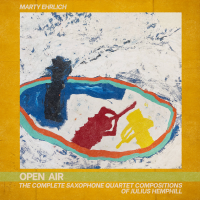
Hemphill, best known as a founding member and principal composer of the World Saxophone Quartet (WSQ), wrote consistently for reed ensembles from 1977 until his death in 1995. First for the WSQ, then for his own sextet, finding within them all the colors he needed to express his multifaceted visions.
Ehrlich convened an array of sympathetic colleagues for four sessions in 2025. Although the non-chronological programming complicates the task of identifying the personnel on individual tracks, the uniformly high standard of execution—including performances achieved through overdubbing—minimizes the distraction. Ehrlich curates the 42 works, ranging from under a minute to almost four and a half minutes, into six "galleries" of seven numbers, separated by extended pauses. This arrangement heightens the contrasts, separates similar constructions and implicitly suggests bite-sized chunks for easier digestion.
Ehrlich's decision to largely dispense with solos means that the spotlight rests firmly on Hemphill's charts. And what charts they are. The saxophone quartet functions as a chamber ensemble, yet its vocabulary draws on the breadth of Black musical traditions, from gospel and blues to jump-band music and bebop. In Hemphill's hands the quartets create a wide range of compact musical narratives which convey complex emotional states. However, a common DNA is evident throughout, often distinguished by Hemphill's characteristically elongated melody lines, rich voicings and his often slightly vinegary harmonies that prevent the music from settling into easy consonance.
Although two thirds of the pieces were recorded by the WSQ, the accounts here offer an alternative perspective. Two examples give a taste of how. "R&B," a tune from the second WSQ album Steppin' (Black Saint, 1979) lasts 1:32 here compared with 9:01 in the WSQ version, whose additional length accommodates solo and group improvisation. Conversely, "Hearts" from the same album runs 2:28 here against 3:00 in the WSQ version, where a short introductory solo precedes a through-composed rendition. Even so, the WSQ's more individualistic approach gives the piece a different, arguably less cohesive character.
Call and response recurs in a myriad of guises throughout the repertoire. In "Slide," the baritone saxophone elicits a catchy but blue-tinged rejoinder, while in "Revue," the baritone prompts a series of extemporized answers from Ehrlich and Rob DeBellis. That cut is one of a dozen where the sleeve lists individual contributions. Often they add a layer of intrigue to riff-based pieces, with Jason Robinson's garrulous tenor squawk on "Ji-Ji Tune," being a case in point. Among them, "Bayou Sketches" stands out for Ehrlich's multiphonics and squeals in reply to the saxophone chorale. Other highlights include the beautiful "Georgia Blue," a mainstay of Hemphill's bands, while two takes of "My First Winter" demonstrate how different interpretations can illuminate the same material.
Taken together, these performances affirm Hemphill's quartets as more than just frames for exhibitions of improvisational prowess; rather, they crystallize into fully realized works of art in their own right.
 FOLLOW John Sharpe
and get notified whenever a new article published.
John first fell under the spell of free jazz in the 1970s when he wistfully regarded the loft jazz scene from across the Atlantic
Track Listing
Open Air (for Tommy); Revue; R & B; My First Winter (#1); Orator; Touchic’; Hearts; Another Feeling; Funny Paper; New Prayers; Untitled; Stick; What I Know Now; Pillars Latino; Bayou Sketches; Dar El Sudan; Cool Red; Affairs of the Heart; Steppin’; Plain Song; Sweet D (for David Murray); Children’s Song; Romance in Time; Slide; Functions; Ink; One/Waltz/Time; Bumpkin; Border Town (San Antonio, TX); Big Foot; Flair; Georgia Blue (for Joanne Robinson-Hill); Little Samba; Dream/Scheme; Ji Ji Tune; Choo Choo; Fixed Signs; Impulse; Connections; Loopology; My First Winter (#2); Void.
Personnel

Marty Ehrlich
woodwinds
Allan Chase
saxophone, altoRob DeBellis
saxophone
Brian Landrus
saxophone, baritone
Andy Laster
saxophone, baritone
Jeff Lederer
woodwindsLisa Parrott
saxophone
Jason Robinson
saxophone, tenorAlbum information
Title: Open Air: The Complete Saxophone Quartet Compositions Of Julius Hemphill | Year Released: 2026 | Record Label: Out Of Your Head Records
About Marty Ehrlich
Tags
PREVIOUS / NEXT


Become a Sustaining Member

Since 1995, All About Jazz has championed jazz as an art form and supported the musicians who create it. Over three decades, it has grown into one of the world's leading jazz resources, serving hundreds of thousands of readers, musicians, presenters and industry professionals each month.
Help Build the Future of All About Jazz
Your support helps us continue building All About Jazz for the next generation—expanding our editorial coverage, preserving jazz history, developing new community features and creating better ways to discover the music and the people behind it.
Become a sustaining member for as little as $20 per year and you'll immediately enjoy an ad-free experience along with access to subscriber features and future articles for a full year.
Together, we're not simply sustaining All About Jazz—we're building its future. Thank you for being part of the journey.