Home » Jazz Articles » Live Review » Omar Sosa: The Magic Piano Man and his Afreecanos Quartet
Omar Sosa: The Magic Piano Man and his Afreecanos Quartet
Sosa played both soft and lyrically, while at other times he made the Steinway sound like a clash of titans, especially when he used his elbow or his forearm on the keys.
Douglas Beach House
Half Moon Bay, San Francisco
March 29, 2009
Before doing live reviews, I never go to the web and check up on the band or the people that I will see perform, preferring not to have any preconceived expectations of the musicians or the music: in fact, ninety-five percent of the time I've never heard their music. All I know is that he or she is loosely cast in the jazz genre.
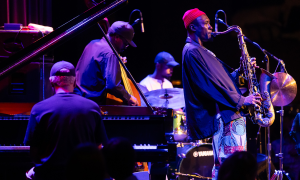
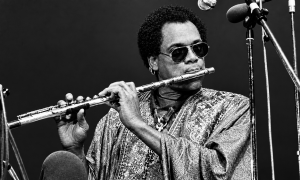
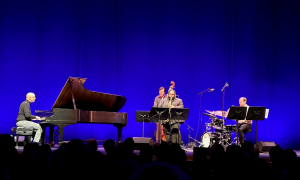
That's the way it was when, on March 29th, my son David and I went to the Douglas Beach House (aka the Bach Dancing & Dynamite Society) to hear Cuban-born Omar Sosa and his Afreecanos Quartet. (Sosa now lives in Barcelona, Spain.) The band consisted of the noted Afro-Latin percussionist John Santos, Mozambican electric/acoustic bassist, and vocalist Childo Tomas, saxophonist and flautist Peter Apfelbaum. (That evening he played a variety of woodwinds, with Sosa on a Steinway concert grand and Fender Rhodes.)
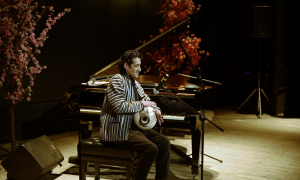
Upon Sosa's entry onto the legendary boutique stage, dressed in a flowing white dashiki, matching circular headdress, Santeria beads, carrying a lit votive candle, a shawl, and two images, he carefully placed them on the piano before commencing with his performance, leaning over into the piano's interior and plucking the strings. Percussionist Santos was also on stage with Sosa, playing an array of acoustic percussive instruments and singing. From a bank of electronic sample triggers and sequencers Sosa had mounted above the piano's keyboard, Santos and Sosa played with each other. Before the piece was half over, Tomas and Apfelbaum had joined the two on stage and took the first composition to an astoundingly abrupt end, directed by Sosa.
What an opening display of creativity that flowed from the quartet. He seemingly tells stories through his fingers. The interplay between the band members simply added to the magic on stage. Sosa and Tomas had a special connection as each in turn seemed to urge the other onwards with a call-and-response style of play. It was obvious that the band was having fun—big grins across the stage, nods—and sometimes a call from Sosa over to Santos. By the second piece, the audience was clapping in time with the rhythm, as they joined in with the musical festivities that enveloped the Douglas Beach House.
Later, I read what others had said about Sosa. Neil Porter of the New York Daily News wrote of Sosa's performance in New York City at the Blue Note, "Sosa's left hand (on the sampler) and right (at the piano) seemed at times to be locked in their own lively exchange. And, like a force of nature, it was beguiling and beautiful and yet it all made perfect sense. The melodies flowed from Sosa's fingers like water. Or was that the digital sample of forest and steam noises that seeped in and out throughout the spellbinding session?" I could not have said it better: at times it was impossible to tell whether the electronics were leading the way or whether the band led the electronics.
Sosa played both soft and lyrically, while at other times he made the Steinway sound like a clash of titans, especially when he used his elbow or his forearm on the keys. The spectrum of music, from compositions to improvisational "conversations," along with his ingenious use of electronics, set Sosa apart from any other jazz musician I've ever heard. He is truly magical when he performs. As the evening came to closure, the audience sat enraptured by the unusual and involving display they had just witnessed and indeed were a part of. They rose from their chairs with a thunderous and prolonged ovation, calling for an encore, which Sosa and his remarkable band performed with an interesting short piece that sustained the supreme quality of Omar Sosa and his Afreecanos Quartet.
Photo Credit
Andy Nozaka
 FOLLOW Bill Leikam
and get notified whenever a new article published.
FOLLOW Bill Leikam
and get notified whenever a new article published.
His jazz interviews have been published in 28 languages.
About Omar Sosa

Tags
PREVIOUS / NEXT


Become a Sustaining Member

Since 1995, All About Jazz has championed jazz as an art form and supported the musicians who create it. Over three decades, it has grown into one of the world's leading jazz resources, serving hundreds of thousands of readers, musicians, presenters and industry professionals each month.
Help Build the Future of All About Jazz
Your support helps us continue building All About Jazz for the next generation—expanding our editorial coverage, preserving jazz history, developing new community features and creating better ways to discover the music and the people behind it.
Become a sustaining member for as little as $20 per year and you'll immediately enjoy an ad-free experience along with access to subscriber features and future articles for a full year.
Together, we're not simply sustaining All About Jazz—we're building its future. Thank you for being part of the journey.