Home » Jazz Articles » Live Review » New Inventions: Greg Osby Debuts Latest Band at Kennedy ...
New Inventions: Greg Osby Debuts Latest Band at Kennedy Center Jazz
Imagine a Cubist painting's spatial fragmentation colliding with Rothko's treatment of color and shape.
 Saturday, October 27, 2007
Kennedy Center Jazz Club
Washington, DC
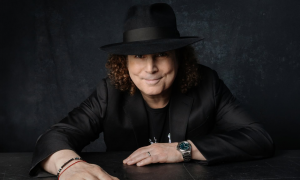
Instrumentalist, composer, and band-leader Greg Osby has helped helm jazz's creative resurgence for nearly two decades. At the Kennedy Center last Saturday, he once again proved why he has long been one of modern jazz's most provocative figures.
Presenting the official launch of his latest collection of new young voices in a brand new configuration, Osby not only redefined his sound, but the combination of novel arrangement, instrumental experimentation, and textural exploration may well have constituted his best work yet.
In his own words, Osby "changes band members like others change their shorts , so one of the enticing elements of any Osby performance is seeing who he'll bring to the stage. By no means shy about his stature, he is also up front about his less than altruistic motives, admitting freely that his own creativity is propelled by interacting with new, innovative players.
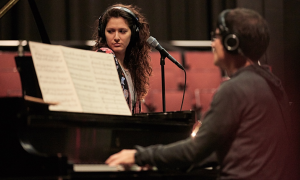
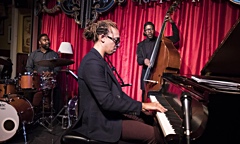
His latest band features Adam Birnbaum on piano, Christopher Tordini on bass, Reggie Quinerly on percussion, and Portuguese vocalist Sara Serpa. While each player possesses enormous ability in his or her own right, it is Serpa's astonishing vocal ability that clearly forms the heart of Osby's latest endeavor, and it was her stunningly unique approach that left the Kennedy Center's audience breathless.
Blending her voice with Osby's alto in a wordless improvisation, Serpa seamlessly integrated her lines and solos together with Osby's. Acting more as an additional frontline horn than a traditional vocalist, Serpa's vocal style resists description and defies the task of identifying precursors or analogs. More than a modernized "scat , Serpa has abandoned the syllabic conventions codified in earlier decades for a thoroughly contemporary form based on flowing lines, color, and texture, owing its closest relation perhaps to opera, with a bit of Luciana Souza, Bjork, and the only briefly recorded Devorah Day mixed in.
From the opening rendition of Ornette Coleman's "Mob Job , to the close of the show, the effect was distressingly evocative, particularly on the several tunes, including "Ask Me Now and "Nature Boy , where Serpa alternated between her wordless method and more traditional lyrics. On these pieces in particular, Osby displayed the latest evolution of his sound, which has progressed from its former cerebral character to a distinctive esotericism fitting an artistic mind that has already broadened the technical and theoretic landscape, and is now seeking to break through to grander vistas. Imagine a Cubist painting's spatial fragmentation colliding with Rothko's treatment of color and shape.
Whether unobtrusively providing the creative frame, or delivering astonishing individual solos, Osby's playing displayed an unusual integration of avant-gardism and traditionalism. From his delicate arrangement of "Nature Boy to his kaleidoscopic solos on "Misterioso , to the startling "Wedding Present , Osby successfully married the two conflicting poles of modern jazz, and in so doing has declared the tension between jazz's modernity and its canonical instincts a void construct.
As a first outing, the Osby Five's performance can only be summarized as heraldic, and Serpa a phenomena. Undoubtedly, the band will continue to evolve overtime, and with a recording already planned for January, audiences have advanced warning to keep attuned.
 FOLLOW Franz A. Matzner
and get notified whenever a new article published.
FOLLOW Franz A. Matzner
and get notified whenever a new article published.
Franz Matzner has contributed interviews and coverage from the Kennedy Center since 2002.
About Greg Osby
Tags
PREVIOUS / NEXT

Become a Sustaining Member

Since 1995, All About Jazz has championed jazz as an art form and supported the musicians who create it. Over three decades, it has grown into one of the world's leading jazz resources, serving hundreds of thousands of readers, musicians, presenters and industry professionals each month.
Help Build the Future of All About Jazz
Your support helps us continue building All About Jazz for the next generation—expanding our editorial coverage, preserving jazz history, developing new community features and creating better ways to discover the music and the people behind it.
Become a sustaining member for as little as $20 per year and you'll immediately enjoy an ad-free experience along with access to subscriber features and future articles for a full year.
Together, we're not simply sustaining All About Jazz—we're building its future. Thank you for being part of the journey.