Home » Jazz Articles » Live Review » Marc Ribot's Ceramic Dog at Tonic New York
Marc Ribot's Ceramic Dog at Tonic New York
Tonic New York City
107 Norfolk Street between Delancey and Rivington
New York, New York
On March 19th Marc Ribot brought to the Tonic his Ceramic Dog. The band was fresh off of a tour of Europe and Turkey, and the venue was standing room only. Ribot opened with a poem, a sort of dry-witted polemic written during the tour (and suiting the venue) about security and silliness at border crossings and in airplane lines. Politics becomes the Tonic. And so does experimental music. Luckily, Ribot's bassist, Shahzad Isamaily, a lanky cord of a man drawn taut, wasn't detained and appeared with Ribot.
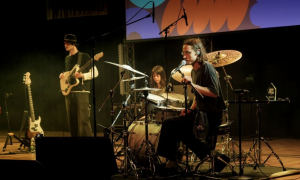
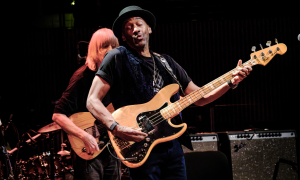
As the band launched into their first number, New York fans unfamiliar with Ribot's music aggressively pushed their way through the crowd, curious to see what sort of music Ribot had to offer them. I can surmise that few were disappointed with the band's modern creative sound. The first song crossed metal and maelstrom, ending with the drums and amplifiers pushing eleven. Ribot played guitar and a little bass. Shahzad and drummer Ches Smith played bells, drum machines, various sample and hold devices, a sunburst P-bass, a Steinbrenner guitar, and most notably, a Moog Rogue. Warmly overdriven drum samples, ring mods, and a sort of crackling short delay accompanied the drums and Ribot's guitar for most of the set.
Kudos to the sound-mixing team at Tonic: they sculpted the sound beautifully. They managed to get all the electronic gadgets and gizmos connected by a snake pit of wires with a minimum of noise and microphone feedback. As the guitars and drums played in the mid-ranges, pouring out inviting overdriven fuzz from the amplifiers, the band's electronic devises wheezed, crackled, thudded and thumped along with them, filling out and adding heft to the sound. At the end of the first song (and after my ability to distinguish between the upper registers of the treble range had been lost for the evening), they launched into another new piece amping up the energy even more. This was the catchiest tune of the evening, driven by a repeating guitar riff followed by a quick percussive refrain punched out by Shahzad in a neighboring key and at the upper reaches of the moog. This motif was propelled by Smith's new wavish punk beat, a beat that came down mid-way between The Clash and retro-disco.
There were also quieter moments. Marc Ribot's always been a sensitive player, fastidious about dynamics and balance. With his guitar sound, he can—both live and in the studio—produce and sustain just the right harmonics and overtones to cut through but not dominate a mix. Whether with Tom Waits, Medeski, Martin, and Wood, or his own band, his carefully crafted tone can by itself create a song's distinctive mood.
During the second half of the set he showed off his mastery of country, funk, jazz, and Cuban idioms. With the help of his young bandmates, he paid homage to and then deconstructed all of these idioms. Indeed, on one song he mixed all these genres, serving them up scrambled through an energetic mix of noise and free form. He also treated his audience to a revamped and reworked version of one of his Cubano Postizo numbers.
But in the end, Ribot was only the anchor and the guide, allowing his band extreme latitude. Ceramic Dog is as much about the band as Ribot's guitar. The leader reciprocally fed off the energy of his bandmates, swinging his guitar around, windmilling like Pete Townsend, building the intensity until the band reached an ending that surpassed the beginning in sonic thunder and lightning. A loud and awesome final climax consummated with Shahzad bursting off the stage, a ball of energy disappearing into the crowd. It really couldn't have been any other way.
FOLLOW James Nichols
and get notified whenever a new article published.
James Nichols is earning a PhD in American History and listening to the radio.
About Marc Ribot

Tags
PREVIOUS / NEXT
Become a Sustaining Member

Since 1995, All About Jazz has championed jazz as an art form and supported the musicians who create it. Over three decades, it has grown into one of the world's leading jazz resources, serving hundreds of thousands of readers, musicians, presenters and industry professionals each month.
Help Build the Future of All About Jazz
Your support helps us continue building All About Jazz for the next generation—expanding our editorial coverage, preserving jazz history, developing new community features and creating better ways to discover the music and the people behind it.
Become a sustaining member for as little as $20 per year and you'll immediately enjoy an ad-free experience along with access to subscriber features and future articles for a full year.
Together, we're not simply sustaining All About Jazz—we're building its future. Thank you for being part of the journey.