Home » Jazz Articles » Musings of a Jazz Piano Teacher » Jazz Practice
Jazz Practice

The solution is to approach scales and arpeggios musically and in a manner appropriate to jazz. You can make a start by playing scales in swing 8s, but here are a couple of suggestions that combine technique with your jazz practice.
Play the scale of Eb major in swing 8s with left-hand voicings of your choosing.

Now, play the same major scale, but starting on the 'and' of 1.

This rhythmic shift reflects what you might play in a solo. Now try starting the scale on the 'and' of 2, 3 and 4.
Next, play these broken chords, also with a swing feel. In this example you are practicing arpeggios, but over a I—VI—II—V turnaround.

You can invent patterns containing your own rhythmic and melodic variations. As well as strengthening your technique, you are also developing your own licks, rather than copying from others.
Drills and exercises
The greatest temptation when practicing is to breeze through a few tunes that you know. This may be pleasurable but will not improve your playing. Repertoire should be a part of your routine and I'll address that below. But I advise that you begin a practice session with a few drills.
There are three chord patterns that come up frequently: the II—V--I sequence, the II—V sequence, and the I— VI—II—V turnaround.
II—V--I Develop the ability to solo and comp through the II—V--I sequence in all major and minor keys. This is crucial to your progress as a jazz musician.
Resist the temptation to only play in the easy keys, as you will soon be encountering certain standards in 'difficult' keys. For example, Body and Soul is usually in Db and 'Round Midnight is in Eb minor!
II—V The II—V sequence doesn't always resolve to its tonic. Instead, it might move to another II—V, in songs such as Stella By Starlight and Satin Doll.
I—VI—II—V This common turnaround often appears at the end of a tune to lead you back to the start. The VI chord is usually a dominant 7.
All these sequences need to be practiced in all keys and in varying combinations. For example, the turnaround sequence could be practiced as follows:
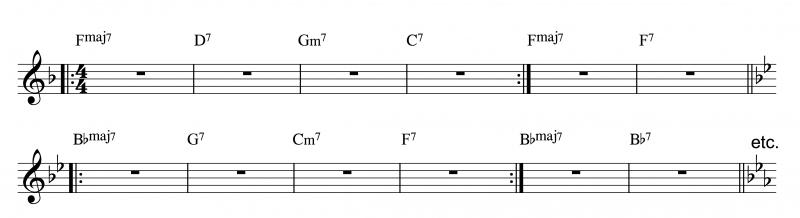
How you approach these sequences depend on the areas in your playing that need strengthening: rootless voicings, soloing, comping etc.
Read the music
How's your sight-reading? Some musicians get by without being able to read a note of music, but I would not have stayed in regular work over the years without this skill. Spend a little time each day reading a new tune. Don't approximate; both melody and rhythm need to be accurate.
Learn a new tune
How many tunes can you play without music? You should be building up a basic repertoire of standards, blues, ballads and Latin tunes. But just focus on one tune per session: identify its key, song structure (AABA etc.) and map. Where are the II—V--I's, turnarounds etc?
Revisit your old tunes
Pick up a tune already in your repertoire and isolate one section that might be giving you trouble. For example, the bridge of Have You Met Miss Jones is far trickier than its A section. Then try transposing it. You may be able to breeze through Autumn Leaves in Bb but what if the singer asks you to play it in B?
Playing along to backing tracks
Before backing tracks were available, we all played along to the original album track; in fact I still enjoy comping behind my favorite players, and recommend that you do the same. Then along came playalong CDs: collections of recorded backing tracks bundled with the sheet music. Apart from being able to tune out the piano track, these playalongs are less flexible than apps (see below), in that each track is in a fixed key and tempo. However, if you wish to try this method of practice, I'd suggest the excellent Jamey Aebersold series.
A third option is to play along to an app such as iReal Pro or Tempo SlowMo. These apps display the chord chart (not the melody) and provide a rhythm track for hundreds of standards. Not only can you turn instruments off, you can also change the key, tempo and style of each song.
A fourth option is to create your own backing tracks. If your keyboard records, then lay down a simple bass line. If you want to get more creative, use a sequencer such as Garage Band or Logic to build up your own track.
I would only suggest practising to a metronome if your playing needs tightening up or if your tempos are slowing down.
Tempo
Don't always opt for the easy option of a steady 120bpm. Start building up your speed in readiness for when the bandleader counts in at 200bpm!
In short, rather than mindlessly running up and down scales and churning out tunes that you know, structure your practice session so that it is both productive and enjoyable.
Tags
PREVIOUS / NEXT

Become a Sustaining Member

Since 1995, All About Jazz has championed jazz as an art form and supported the musicians who create it. Over three decades, it has grown into one of the world's leading jazz resources, serving hundreds of thousands of readers, musicians, presenters and industry professionals each month.
Help Build the Future of All About Jazz
Your support helps us continue building All About Jazz for the next generation—expanding our editorial coverage, preserving jazz history, developing new community features and creating better ways to discover the music and the people behind it.
Become a sustaining member for as little as $20 per year and you'll immediately enjoy an ad-free experience along with access to subscriber features and future articles for a full year.
Together, we're not simply sustaining All About Jazz—we're building its future. Thank you for being part of the journey.