Home » Jazz Articles » Album Review » Cecil Taylor: Fragments: The Complete 1969 Salle Pleyel Concerts
Cecil Taylor: Fragments: The Complete 1969 Salle Pleyel Concerts
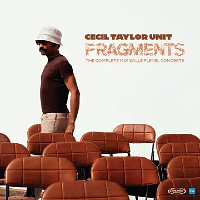
The Cecil Taylor Unit included longtime musical partners Jimmy Lyons on alto sax and Andrew Cyrille on drums, with the addition of tenor saxophone giant Sam Rivers. Fragments represents the 2026 fruit of producer Zev Feldman's ongoing relationship with INA (Institut national de l'audiovisual), the French radio and television audiovisual archive, which has produced several albums of great jazz music originally recorded for French broadcast. The audio was restored and mixed from the original analog tapes by Marc Doutrepont at EQuuS, cut for LP by Matthew Lutthans at The Mastering Lab, and presented in a beautiful triple-gatefold sleeve with a full-size booklet. The shorter evening performance is presented first, on LP 1, which makes sense as it is the more concise, better recorded and approachable version of the piece. "Approachable" is a relative term when it comes to Taylor, however.
As always, the pianist composed the piece, and in the film that circulates from the concert Rivers and Lyons are seen to have music on a stand in front of them. Nevertheless, while on the macro scale a pattern emerges (full band, then piano and drums, then Rivers on flute, then piano solo, etc.), on the micro scale the music sounds free. Taylor plays so many notes on the piano with such rapidity that there is a constant flow of trills, glissandos, and clusters, Cyrille engages in constant motion, rarely settling into a repeated beat, and the saxophonists trill, shout, and scream across their full ranges. For the listener, it is perhaps best to let this music flow where it will, listening for the energy, the texture, and the impact that the changes in its character have as the piece progresses.
There are many fascinating episodes. The evening show roars out of the gate, with everyone in full flight. Midway through the piece, the horns drop out, the piano gets quiet and Taylor begins to play more discernible patterns. Cyrille's quiet drumming is sensitive, and the two men engage in a true conversation. After several minutes, Rivers enters on flute and a nearly-lyrical trio section ensues, receiving applause. Then it is back to just Taylor, playing trills that move slowly up and down the keyboard like standing waves. Just as he reaches the top of his range for the final time, the pianist quickly jumps to the piano's low end for a gospel-like chord that, with some snare drum patter, ends the performance.
The much longer afternoon performance is spread across LP 2 and LP 3, and here it is sometimes easier to pick up fragments of Ellington. Taylor plays diatonic filigrees across the piano amidst bluesy interjections by Lyons, who exhibits roots in the tradition of Charlie Parker. The dominant voice here, however, is Rivers, who, as the weave gets thicker with the entry of the drums, begins several minutes of free blasting and screaming through his tenor. A calm episode of solo piano relieves this tension, and soon Rivers engages in some lovely lyrical playing on his flute. But as Lyons enters and builds in his free playing, Rivers begins making vocal moans, wails and, eventually, blood-curdling screams. In person in 1969, this may have come across as a powerful statement of existential or political unrest, but over-modulated on a record decades later, it seems a moment of avant-garde self-parody. Thankfully, it quickly gives way to some wonderful interaction between Cyrille's toms, not a focus until now, and Taylor's trills and chordal statements.
Fragments: The Complete 1969 Salle Pleyel Concerts will be self-recommending to serious fans of Taylor's, or Rivers,' monumental musical legacies. The beautifully-presented set captures a quartet of immense power and invention at a time when avant-garde jazz could garner an appreciative mainstream audience alongside that of Ellington and Davis.
 FOLLOW Joshua Weiner
and get notified whenever a new article published.
FOLLOW Joshua Weiner
and get notified whenever a new article published.
Joshua Weiner enjoys his day job as a professor and dean but wishes it left more time for music.
Track Listing
Side A: Fragments of a Dedication to Duke Ellington, Evening Set Version, Part 1; Side B: Fragments of a Dedication to Duke Ellington, Evening Set Version, Part 2; Side C: Fragments of a Dedication to Duke Ellington, Afternoon Set Version, Part 1; Side D: Fragments of a Dedication to Duke Ellington, Afternoon Set Version, Part 2; Side E: Fragments of a Dedication to Duke Ellington, Afternoon Set Version, Part 1; Side F: Fragments of a Dedication to Duke Ellington, Afternoon Set Version, Part 2.
Personnel


Additional Instrumentation
Sam Rivers: soprano saxophone, flute.
Album information
Title: Fragments: The Complete 1969 Salle Pleyel Concerts | Year Released: 2026 | Record Label: Elemental Music
About Cecil Taylor
Tags
PREVIOUS / NEXT

Become a Sustaining Member

Since 1995, All About Jazz has championed jazz as an art form and supported the musicians who create it. Over three decades, it has grown into one of the world's leading jazz resources, serving hundreds of thousands of readers, musicians, presenters and industry professionals each month.
Help Build the Future of All About Jazz
Your support helps us continue building All About Jazz for the next generation—expanding our editorial coverage, preserving jazz history, developing new community features and creating better ways to discover the music and the people behind it.
Become a sustaining member for as little as $20 per year and you'll immediately enjoy an ad-free experience along with access to subscriber features and future articles for a full year.
Together, we're not simply sustaining All About Jazz—we're building its future. Thank you for being part of the journey.