Home » Jazz Articles » Ken Schaphorst
Jazz Articles about Ken Schaphorst
About Ken Schaphorst
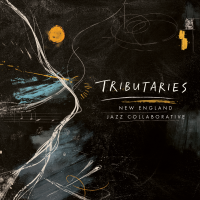
New England Jazz Collaborative: Tributaries
by Jack Bowers
Tributaries is the debut recording by the seventeen-member New England Jazz Collaborative whose origin and purpose are summed up as follows: “an artist-led non-profit collective dedicated to commissioning, presenting and documenting new music and expanding the audience for what remains a thrilling and vital musical form." The album consists of half a dozen fresh compositions by a quartet of talented composers and arrangers: NEJC founder Jeremy Cohen, Matan Rubinstein, Darryl Harper and Sam Spear, with the ensemble ably ...
Continue Reading...Ken Schaphorst: Indigenous Technology

by Russell Moon
Ken Schaphorst is associated with big band albums, the best known and best distributed, I suspect, being Purple (Naxos, 1998).
With Indigenous Technology Schaphorst takes a new look on the jazz trio. Schaphorst plays trumpet, flugelhorn or piano on the record alongside cellist Matt Turner and marimba/percussion player Dane Richeson. There is no drummer here.
It would be fair to categorize this recording as New Age, but the featured improvisation is far better than that genre's usual light fare, perhaps ...
Continue Reading...Ken Schaphorst: Purple

by Mark Corroto
As a jazz fan who’s listening preferences tend toward small group recordings, I find big band recordings, by definition tend to be, well...BIG. Most large ensembles, like ocean liners, have trouble maneuvering, their sounds tend to be crowded and loud. By the time Leonardo screams “iceberg” it’s too late, the record is sunk. Maybe that’s why I enjoyed Purple by captain and arranger Ken Schaphorst, his 19-piece band steers clear of the largeness. Schaphorst, the director of Jazz studies at ...
Continue Reading...Ken Schaphorst Big Band: Purple
by Jack Bowers
Unlike some Jazz composers who write unpretentious big–band charts designed to serve as springboards for soloists, Ken Schaphorst approaches the task with soloists in mind but focuses always on orchestral textures and colors, employing improvisation as an integral element in the over–all compositional makeup. Instead of playing “outside” the chart with rhythm accompaniment, as is so often the case, Schaphorst’s soloists usually must adapt to its nuances, tailoring their approach to suit its particular needs without sacrificing warmth or creativity. ...
Continue Reading...Album Showcase


Trending
 In Tribute To...
Points of View: Celebrating Dave Holland
 In Tribute To...
John Coltrane At 100: A Global Perspective
 Jazz Raconteurs
Julius Hemphill: Marty Ehrlich and Tim Berne Remember a...
 Profile
Sequoia Snyder: Growing in the Light of the Masters
 Interview
Jasur Khalilov: From Falak to Fusion
 Interview
Boney James: A Simple Man And A Lifetime Study
 Musician 2 Musician
Steve Coleman on Dave Holland
Premium
VOTE!