Home » Jazz Articles » Duke Ellington
Jazz Articles about Duke Ellington
About Duke Ellington
Celebrating Duke Ellington's Late-Period Creative Music On His 127th Birthday And More

by Lawrence Peryer
This week's Rotations marks the 127th birth anniversary of Duke Ellington with a deep dive into the final fifteen years of his career. Those were the years of surprising, searching work that tends to get overlooked in favor of the canonical recordings. Ellington appears in four different contexts: sacred, suite, duo, and globe-spanning large ensemble. Close your eyes and listen without the name attached.Opening and closing sets from a variety of contemporary artists frame the Ellington material.
Continue ReadingPlays Duke, Part III: More contemporary covers of Ellington's best loved tunes.
by Larry Slater
Duke Ellington's legacy lives on today largely through his compositions, and musicians from around the globe continue to embrace his music, finding new ways to re-interpret his songs.In this hour, you'll hear some immortal selections from the Ellington canon, including “Cotton Tail," “Solitude," “In A Sentimental Mood," “Come Sunday," “Reflections in D," and “The Feeling of Jazz."Featured artists include Emmet Cohen, Wes Montgomery, the gypsy jazz guitarist Angelo DeBarre, Shai Maestro, Sean Jones, Delfeayo Marsalis, Enrico ...
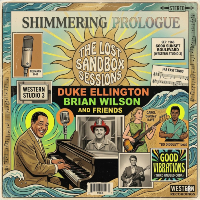
Continue ReadingDuke Ellington, Brian Wilson and Friends: Shimmering Prologue: The Lost Sandbox Sessions
by Mike Jurkovic
Picture this: LA: Tuesday, early September, '66. A few months after Pet Sounds (Capitol, 1966) reshaped the landscape. The weather (pre-climate change) breaks around the mid 70's with a slight breeze sliding in from the east. Mired in an un-stately creative slump, Duke Ellington finds himself being ushered into 6000 Sunset Boulevard (Western Studio 3 for all you folklorists out there) where Beach Boy Brian Wilson (a man who believed his every whim was a twenty-four track master) ...
Continue ReadingPlays Duke, part II: Contemporary Covers of Ellingtonia from the Swing Era
by Larry Slater
Duke Ellington always said his orchestra was his instrument, and the Duke Ellington Orchestra was at the peak of its power and popularity in the 1930s and 40s. Many famous Ellington masterpieces were penned during this era; “It Don't Mean a Thing If It Ain't Got That Swing," “Do Nothing Till You Hear From Me," “I Got It Bad and That Ain't Good,""Sophisticated Lady," I Let A Song Go Out of My Heart" and “Warm Valley" are just a few ...
Continue ReadingPlays Duke: Contemporary Covers of Early Ellington Classics
by Larry Slater
Duke Ellington is unquestionably the most important and prolific jazz composer. He composed over 1,500 tunes and quite a few have become both jazz standards and part of Americana. Even folks who don't listen to jazz know Ellington tunes like “ It Don't Mean A Thing If It Ain't Got That Swing," “Mood Indigo" and “Caravan."Ellington waxed his first recordings in 1923 . Remarkably, quite a number of Ellington compositions from his early period remain popular with jazz ...
Continue ReadingThe Symphonic Ellington
by Larry Slater
Pianist Ethan Iverson wrote, “Every Ellington record I've ever heard has a unique ambience. Thick harmonic complexity sits deep inside blues and swing. There are larger Ellington compositions where he is stretching the form and apparently putting his hat into the ring as a great composer."In this hour, you'll hear Duke Ellington's most impressive symphonic works. “The Harlem Suite" was originally commissioned by Arturo Toscanini and was performed by both the Ellington Orchestra and symphony orchestras. “A New ...
Continue ReadingThe Duke Ellington Collaborations
by Larry Slater
Miles Davis once said, “I think all the musicians in jazz should get together on one certain day and get down on their knees and thank Duke."Duke Ellington often remarked that the Ellington Orchestra was his instrument, but occasionally Duke stepped out of his role as maestro to collaborate with jazz artists in different musical settings. There were rare instances when he shared the limelight with one of the band's musicians, like Johnny Hodges and Ray Nance.
Continue ReadingAlbum Showcase



Trending
 Interview
Lou Marini: A Solo Career Starting At The Age Of 80
 History of Jazz
John Coltrane in Detroit: A Brief History
 Live Review
The Tension Is Where the Music Lives: Miles Davis at 100,...
 Live Review
Detroit Jazz Festival 2026: A Gathering in a Great Jazz City
 Radio & Podcasts
Sullivan Fortner, Jim Rotondi & Dena DeRose, Ardeshir,...
 Reanimating Conversations Past
Charlie Haden: Anatomy of a Jazz Classic
 Profile
The Discreet Charm of Tete Montoliu
Premium
VOTE!