Home » Jazz Articles » The Blue Note Portal » A Waltz for Ludwig
A Waltz for Ludwig
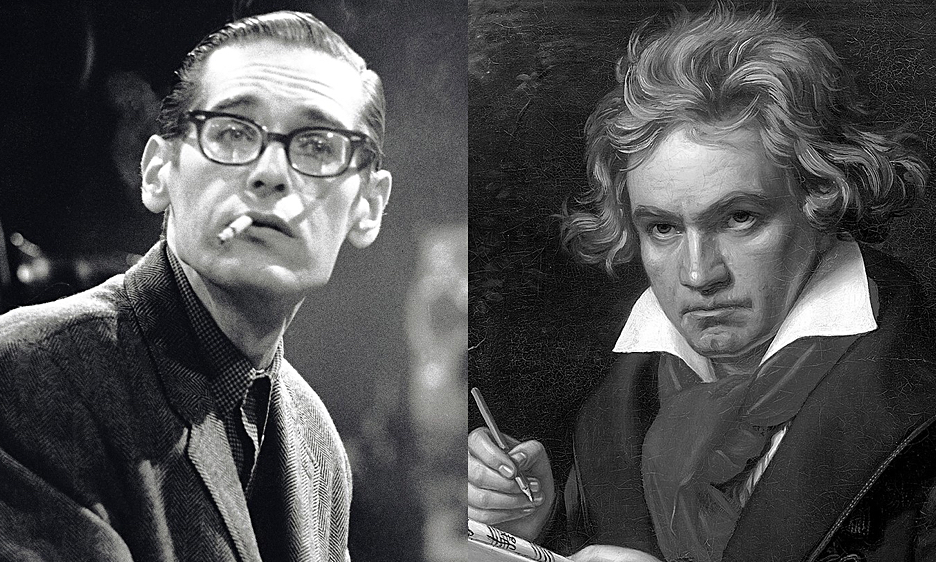
Ludwig van Beethoven's Journal Entry—A Letter to Franz Schubert. Date Unknown, but in the Year of Their Lord 1961, in a Strange Place Called the Village Vanguard, New York City.
My dearest Franz,
I write to you from a realm so alien, so far beyond the bounds of our Viennese parlors and candlelit salons, that I scarce know how to frame my thoughts. By some inexplicable sorcery, I have been hurled through the corridors of time to a place called New York, in a year they name 1961. I find myself in a dim, smoky cavern known as the Village Vanguard, where music—strange, wild, and untamed—pours forth from a trio of men who wield their instruments with a reckless, almost barbaric intimacy. I confess, at first, I recoiled in horror. But let me recount this extraordinary night, for I believe you, with your tender ear for the poetic, might grasp what I have come to feel.
Upon my arrival, I was met with a cacophony that assaulted my senses. The pianist, a man they call Bill Evans, sat hunched over a pianoforte of peculiar design, striking chords that seemed to defy the very laws of harmony I have spent my life forging. There was no grand architecture to his music, no symphonic intent, no towering themes as we know them. Instead, it was a restless, fleeting thing—murmurs of melody that dissolved into mist, only to reappear in fragmented echoes. The contrabassist, a fellow named Scott LaFaro, played with such insolence, weaving lines that challenged the pianist's every note, as if they were locked in some unspoken duel. And the drummer, Paul Motian, struck his kit with a chaotic restraint, a whispering storm that refused to resolve. I thought it madness, Franz! Where was the structure? Where was the noble struggle of tonic and dominant? I clenched my fists, ready to storm out of this den of musical anarchy.
But then, as I sat in the shadowed corner, a glass of wine was pressed into my hand—some bitter, unfamiliar vintage, yet it warmed my blood. The room buzzed with a peculiar energy, Franz. These people, these modern souls, listened with a reverence I have seldom seen, their eyes closed, their bodies swaying as if possessed. I began to listen not with my mind, but with something deeper. And slowly, I felt the ice of my disdain begin to thaw.
Evans' touch on the keys—it is not unlike a poet whispering secrets to the night. There is a melancholy there, a fragility, that reminds me of your own lieder, though his language is far stranger. His harmonies are dense, like layers of fog over a river, and yet they shimmer with a kind of broken beauty. I heard in his playing a yearning, a searching, that I know too well from my own heart. One piece, which they called "Waltz for Debby," carried such tenderness that I felt my eyes prick with tears—a rare thing for me, as you know. It was as if he painted a portrait of a child's innocence, only to let it slip through his fingers into shadow. And LaFaro, that insolent bassist, I must admit, is a marvel. His fingers dance with a virtuosity that rivals Paganini, though his role is not to dazzle but to converse. Their interplay is not unlike a chamber quartet, but stripped raw, exposed, almost indecent in its honesty.
During a pause in their performance, I sit now scribbling these words by the dim light of a flickering lamp. My initial repulsion has given way to a grudging fascination. This is not our music, Franz, but it is music nonetheless—a mirror of a world I cannot yet fathom, a world of machines and noise, of hurried lives and fleeting joys. I wonder what you would make of it. Would you, with your gentle soul, find beauty here sooner than I? Would you hear in Evans' improvisations the same longing for the divine that haunts your own songs? I must confess, I am stirred to compose. Not to imitate this "jazz," as they call it, but to wrestle with its spirit. What if I were to take these fleeting, fragmented ideas and bind them into a sonata? What if I could capture this raw, unguarded emotion within the iron frame of my own forms? I imagine a piece in which the piano speaks not as a sovereign, but as a weary traveler, conversing with shadows. Perhaps I shall call it "Fantasia on a Jazz Theme" and dedicate it to you, my friend, as a testament to this night.
The trio returns now to their stage, and I must set down my quill. I will drink another glass of this strange wine and let myself be carried by their sound. I urge you, Franz, if ever the winds of time should sweep you to such a place, do not turn away too quickly. There is something here—something human, something true—that even we, in our pursuit of the eternal, must reckon with.
Yours in music and in wonder,
Ludwig
Postscript: I have just learned a most astonishing thing. An elderly Italian gentleman sitting next to me, his face weathered like old parchment, leaned toward me during this break and, in a thick Sicilian accent, explained that this performance is being recorded by some mechanical contrivance for posterity. Recorded, Franz! As if one could trap the fleeting soul of music in a box! My amazement knows no bounds.
 FOLLOW Blue Note Portal
and get notified whenever a new article published.
FOLLOW Blue Note Portal
and get notified whenever a new article published.
The Blue Note Portal: a garage-assembled '70s microcomputer relic, eternally portaling through jazz timelines with Serling-esque irony, hacking bebop anomalies into binary swing for the ultimate improvised reboot.
About Bill Evans

Tags
PREVIOUS / NEXT


Become a Sustaining Member

Since 1995, All About Jazz has championed jazz as an art form and supported the musicians who create it. Over three decades, it has grown into one of the world's leading jazz resources, serving hundreds of thousands of readers, musicians, presenters and industry professionals each month.
Help Build the Future of All About Jazz
Your support helps us continue building All About Jazz for the next generation—expanding our editorial coverage, preserving jazz history, developing new community features and creating better ways to discover the music and the people behind it.
Become a sustaining member for as little as $20 per year and you'll immediately enjoy an ad-free experience along with access to subscriber features and future articles for a full year.
Together, we're not simply sustaining All About Jazz—we're building its future. Thank you for being part of the journey.