Home » Jazz Articles » Album Review » Sandy Evans: When the Sky Cries Rainbows
Sandy Evans: When the Sky Cries Rainbows
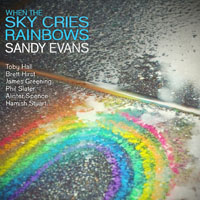
The title track is a dynamic nine minutes of fluidly shifting patterns. Trumpeter Phil Slater, trombonist James Greening and Evans' soprano weave dense harmonies which blend as one, yet whose individual colors—like a rainbow's bands—gradually gain in definition. Bassist Brett Hirst and drummer Toby Hall provide a sophisticated rhythmic platform from which Evans, pianist Alister Spence and Slater launch telling solos. The three-part harmonies converge again, serene yet powerful, and carry the composition out over a dramatic bass and piano riff. It's a mightily impressive opener, and its mixture of careful architecture and inherent freedom rather nicely sets the tone for all that follows.
Evans' arrangements vary greatly and maximize the possible combinations of the six musicians. Lone trumpet features on "Spectre," an atmospheric, blue reveille; "Indigo Blue"—an intimate duet with long-time collaborator Spence—is a beautiful, John Coltrane/McCoy Tyner-influenced affair, with a wonderfully commanding tenor solo from Evans, confident and poised. Evans sits out the trio piece, "Indra Slays the Demon Serpent," a short but vibrant trombone showcase. Greening's muted trombone is protagonist of the churning "Alexander's Dark Band," growling an exceedingly catchy motif in sync with bowed bass. Trumpet, tenor and trombone chatter together a little drunkenly before the trombone and bass motif returns, with sax and trumpet dovetailing on the flanks.
There are three radically different quartet numbers: the drummer-less "Chromatic Dispersion" sounds like a Gil Evans score for an unsettling film noir scene; the post-bop "Violet" is a classic, tenor-led piece in the swinging vein of tenor player Ernie Watts; and the slightly morose "Broken" is a lament, with trumpet emitting pained cries. Two quintet pieces also provide stark contrast: "Spectre of the Broken" is a notable, moody vignette with trumpet and tenor inseparable, following a forceful melodic line over a funereal bass; and "Heedrum-Hodrum Headbanging" goes from jumpy, minimalist patterns that interlock, to gritty riffs before morphing into unreserved free jazz.
"40 Degrees" is a rousing hard-bop workout of few surprises but charged soloing. There's a celebratory South African Township air about "Hand in Hand," with beautiful, concise statements from the lead voices. An irresistible bass ostinato drives the rhythmically strong "With the Sun Behind Me," Evans again delivering a stirring and impassioned tenor solo.
Without rain there's no rainbow, and without pain there's no yardstick for love. When the Sky Cries Rainbows is a sublime personal statement, tinged by introspection and pain but ultimately vital, triumphant and inspired.
 FOLLOW Ian Patterson
and get notified whenever a new article published.
FOLLOW Ian Patterson
and get notified whenever a new article published.
Ian is dedicated to the promotion of jazz and all creative music all over the world, and to catching just a little piece of it for himself.
Track Listing
When the Sky Cries Rainbows; Spectre; Chromatic Dispersion; Heedrum-Hodrum Headbanging; Violet; Alexander's Dark Band; Spectre of the Broken; Indra Slays the Demon Serpent; Broken; Indigo Blues; 40 Degrees; Hand in Hand; With the Sun Behind Me.
Personnel
Sandy Evans: tenor and soprano saxophones; Toby Hall: drums (1, 3, 5, 7-13); Brett Hirst: bass; James Greening: trombone; Phil Slater: trumpet; Alister Spence: piano; Hamish Stuart: drums (4, 6).
Album information
Title: When the Sky Cries Rainbows | Year Released: 2012 | Record Label: Australian Broadcasting Corporation
Tags
PREVIOUS / NEXT

Become a Sustaining Member

Since 1995, All About Jazz has championed jazz as an art form and supported the musicians who create it. Over three decades, it has grown into one of the world's leading jazz resources, serving hundreds of thousands of readers, musicians, presenters and industry professionals each month.
Help Build the Future of All About Jazz
Your support helps us continue building All About Jazz for the next generation—expanding our editorial coverage, preserving jazz history, developing new community features and creating better ways to discover the music and the people behind it.
Become a sustaining member for as little as $20 per year and you'll immediately enjoy an ad-free experience along with access to subscriber features and future articles for a full year.
Together, we're not simply sustaining All About Jazz—we're building its future. Thank you for being part of the journey.