Home » Jazz Articles » Multiple Reviews » Two Unearthed Live Gems By Rahsaan Roland Kirk
Two Unearthed Live Gems By Rahsaan Roland Kirk

I was first introduced to Kirk as a teenager while visiting friends whose parents' record collections often included his more commercially successful albums like The Case of the 3 Sided Dream in Audio Color (Atlantic, 1975). I was so inspired by Kirk that I set off on my own path to play two saxophones at once. In a sense, that ambition came from wanting to be more like Kirk and less like everyone else. Rahsaan said the idea of playing three saxophones at once came to him "in a dream."
My collection of Kirk's music grew immensely in the '90s when many of his albums became available on CD. Volunteered Slavery (Atlantic, 1969), Blacknuss (Atlantic, 1972), and various Atlantic releases spoke to me because of their stylistic and creative range. Kirk's albums are a testament to his relationship with sound and the natural world. He was a deeply profound artist with a historical scope unmatched by any musician before or since. His ability to connect traditional jazz, swing, modern jazz, the avant-garde, and pop music was deeply rooted in the American experience. Shunning the term jazz, he preferred to call it Black Classical Music.
Kirk was also sightless (he disliked the term blind). An average-sized man, the combined weight of his saxophones would easily add up to 15 pounds. Tack on the flutes, whistles, percussion, spoken word... that's a heck of a load to carry—especially while leading a band.
As far-reaching and physically demanding as it is to play two saxophones simultaneously, managing a third horn seems impossible. That Rahsaan was capable of this feat while circular breathing is almost incomprehensible. As saxophonist James Carter states in the liner notes of Seek & Listen, "Rahsaan was a walking miracle."
Recorded four years apart, these albums present an array of musical styles, with the multi-instrumentalist supported by the steadfast accompaniment of his bands. Where the 1967 Penthouse sets capture a wide spectrum of genres, the Village Gate sets reflect a more traditional vibe. One thing they share is Kirk's ability to present music that is never predictable.
 Rahsaan Roland Kirk
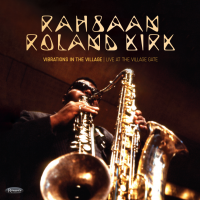
 Vibrations in the Village: Live at the Village Gate
Resonance Records
2025
The opening number at the Village Gate in November 1963 is a 12-bar blues in F major called "Jump Up and Down Fast." The child-like reference comes through in his opening solo on manzello, a soprano sax made by King and sold as a saxello. Kirk launches into a wonderfully bop-ish series of choruses that climaxes with quotes including "The Twilight Zone" and "Deck the Halls." Eventually he switches to tenor and begins circular breathing, using the soprano as a drone. During these sectional forays the music can take on a mystical quality. The tenor solo starts with multiphonic blasts before he takes off into a cascade of double-time passages. He's back on both horns for the punchy finale. There's a fine piano solo by Horace Parlan and a locked-in bass solo by Henry Grimes. Rahsaan re-enters to trade phrases with the drummer and ends the tune with his signature party horn... Wheee!
He slows things down with Charles Mingus' "Ecclusiastics." Opening with a perfect unison sax intro, he nails the composition, and Parlan's bluesy comping fits beautifully. Kirk sings a verse, and you immediately understand why Charles Mingus hired him for his Town Hall concert and other occasions.
The collection is punctuated by familiar jazz forms: blues, show tunes, and originals. "All the Things You Are" and "Falling in Love" are swinging tenor features with Rahsaan in fine form throughout. "Kirk's Delight" carries a similar buoyancy and expressive gush.
"Laura" is a flute feature, and Kirk brings all his great alternative techniques to this haunting ballad. The flute is a fragile instrument and can't be muscled like the saxophone, but in Rahsaan's hands it gains extra girth through his vocalizing and tonguing.
"Oboe Blues" is my least favorite piece in the collection, but it opens and closes with an incredible double-sax passage that's unfamiliar to my ears. Kirk is back on tenor for "Blues Minor at the Gate." We're treated to another powerful solo from Grimes and a brief duet between him and the leader. I didn't hear any stritch (a straight alto sax) solos on these tracks, but he adds it to the sax section on his popular closer "Three for the Festival."
 Rahsaan Roland Kirk
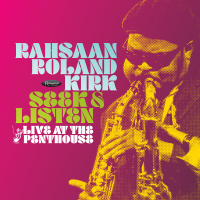
 Seek & Listen: Live At The Penthouse
Resonance Records
2025
The 1967 Penthouse sets are closer to the vibrant live recordings I came to know, like Bright Moments (Atlantic, 1973) and Volunteered Slavery, featuring Kirk's working band of pianist Rahn Burton, bassist Steve Novosel, and drummer Jimmy Hopps.
"The Jump Thing," a short opener that is incomplete, is followed by a lovely version of Burt Bacharach's "Alfie." On his take on Charlie Parker's "Confirmation," reconstructed as "Mingus-Griff Song," Kirk trades choruses—and eventually phrases—with himself, seamlessly switching between tenor and manzello.
Kirk loved medleys, and at the Penthouse he performs one combining "Ev'ry Time We Say Goodbye" with Duke Ellington's "I Got It Bad," "Sophisticated Lady," and "Satin Doll." The flute is at the heart of this excursion, but halfway through we finally hear him on the stritch. He is back on all three saxophones for "Satin Doll," blowing the roof off the joint.
Mid-decade, Kirk began covering pop tunes, so I was delighted to hear his version of "Ode to Billie Joe." It's an exciting take—unfortunately the only one marred by tape distortion. Returning to Ellington, we get another superb tenor/manzello exchange on "Prelude to a Kiss."
On "Funk Underneath," Kirk gets down and dirty on the flute, unleashing incredible passages including nonsensical scat vocals. The nose flute once again proves a crowd pleaser, as does "Down by the Riverside," a rollicking nod to New Orleans. "Lovelleveliloqui" and "Please Don't Cry Beautiful Edith" are both Kirk originals, and on both he sounds equally at home on the lesser-known stritch.
All these sets reveal Rahsaan's boundless spirit. When we think about the budding avant-garde of the '60s jazz scene, it might seem like prime territory for an outsider like Kirk. Where fury and self-expression rose through a cacophonous freedom that often dissuaded listeners, Kirk was more interested in bringing people together.
Rahsaan deserved even greater popularity during his lifetime, but it's comforting to know that in the '70s he was invited to play the Fillmore and open for rock bands. Quincy Jones featured him on several recordings, including his iconic Big Band Bossa Nova (Mercury Records, 1962).
Despite a debilitating stroke in 1975, Kirk kept playing—with only one arm. After hearing this music, I don't think Rahsaan could exist without making it. It's as if every cell in his body was involved in the process.
Bright Moments!
Tracks and Personnel
Vibrations in the Village: Live at the Village GateTracks: Jump Up and Down-Fast; Ecclusiastics; All the Things You Are; Laura; Kirk's Delight; Oboe Blues; Blues Minor at the Gate; Falling in Love with Love; Three for the Festival.
Personnel: Rahsaan Roland Kirk: saxophone (tenor), stritch, manzello, oboe, flute, vocals, whistle, percussion; Horace Parlan: piano; Melvin Rhyne: piano; Jane Getz: piano; Henry Grimes: bass; Sonny Brown: drums.
Seek and Listen: Live at the Penthouse 1967
Tracks: Disc 1: The Jump Thing; Alfie; Mingus—Griff Song; Medley Ev'ry Time We Say Goodbye; I've Got It Bad (and That Ain't Good); Sophisticated Lady; Satin Doll; Medley: Blues For C&T; Happy Days Are Here Again; Down by The Riverside. Disc 2: Ode to Billie Joe; Prelude to a Kiss; Funk Underneath; Now Please Don't You Cry, Beautiful Edith; Making Love After Hours.
Personnel: Rahsaan Roland Kirk: saxophone (tenor), stritch, manzello, flute, vocals, whistle, percussion; Rahn Burton: piano; Steve Novosel: bass; Jimmy Hopps: drums.
About Rahsaan Roland Kirk

Tags
PREVIOUS / NEXT

Become a Sustaining Member

Since 1995, All About Jazz has championed jazz as an art form and supported the musicians who create it. Over three decades, it has grown into one of the world's leading jazz resources, serving hundreds of thousands of readers, musicians, presenters and industry professionals each month.
Help Build the Future of All About Jazz
Your support helps us continue building All About Jazz for the next generation—expanding our editorial coverage, preserving jazz history, developing new community features and creating better ways to discover the music and the people behind it.
Become a sustaining member for as little as $20 per year and you'll immediately enjoy an ad-free experience along with access to subscriber features and future articles for a full year.
Together, we're not simply sustaining All About Jazz—we're building its future. Thank you for being part of the journey.