Home » Search Center » Results: piano
Results for "piano"
About Steve Kuhn
Results for pages tagged "piano"...
Steve Kuhn
Born:
Over a career of a half-century and counting, Steve Kuhn has earned renown as one of the most lyrical and affecting pianists in jazz, with an unfailingly beautiful touch and a sophisticated sense of swing. “Steve is an original stylist,” points out Dan Morgenstern, director of the Institute of Jazz Studies at Rutgers. “He’s one of the finest pianists out there today.” Jazziz magazine described Kuhn’s distinctive sound: “Few other pianists, regardless of genre, can tease such an evocative range of timbres from their instrument. Kuhn’s lower register is as dark and rich as Belgian chocolate, and his upper register has the light, translucent quality of ice-cold champagne.”
About Joachim Kühn
Results for pages tagged "piano"...
Joachim Kühn

Born:
His playing defies all categorization, and has earned him a place as a world class musician. He hasalready left his mark on contemporary jazz and given it new direction. The musical cosmopolitanJoachim Kühn sees himself as part of the jazz tradition, connected to European concert music and yetdirectly indebted to a contemporary musical language.
He displays vehemence and sensibility, a virtuoso technique and imagination and an unfailing sense ofdynamics. Be it in his interaction with long-time musical partners, in ever new and challenging musicalconstellations, or alone in his solo performances, Kühn always manages to make his concerts into aunique experience.
About Diana Krall
Results for pages tagged "piano"...
Diana Krall

Born:
It had only been a few days since singer and pianist Diana Krall publicly announced that she and husband Elvis Costello were expecting their first child. Her remarks may have primarily focused on her upcoming album, but it was easy to discern the rosy glow as she discussed imminent arrivals, and how she came up with the name for one of them. “I already knew before we went into the studio the title of the record. I definitely knew it was going to be From This Moment On.” Cole Porter’s romantic ode to great expectations (with its hip, heartening couplet, “No more blue songs/Only whoop-dee-doo songs”) could not be more apt a title track for Krall’s tenth album
About Jancy Korossy
Results for pages tagged "piano"...
Jancy Korossy

Born:
American jazz pianist, arranger and composer born in Romania. Korossy is the first who combined the Romanian folklore music with American jazz rhythms ,and the creator of the "free style" in Romanian jazz, but he is also the one who arranged in jazz and performed worldwide "The Rhapsody no.1" written by great George Enescu. Jancy Korossy it was considered "the most authentic jazz pianist in Europe" (according to famous jazz promoter Willis Connover), and is up until nowadays considered and undeniable as the most valuable and unrivaled jazz musician coming from Romania. 2006 - Awarded with the highest distinction, as a "Comandor" by the President of Romania, as a recognition for the special achievements in promoting the Romanian culture abroad, and the unique developments of folclorique music in jazz. 2002 - Awarded with the prize of "The most valuable musician from diaspora", by the National Radio of Romania. 1975 - Awarded by President Jimmy Carter, with the distinction as a "Lieutenant Governor's award of Excellence" for extraordinary cultural merit in jazz music. Jancy Korossy performed and recorded with artists like: Milt Jackson, Woody Herman, Phil Woods, Percy Heath, Ray Brown, Zoot Sims, Lee Konitz, James Martin, Connie Kay and many others...
About Krzysztof Komeda
Results for pages tagged "piano"...
Krzysztof Komeda

Born:
Christopher Komeda's big time began back at the time of the I Sopot Jazz Festival in August 1956, but his ties with music were much older. Born in Poznan in 1931 he took piano lessons since his childhood and his first dreams were to be a famous virtuoso. They were no daydreams for at the age of eight he started at the Poznan conservatory. But the war upset his plans. During the war and later, until 1950 he continued to study the piano and theory but he was aware the six years were actually lost. Having graduated from secondary school he had to make up his mind as to his further studies. He wanted to have an exciting job and so he became an M
About Kenny Kirkland
Results for pages tagged "piano"...
Kenny Kirkland

Born:
Beginning his career as a teacher of classical music, Kenny Kirkland next became a jazz musician. Later he emerged from his jazz chrysalis as a practitioner of exotic pop/rock music and finally shed his wings to follow the mundane but financially more stable profession of studio musician. Kirkland was an associate of Wynton Marsalis, it is not surprising therefore that the five years Kirkland spent working for him (1981-85) should have been such a powerful influence on him. He was born Kenneth David Kirkland in Brooklyn, New York, on 28 September, 1955, and took up piano at the age of six. The enthusiasm and urgency Kirkland applied to his piano lessons at such an early age, confirmed that his life was to be devoted to music, "although it wasn't until I was 13 that it actually caught on for me," he remembered
About Frank Kimbrough
Results for pages tagged "piano"...
Frank Kimbrough

Born:
North-American jazz pianist, composer and educator Frank Kimbrough was born November 2, 1956 in Roxboro, North Carolina and has been playing piano since before he can remember, and received influential piano instruction from an early age. His foundation in classical music studies grounded him in strong technique and profoundly influenced his open musical tastes. After leaving college, he formed his first trio and set out in pursuit of real world musical opportunities, first in Chapel Hill, and then in Washington, D.C. In Washington he met Shirley Horn, who became an enthusiastic supporter and mentor
About David Kikoski
Results for pages tagged "piano"...
David Kikoski

Born:
At a time when jazz has been to the reaches of the musical universe and back, some would say that it's all been played before and we're currently at a point in the cyclical nature of this artform when those lesser talents are merely rewriting the past. This is why innovation and individualism are so rare these days and why David Kikoski stands apart from the scores of pianists/keyboardists as well as composers.
Born in 1961 in Milltown, N.J., Dave was part of a musical family and given his first piano lessons at the age of six by his father.In his early teens he began working with jazz and rock groups and won "The New Jersey Allstate Jazz Competition". After high school, Kikoski would head to the prestigious Berklee College of Music in Boston where he earned a bachelor's degree in piano. While in Boston he had a steady trio gig and met Pat Matheny who sat in with Dave's trio. Later( in 1994) they would meet up again and record together on Roy Haynes' cd "Te-Vou" which also featured Christian McBride and Donald Harrison.
About Masabumi Kikuchi
Results for pages tagged "piano"...
Masabumi Kikuchi

Born:
Masabumi "Poo" Kikuchi was a Japanese jazz pianist of legendary stature with a vast discography that ran the gamut from straight-up post-bop and vanguard classical to fusion recordings, solo synthesizer dates, and even digital dub. He toured and recorded with artists as diverse as Sonny Rollins, Lionel Hampton, Terumasa Hino, Sadao Watanabe, and drummer Paul Motian, among others. Kikuchi was born in Tokyo in October of 1939. He studied music at the Tokyo Art College High School and, upon graduating, immediately formed his own trio. Soon after, he won a spot in Hampton's Japanese touring band
About Stan Kenton
Results for pages tagged "piano"...
Stan Kenton

Born:
Stanley Newcomb Kenton (December 15, 1911 - August 25, 1979) led a highly innovative, influential, and often controversial American jazz orchestra. In later years he was widely active as an educator. Stan Kenton was born in Wichita, Kansas, and raised first in Colorado and then in California. He learned piano as a child, and while still a teenager toured with various bands. In June 1941 he formed his own band, which developed into one of the best-known West Coast ensembles of the Forties. Kenton's musical aggregations were decidedly “orchestras.” Sometimes consisting of two dozen or more musicians at once, they produced an unmistakable Kenton sound--as recognizable as that of the bands of Glenn Miller, Duke Ellington, or Count Basie
Trending
 In Tribute To...
Points of View: Celebrating Dave Holland
 Interview
Boney James: A Simple Man And A Lifetime Study
 Interview
Miles Okazaki's Monkathon: The Complete Thelonious...
 Musician 2 Musician
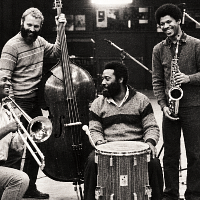
Steve Coleman on Dave Holland
 Live Review
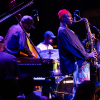
Isaiah Collier Plays Coltrane: Live at Jazz Alley in Seattle
 Reanimating Conversations Past
John Scofield: Meant To Be
 Groove Orbit
A Time Capsule in Sound: Jim Pugh’s New American...
VOTE!