Home » Search Center » Results: Building a Jazz Library
Results for "Building a Jazz Library"
Jazz Masterpieces: 1956-1965

by AAJ Staff
There are times when you have to hold back and let certain music speak for itself. This list of jazz masterpieces is exactly that kind of music. By definition, these records are without flaw. (Okay, so humans are inherently flawed, but you'll have to get out a microscope to find anything that falls short here.)
Pat Metheny: Quantum Musician

by Nathan Holaway
If Pat Metheny never plays another single note, he would have already lived a “bright size life." Pat Metheny was born in Lee's Summit, MO in 1954 and first picked up his guitar at the age of twelve. By age fifteen, he was already playing with the top jazz musicians in town. In 1974, ...
Classic Bebop
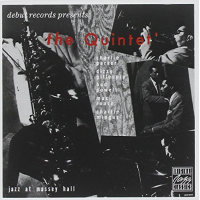
by Chris M. Slawecki
Bebop played the same part in the history of jazz that rock & roll played in the history of pop: Seemingly equal parts genius, accident, hard work, and willful rebellion, it was born of its turbulent times and forever changed the course of music. Bebop is the sharp dividing line between swing and modern ...
Jazz With Strings

by Roger Crane
Please note the title of this collection. It does not include symphony orchestras playing jazz compositions. Nor does it feature what is known as “third stream" music, which is the combination of jazz and classical elements for what is hoped to be a unified whole. No, just like the title says, this collection includes jazz musicians ...
Tomasz Stanko

by Budd Kopman
Trumpeter and composer Tomasz Stanko (b. 1942 Rzeszow, Poland) was present at the birth of modern European jazz. He's most closely associated with the man who was at the center of seemingly all art forms in Poland in the late 1950s and early 1960s, Krzysztof Komeda. Although his early work has been described, even by himself, ...
Drum-n-Bass

by AAJ Staff
Electronica stands alone among modern music styles as a byproduct of both audience appeal and technological progress. Once techno had caught on and the underground scene was well-established, DJ's began experimenting more creatively with programming the beats themselves. In the clubs and in the studio (mostly in England), drum-and-bass (d-n-b) was born. (Note: you'll hear “jungle" ...
Blues

by Ed Kopp
The blues is the progenitor of most popular music in America, but it hasn't always gotten the respect it deserves. The recorded history of the blues proves the point. Prior to World War II, very few white people had ever heard any authentic blues music. Up until the late 1950s, blues labels could only afford to ...
Post-Bop Records of the Modern Era
by AAJ Staff
With the arrival of Wynton Marsalis on the scene in 1979 was the beginning of a renaissance on the jazz scene that was to involve a reappraisal of the acoustic jazz tradition that had been left stranded with few exceptions in the late '60s and '70s, when fusion and the avant-garde held sway.From 1980 ...
Gene Harris

by C. Michael Bailey
Gene Harris (1933-2000) can safely be termed the most serious populist jazz musician to perform in the last 50 years. He is among the most accessible and amiable of jazz pianists, who focused his superior command of the blues and ballads to produce some of the most enduring and enlightening jazz music ever. For these reasons, ...
Free Improvisation

by John Eyles
In Britain, in the mid-60s, free improvisation (often just called “improv") developed out of free jazz, eventually becoming a separate and distinct music. Free jazz gradually removed conventional structure -chords, melodic themes, regular rhythm--but free improvisation took their absence as its starting point. Essentially, free improvisation has no rules; in Derek Bailey's words, it is “playing ...
Album Showcase




Trending
 Interview
Lou Marini: A Solo Career Starting At The Age Of 80
 History of Jazz
John Coltrane in Detroit: A Brief History
 Live Review
Detroit Jazz Festival 2026: A Gathering in a Great Jazz City
 Live Review
The Tension Is Where the Music Lives: Miles Davis at 100,...
 Radio & Podcasts
Sullivan Fortner, Jim Rotondi & Dena DeRose, Ardeshir,...
 Reanimating Conversations Past
Charlie Haden: Anatomy of a Jazz Classic
 Profile
The Discreet Charm of Tete Montoliu
Featured Video
VOTE!