Home » Jazz Articles » Live Review » Orlando Molina At Scott's Jazz Club
Orlando Molina At Scott's Jazz Club
There is something of a filmmaker’s meticulous attention to detail accorded each frame—and to the flow of frames—in the way Molina tells his story via music.
One of the great things about Scott's Jazz Club is that musicians are often invited back. You get to see the first steps and evolution of a band or a leader new to the scene. You experience the growth and development of established acts, and you witness the different skins that many hard-gigging musicians inhabit.
Venezuelan Chilean guitarist Orlando Molina first played the Ballyhackamore venue in March 2024, a performance broadcast on BBC Radio in July that year. Since then, he released his debut album, Autorretrato en Tres Colores (Self Produced, 2025) to uniformly positive reviews. It bagged a Grammy nomination for Best Latin Jazz Album of the year. Nada mal, hombre.
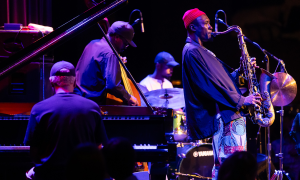
For this official album launch gig Molina was backed by core collaborators Scott Flanigan (piano), Cormac O'Brien (double bass), Matthew Jacobson (drums) and Steve Welsh (saxophones). Molina had every reason to feel confident presenting music that had been well road tested—and enthusiastically received—in the previous year. And so it proved. This was the assured performance of an artist going places.
Though a consummate guitarist, for Molina the composition is the thing. Mood, texture and unfolding musical arc tend to trump personal bravura. On set opener "Paciencia," the leader's unhurried solo on nylon string guitar—where every refined note counted—set the tone. Dublin-based New York City saxophonist Welsh leaned into his solo with gusto, but these fine solos aside, the takeaway was the contrast between bright melodic lines and the darker hues of Flanigan's minor-key shading.
It is sobering to think that around 10 million Venezuelans have left the country since 2014. Molina's debut album charts his own migration from Venezuela to Ireland, tracing the emotions that accompanied the upheaval; loss, trepidation, hope and resolution are all subtly conveyed within his artfully wrought compositions. There is something of the filmmaker's meticulous attention to detail accorded each frame—and to the flow of frames—in the way Molina tells his story via music.
Yet for all Molina's compositional sophistication there was still blood and thunder in the exchanges between Flanigan and Jacobson on "Desde Muy Temprano." Freedom too, in Welsh's burrowing Afro-Caribbean solo on tenor saxophone—and in the leader's response. From quasi-baroque linearity and the razor-sharp clarity of composed lines to broiling free-form expression, the shifts in perspective were striking.
In O'Brien and Jacobson, Molina boasts two of Ireland's keenest purveyors of rhythm. O'Brien may have stood unobtrusively at the back of the stage, but his swinging bass grooves and sure pulses were a constant reference point as tempi evolved. Jacobson exhibited painterly finesse with brushes and mallets during the music's quieter passages, transitioning via sticks to coalface industry of compelling choreography whenever the siren called.
The Latin Jazz Grammy may have eluded Molina, for now, but there were clearly no hard feelings as the quintet closed out the first set with "Afro Choro" by the 2025 winner, Hamilton de Holanda. Jacobson's carnivalesque Brazilian rhythms on brooms and then sticks drove the quintet's motion, his energy underpinning expansive solos from Welsh, Flanigan and Molina. The common denominator in their soloing was a joyous inflection.
Back-to-back ballads kicked off the second set. The magic-realism genre associated with Colombian author Gabriel Garcia Márquez inspired "Mi Realismo Mágico." On this deftly rendered rumination, O'Brien's innate lyricism was beautifully framed in a solo spot. On his black Gibson 335, Molina picked up the bassist's thread with a sparkling improvisation—spare yet emotive. Of even greater allure was "De lo vivido a lo vivo," with Molina's yearning improvisation the heart and soul of an affecting tune.
Strong motivic character leapt from Molina's compositions. This was especially true of the luminous final number, "Una Vida, Many Lives," where guitar and tenor saxophone combined on the uplifting head. Over O'Brien's insistent groove and Jacobson's bustle, Welsh soloed with the swing of a Sonny Rollins' calypso and the imploring cry of John Coltrane. Another animated Flanigan solo—all vampy figures and tumbling glissandi—fueled Jacobson's fire. Then, with his most effervescent and free-flowing electric playing of the evening, Molina led the quintet home in a rousing finale.
Molina has already lived a rich and varied musical life, but Autorretrato en Très Colores represents the first fruits of his Irish/European odyssey. Hopefully, he will continue to work with this intuitive group of musicians as he moves forward. Scott's Jazz Club will be waiting with open arms for his next musical portrait.
 FOLLOW Ian Patterson
and get notified whenever a new article published.
FOLLOW Ian Patterson
and get notified whenever a new article published.
Ian is dedicated to the promotion of jazz and all creative music all over the world, and to catching just a little piece of it for himself.
About Orlando Molina

Tags
PREVIOUS / NEXT

Become a Sustaining Member

Since 1995, All About Jazz has championed jazz as an art form and supported the musicians who create it. Over three decades, it has grown into one of the world's leading jazz resources, serving hundreds of thousands of readers, musicians, presenters and industry professionals each month.
Help Build the Future of All About Jazz
Your support helps us continue building All About Jazz for the next generation—expanding our editorial coverage, preserving jazz history, developing new community features and creating better ways to discover the music and the people behind it.
Become a sustaining member for as little as $20 per year and you'll immediately enjoy an ad-free experience along with access to subscriber features and future articles for a full year.
Together, we're not simply sustaining All About Jazz—we're building its future. Thank you for being part of the journey.