Nicole Zuraitis & Dan Pugach: When Jazz Is Like Love
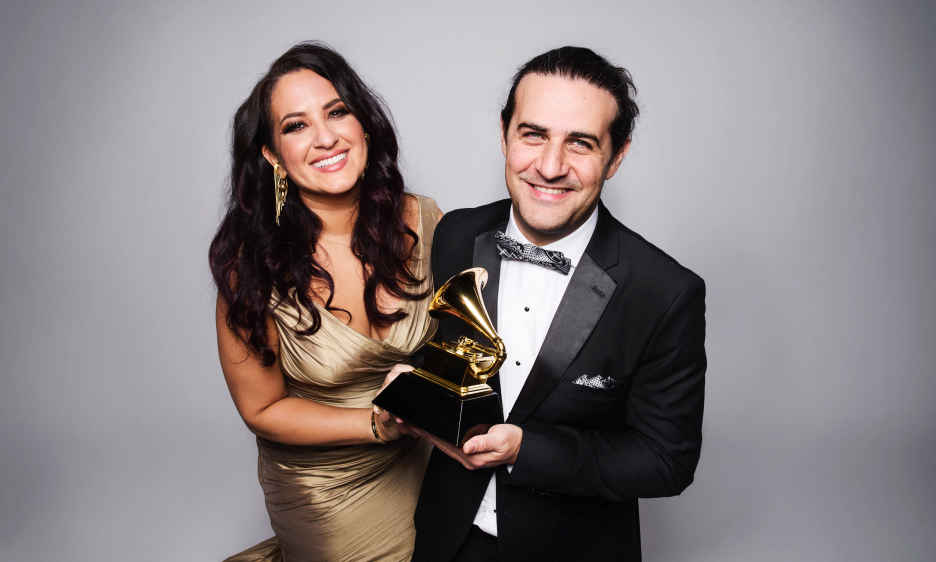
Courtesy Ronkin

I’ve never doubted that good music—only truly good music—makes us a little better, quietly cleansing something inside us in a mysterious way. And not only music: love, too—our changeable majesty by the name of love, which, as a poet once said, is often right. Love—for all living things, for nature, for people, and, of course, for each other.
—Gregory Golub
I first hear Nicole Zuraitis dabout three years ago and I was immediately drawn in by the power and charm of her voice. The richness of overtones in her timbre quite literally caresses the ear—even an experienced listener like me—a jazz musician and composer with a few decades in music. This was before her ascent into what you might call the “Olympus” of American music—even though the nominations were already there. You could still clearly feel that she was searching for her own artistic self.
And then—her first truly “star” album, How Love Begins, became the Best Jazz Vocal Album of the Year in 2024. On that record, most of the songs—and the lyrics—belonged to Nicole herself. It was a bold, confident statement: not only as a performer, but as a songwriter. This time, it delivered.
Now, after hearing her live at the Red Sea Jazz Festival and seeing her in person, close up, I’m only more convinced: Nicole is deeply emotional and open, finely attuned to the band, and genuinely enjoying the interplay—both with the musicians and the audience. She truly belongs on stage. And beyond all that, she’s warm, vivid, with infectious energy—she really lit up that jam session in Eilat. And since they often tour in a smaller-group format, it’s worth noting that she doubles as her own pianist, accompanying herself on piano or keyboards. These days, though, she may be carrying a heavy load—one that’s also a happy one in its own way: endless work, nonstop touring, and the sheer amount of attention that inevitably comes with recognition and public visibility—and that isn’t easy. On top of that, with the Grammy ceremony coming up on February 1, mounting anticipation surrounds two new nominations: Best Jazz Performance (All Stars Lead To You, Live) and Best Jazz Vocal Album (Live at Vic’s Las Vegas).
It so happened that Dan Pugach and I met at the airport, on the way to the Red Sea Jazz Festival—held in Eilat, Israel, for the 39th time.
I’ll admit it: I’ve always loved a big band when it really sounds right. So, there I was at the festival concert—Dan Pugach Big Band—which, alongside Nicole Zuraitis, became the festival’s undisputed breakthrough. I was among the first to enter the vast open-air arena at the Eilat port—an impressive space framed by towering cargo containers. Later on, I found myself noting just how superb the sound and balance were. Then I saw the orchestra. Dan, seated at his kit just to the left of center stage, was angled toward the band far more than toward the audience—which struck me as a little odd at first. The band started playing. And then some. And more. And more.
Real groove, real drive—everything was in place. At first, I didn’t quite get why the drums were pushed forward in the mix. But very soon, it all made sense. Dan was the “pulsating nerve” of the whole orchestra—leading it rhythmically and emotionally—and he pulled it off.
In the interview, I asked Dan what groove means to him—how he understands it—because during the concert I had an almost physical sensation: it felt as if the orchestra was breathing, not metaphorically but literally, as one living organism. I even told him that right after the set. Achieving that level of cohesive ensemble sound is the ultimate goal for any bandleader—and Dan Pugach clearly achieved it. His well-deserved 2025 Grammy win for Best Large Jazz Ensemble Album only underscores that.
Let’s be honest, presenting your own original music always takes courage. I’ve done it many times myself—though I performed solo. This time, it was an entire big band.
And now, speaking as one musician to two others, I had a purely friendly conversation with Nicole and Dan—about jazz first and foremost, but also about so many other things: what was, what is, and what’s still to come.
Gregory Golub: What led you to jazz rather than any other genre?
Nicole Zuraitis: I grew up loving singer-songwriters, musical theater, classical piano — all of it — but jazz was the one place where I felt like I could be fully myself — a strange little musical nerd who was into mixed meters and complex harmonies, but also big voices and storytelling. It gave me room to be emotional, to improvise, to take risks, to fail and try again. It’s the only genre I found where you can blend everything you love — harmony, storytelling, groove, vulnerability — and still have it feel authentic. And even though it isn’t the “mainstream choice,” I never cared about that because I always marched to the beat of my own drum.
GG: How do you feel about using the voice as an instrument?
NZ: I love it—as long as it’s in service of the story. The voice is an instrument, but it’s also one of the most emotional tools we have. So, when I use it texturally—to blend with horns, to add rhythmic layers, or to improvise—I always want it to feel intentional, not just flashy. The goal is connection, not gymnastics. Blending with the orchestra feels like being a single fish in a gigantic school—it’s exhilarating.
GG: How important is improvisation today for a jazz singer?
NZ: Improvisation is one of the important tools in the language of jazz. For singers, maybe it’s less about scatting like Ella Fitzgerald and Betty Carter and Mel Torme—because honestly, no one will ever touch what they did — and more about being willing to be present, responsive, and a little fearless. Improvisation can be phrasing, harmony choices, interaction with the band… it doesn’t have to be eight bars of bebop syllables. It’s about being alive in the moment, and oftentimes I improvise using lyrics.
GG: What is the “peak” for a jazz singer? And how does someone find their voice as both a singer and songwriter?
NZ: I don’t know if there’s a single “peak.” For me, achievement is making work that feels honest and finding listeners who connect with it. Of course, the Grammys matter, and I’m grateful — but the real milestone is when you stop trying to imitate your heroes and start sounding like yourself. Songwriting has helped me do that. When you write your own material, your voice naturally shifts toward what feels true. That’s the compass.
Gregory Golub: Why the drums and a big band, Dan? Why not something like blues, techno, rock, pop, or rap? I’d love to know what drew you to this particular genre and instrument.
Dan Pugach: My older brother, Gadi, had a broken, beat-up drum set with holes in the drumheads and stuff missing — or not working properly. My brother is a violinist but could play some drums, and he held my hands when I was maybe eight years old, and I picked it up from there, wanting a real drum set for myself. I enjoyed playing beats, and something about the coordination and the feeling around a drum set always felt natural to me. Everyone should have a drum set.
I started playing in rock bands when I was coming up in school and was listening to whatever was around me: classical music and Jacques Brel in the living room; Metallica and the Beastie Boys in my brother’s room; and Kraftwerk and Michael Jackson in my own room. I was slowly introduced to jazz, and by high school I was playing in jazz ensembles—and later in professional big bands.
I had cassettes of Gene Krupa and Shelly Manne & His Men, and my first big band CD was Burning for Buddy, a tribute to Buddy Rich and his big band by top drummers from different genres. Since then, I’ve dug deep into the Thad Jones/Mel Lewis Jazz Orchestra, Count Basie, Duke Ellington, and Gil Evans — and then got hip to Kenny Wheeler, Alan Ferber, Maria Schneider, etc., which made me want to experiment with composition and arranging.
GG: I’ve always loved the sound of a truly great big band — and your band carries that same spirit. Still, many people say the big-band era is long gone. What makes a big band ideal for you? And how do you see big-band music fitting into the broader palette of modern jazz today?
DP: I have been writing for a nine-piece ensemble since 2010 and have been trying to get that big band sound in a small setting. But only after writing for a full 17-piece big band, I felt I had all the sound possibilities at my disposal. I feel like writing for a full big band made my writing for smaller ensembles better.
I see today’s big band as a vehicle for living composers, arrangers, and really any type of working musicians for self-expression and experimenting with rich, large-scale musical works. I feel like the big band is an essential representation of the sound and depth of jazz and, done right, it is no less effective in shaping an improvised solo than a quartet setting, for example.
The big band is a standardized way of sounding a jazz composition, and the sound possibilities are still out there to be explored.
GG: How do you personally define that rhythmic feel we call “groove” in the jazz vocabulary?
DP: I think “groove” and “pocket” mainly mean focus. It’s playing that feels good and relaxed — not forced, not distracted, and not distracting. It’s focusing on the long game and not reacting to everything that happens in the music. It is like providing a solid ground for the music to cruise on top of.
GG: What excites you most in the creative process — and what do you find most challenging about it?
NZ: I live for the creative spark — that moment when an idea hits, or a lyric lands, or the band locks into something unexpected. Collaboration is my happy place.
The hard part is the logistics: emails, contracts, budgets, coordinating schedules… and sometimes the emotional toll of perfectionism. Creativity is pure magic; the business around it is… necessary.
It’s also difficult to navigate this space as a woman who didn’t come up through the jazz educational system. I learned by listening and didn’t go to jazz school. Honestly, I’m grateful for that because I have a unique voice not shaped by what someone else decided was “right.”
DP: The creative process can feel great when you are in a flow and the music writes itself, or when you hear a piece of music you had written for the first time, and it slaps! The rest of it is pretty lonely to be honest. It’s mostly living up in your own head and beating yourself up for not writing or not doing enough. That’s part of the self-employed syndrome but without a deadline it’s hard to just sit down and get creative so having those is really helpful whether it’s a gig, a reading, a rehearsal, a commission, grant or anything that can be added to the calendar. What I do is I go for walks or drive, and that’s when my ideas come to me. I also try to play drums in the house every day, and it helps clear my head.
GG: What do you remember most from your performance in Eilat at the Red Sea Jazz Festival — any moments that really stayed with you?
NZ: Eilat was unforgettable. The energy of that festival is unlike anywhere else — warm, alive, and so special to return after two long years to see family and friends. I remember looking out at the Red Sea with my band, feeling this mix of gratitude and disbelief that music brought us all the way there. And the crowd! They were so present and generous. It’s one of those gigs that stays with you. And the students who attended — I saw myself in them, and so did Dan. It was a full-circle moment.
DP: Eilat was incredible. It was a huge milestone for me to play the Red Sea Jazz Festival. Since I was young, I went to the festival and saw international jazz legends, so it was such a huge honor for me to bring my big band and play original music. I flew Nicole and nine members of the NYC big band and teamed up with seven local Israeli musicians, and with one quick soundcheck and rehearsal at 9am the morning of the show, we pulled it off and I couldn’t be happier.
The vibe was great; everyone learned the music and appreciated the challenges, and we all had a blast playing together. I felt very connected to the audience — it was the first time I got to present the big band while speaking in Hebrew, and I felt relaxed and at home. The audience participated, and even one young man asked what time signature one of the pieces was in. It was a special concert I’ll never forget, also because my family and friends were there and I got to hang with local musicians I haven’t seen since I moved to the States.
A few names stayed with me after that night: Mike Fahie on trombone (it turned out we’re Facebook friends), Pete McCann on guitar, and Uri Gurvich on saxophone—though to be fair, the whole band was excellent.
GG: What would you still like to try in life — something you haven’t done yet?
NZ: I’d love to learn how to be a wildlife rehabber and also have a small dog rescue outside of our activism efforts.
Maybe live abroad for a bit, or learn Italian properly, or take time to slow down and cook for people I love. Passive income would also be nice ha-ha.
DP: I am just at the beginning of my career, so there is more music to write and play. I’d like to write for different ensembles down the road, like a symphony orchestra and chamber ensembles, but I’m busy enough and happy with big band for now. I also am an espresso nerd and make my own cappuccino and caffe latte drinks at home, and I’ve always wondered if I’d ever retire from touring and open a little espresso bar somewhere.
Next time I’m in New York, I’m going to show up for that coffee—“Pugachino—you promised!” I saw the video on Facebook; your coffee magic is seriously cool.
GG: What do the next 3–5 years look like? What good things do you expect, in music and beyond?
NZ: The next few years feel big. I’m releasing my conceptual album The Devil I Knew — probably the most personal and layered thing I’ve ever made. Dan and I will keep touring, building our projects, and expanding our audiences globally. My modern songbook is being assembled and I expect more storytelling, more collaboration, more advocacy work, and honestly… more joy. I’m finally learning how to balance ambition with a little grace.
I have a soft spot for anything conceptual (G.G. Music Concept, after all). But jokes aside—I’ll be looking forward to hearing your upcoming album. This thoughtful answer leaves a subtle aftertaste of refinement and elegance—another weakness of mine.
DP: Personally, I’m really hoping to play this and other music I write all over the world. I have been getting calls from established jazz orchestras in the States and in Europe to bring my music and be a featured guest, so that’s fun and easier than hauling my entire big band, which I happily do as well.
Between touring with Nicole’s quartet, filling in big band and nonet dates, and playing and recording in other projects, we both are pretty busy. This year we are nominated for two Grammy Awards in the Jazz Performance and Jazz Vocal Album categories, which is exciting and surprising, so we are grateful for the love and support and are hoping it would bring more work and opportunities.
GG: You’ve already made serious headway in exploring the world through your touring “geography”: you’ve crisscrossed Europe, covered substantial ground across your native U.S., and Australia clearly struck a chord with you. Most recently, you made it to Shanghai and Hong Kong, winning audiences over with your unique drive, charisma, and Nicole’s captivating voice. You’ve toured so much of the globe. What’s next—and what about Japan?
NZ: Japan is absolutely on my list — I’ve been dreaming of performing there for years. My music has found listeners there even without me touring, so I hope that’s a “soon” rather than a “someday.” I’d also love to play more festivals in South America and return to Australia. And selfishly, I want to bring Dan everywhere with me — the world tours are more fun when your favorite person is on stage next to you.
DP: I’ve been to Japan with my quartet in 2008 and loved it. We played the Newport Jazz Festival last year with Nicole’s band, and I’m hoping to bring my big band there soon.
Food for thought: I’m waiting for the day I catch you on MEZZO TV—they broadcast worldwide (including the U.S.) and often air live festival performances by top jazz artists. You should be there too.
As expected—but even more than I’d anticipated—they’re a strikingly vibrant musical partnership: two artists who each grow in their own way, climbing upward through a long chain of searching and mistakes, expectations and successes, driven by an inexhaustible hunger to create. And at the same time, they somehow keep finding the space to make projects together—projects that, more often than not, truly land.
Once, I had the good fortune to look Chick Corea in the eyes. You could see many things there, but most of all you could see this: not a trace of snobbery. In my view, a truly great musician simply shouldn’t be a snob. Thankfully, neither of you suffers from that.
I’ve never doubted that good music—only truly good music—makes us a little better, quietly cleansing something inside us in a mysterious way. And not only music: love, too—our changeable majesty by the name of love, which, as a poet once said, is often right. Love—for all living things, for nature, for people, and, of course, for each other.
I have a confession to make: I caught sight of it purely by accident—no, I didn’t “catch” it; I simply saw it from afar. We hadn’t even said hello yet, but there you were in the airport line, and Nicole gently touched Dan—and in that one small gesture, everything was already said.
You’re wonderful—and not at all because of any Grammys, though I’m sure there will be plenty more. At the same time, I understand perfectly well why those honors matter: they help you become festival headliners, fill halls worldwide, lead masterclasses, teach, mentor, be invited, be recognized—and so on. But most of all—you’re both the real deal.
Who knows—maybe with time, Nicole’s finest songs will enter the Great American Songbook, and Dan’s most successful compositions will become jazz standards. Of course, nobody can know that yet. But I sincerely wish it for you—and a win in both nominated categories; I’m keeping my fingers crossed.
Thank you, Nicole Zuraitis and Dan Pugach, for this half-interview, half-improvisation—our own kind of jam session.
To new jazz victories, guys—which means: back to work.
And as for me… it’s time, too.
~Gregory Golub, composer/pianist, jazz advocate
And then—her first truly “star” album, How Love Begins, became the Best Jazz Vocal Album of the Year in 2024. On that record, most of the songs—and the lyrics—belonged to Nicole herself. It was a bold, confident statement: not only as a performer, but as a songwriter. This time, it delivered.
Now, after hearing her live at the Red Sea Jazz Festival and seeing her in person, close up, I’m only more convinced: Nicole is deeply emotional and open, finely attuned to the band, and genuinely enjoying the interplay—both with the musicians and the audience. She truly belongs on stage. And beyond all that, she’s warm, vivid, with infectious energy—she really lit up that jam session in Eilat. And since they often tour in a smaller-group format, it’s worth noting that she doubles as her own pianist, accompanying herself on piano or keyboards. These days, though, she may be carrying a heavy load—one that’s also a happy one in its own way: endless work, nonstop touring, and the sheer amount of attention that inevitably comes with recognition and public visibility—and that isn’t easy. On top of that, with the Grammy ceremony coming up on February 1, mounting anticipation surrounds two new nominations: Best Jazz Performance (All Stars Lead To You, Live) and Best Jazz Vocal Album (Live at Vic’s Las Vegas).
It so happened that Dan Pugach and I met at the airport, on the way to the Red Sea Jazz Festival—held in Eilat, Israel, for the 39th time.
I’ll admit it: I’ve always loved a big band when it really sounds right. So, there I was at the festival concert—Dan Pugach Big Band—which, alongside Nicole Zuraitis, became the festival’s undisputed breakthrough. I was among the first to enter the vast open-air arena at the Eilat port—an impressive space framed by towering cargo containers. Later on, I found myself noting just how superb the sound and balance were. Then I saw the orchestra. Dan, seated at his kit just to the left of center stage, was angled toward the band far more than toward the audience—which struck me as a little odd at first. The band started playing. And then some. And more. And more.
Real groove, real drive—everything was in place. At first, I didn’t quite get why the drums were pushed forward in the mix. But very soon, it all made sense. Dan was the “pulsating nerve” of the whole orchestra—leading it rhythmically and emotionally—and he pulled it off.
In the interview, I asked Dan what groove means to him—how he understands it—because during the concert I had an almost physical sensation: it felt as if the orchestra was breathing, not metaphorically but literally, as one living organism. I even told him that right after the set. Achieving that level of cohesive ensemble sound is the ultimate goal for any bandleader—and Dan Pugach clearly achieved it. His well-deserved 2025 Grammy win for Best Large Jazz Ensemble Album only underscores that.
Let’s be honest, presenting your own original music always takes courage. I’ve done it many times myself—though I performed solo. This time, it was an entire big band.
And now, speaking as one musician to two others, I had a purely friendly conversation with Nicole and Dan—about jazz first and foremost, but also about so many other things: what was, what is, and what’s still to come.
Gregory Golub: What led you to jazz rather than any other genre?
Nicole Zuraitis: I grew up loving singer-songwriters, musical theater, classical piano — all of it — but jazz was the one place where I felt like I could be fully myself — a strange little musical nerd who was into mixed meters and complex harmonies, but also big voices and storytelling. It gave me room to be emotional, to improvise, to take risks, to fail and try again. It’s the only genre I found where you can blend everything you love — harmony, storytelling, groove, vulnerability — and still have it feel authentic. And even though it isn’t the “mainstream choice,” I never cared about that because I always marched to the beat of my own drum.
GG: How do you feel about using the voice as an instrument?
NZ: I love it—as long as it’s in service of the story. The voice is an instrument, but it’s also one of the most emotional tools we have. So, when I use it texturally—to blend with horns, to add rhythmic layers, or to improvise—I always want it to feel intentional, not just flashy. The goal is connection, not gymnastics. Blending with the orchestra feels like being a single fish in a gigantic school—it’s exhilarating.
GG: How important is improvisation today for a jazz singer?
NZ: Improvisation is one of the important tools in the language of jazz. For singers, maybe it’s less about scatting like Ella Fitzgerald and Betty Carter and Mel Torme—because honestly, no one will ever touch what they did — and more about being willing to be present, responsive, and a little fearless. Improvisation can be phrasing, harmony choices, interaction with the band… it doesn’t have to be eight bars of bebop syllables. It’s about being alive in the moment, and oftentimes I improvise using lyrics.
GG: What is the “peak” for a jazz singer? And how does someone find their voice as both a singer and songwriter?
NZ: I don’t know if there’s a single “peak.” For me, achievement is making work that feels honest and finding listeners who connect with it. Of course, the Grammys matter, and I’m grateful — but the real milestone is when you stop trying to imitate your heroes and start sounding like yourself. Songwriting has helped me do that. When you write your own material, your voice naturally shifts toward what feels true. That’s the compass.
Gregory Golub: Why the drums and a big band, Dan? Why not something like blues, techno, rock, pop, or rap? I’d love to know what drew you to this particular genre and instrument.
Dan Pugach: My older brother, Gadi, had a broken, beat-up drum set with holes in the drumheads and stuff missing — or not working properly. My brother is a violinist but could play some drums, and he held my hands when I was maybe eight years old, and I picked it up from there, wanting a real drum set for myself. I enjoyed playing beats, and something about the coordination and the feeling around a drum set always felt natural to me. Everyone should have a drum set.
I started playing in rock bands when I was coming up in school and was listening to whatever was around me: classical music and Jacques Brel in the living room; Metallica and the Beastie Boys in my brother’s room; and Kraftwerk and Michael Jackson in my own room. I was slowly introduced to jazz, and by high school I was playing in jazz ensembles—and later in professional big bands.
I had cassettes of Gene Krupa and Shelly Manne & His Men, and my first big band CD was Burning for Buddy, a tribute to Buddy Rich and his big band by top drummers from different genres. Since then, I’ve dug deep into the Thad Jones/Mel Lewis Jazz Orchestra, Count Basie, Duke Ellington, and Gil Evans — and then got hip to Kenny Wheeler, Alan Ferber, Maria Schneider, etc., which made me want to experiment with composition and arranging.
GG: I’ve always loved the sound of a truly great big band — and your band carries that same spirit. Still, many people say the big-band era is long gone. What makes a big band ideal for you? And how do you see big-band music fitting into the broader palette of modern jazz today?
DP: I have been writing for a nine-piece ensemble since 2010 and have been trying to get that big band sound in a small setting. But only after writing for a full 17-piece big band, I felt I had all the sound possibilities at my disposal. I feel like writing for a full big band made my writing for smaller ensembles better.
I see today’s big band as a vehicle for living composers, arrangers, and really any type of working musicians for self-expression and experimenting with rich, large-scale musical works. I feel like the big band is an essential representation of the sound and depth of jazz and, done right, it is no less effective in shaping an improvised solo than a quartet setting, for example.
The big band is a standardized way of sounding a jazz composition, and the sound possibilities are still out there to be explored.
GG: How do you personally define that rhythmic feel we call “groove” in the jazz vocabulary?
DP: I think “groove” and “pocket” mainly mean focus. It’s playing that feels good and relaxed — not forced, not distracted, and not distracting. It’s focusing on the long game and not reacting to everything that happens in the music. It is like providing a solid ground for the music to cruise on top of.
GG: What excites you most in the creative process — and what do you find most challenging about it?
NZ: I live for the creative spark — that moment when an idea hits, or a lyric lands, or the band locks into something unexpected. Collaboration is my happy place.
The hard part is the logistics: emails, contracts, budgets, coordinating schedules… and sometimes the emotional toll of perfectionism. Creativity is pure magic; the business around it is… necessary.
It’s also difficult to navigate this space as a woman who didn’t come up through the jazz educational system. I learned by listening and didn’t go to jazz school. Honestly, I’m grateful for that because I have a unique voice not shaped by what someone else decided was “right.”
DP: The creative process can feel great when you are in a flow and the music writes itself, or when you hear a piece of music you had written for the first time, and it slaps! The rest of it is pretty lonely to be honest. It’s mostly living up in your own head and beating yourself up for not writing or not doing enough. That’s part of the self-employed syndrome but without a deadline it’s hard to just sit down and get creative so having those is really helpful whether it’s a gig, a reading, a rehearsal, a commission, grant or anything that can be added to the calendar. What I do is I go for walks or drive, and that’s when my ideas come to me. I also try to play drums in the house every day, and it helps clear my head.
GG: What do you remember most from your performance in Eilat at the Red Sea Jazz Festival — any moments that really stayed with you?
NZ: Eilat was unforgettable. The energy of that festival is unlike anywhere else — warm, alive, and so special to return after two long years to see family and friends. I remember looking out at the Red Sea with my band, feeling this mix of gratitude and disbelief that music brought us all the way there. And the crowd! They were so present and generous. It’s one of those gigs that stays with you. And the students who attended — I saw myself in them, and so did Dan. It was a full-circle moment.
DP: Eilat was incredible. It was a huge milestone for me to play the Red Sea Jazz Festival. Since I was young, I went to the festival and saw international jazz legends, so it was such a huge honor for me to bring my big band and play original music. I flew Nicole and nine members of the NYC big band and teamed up with seven local Israeli musicians, and with one quick soundcheck and rehearsal at 9am the morning of the show, we pulled it off and I couldn’t be happier.
The vibe was great; everyone learned the music and appreciated the challenges, and we all had a blast playing together. I felt very connected to the audience — it was the first time I got to present the big band while speaking in Hebrew, and I felt relaxed and at home. The audience participated, and even one young man asked what time signature one of the pieces was in. It was a special concert I’ll never forget, also because my family and friends were there and I got to hang with local musicians I haven’t seen since I moved to the States.
A few names stayed with me after that night: Mike Fahie on trombone (it turned out we’re Facebook friends), Pete McCann on guitar, and Uri Gurvich on saxophone—though to be fair, the whole band was excellent.
GG: What would you still like to try in life — something you haven’t done yet?
NZ: I’d love to learn how to be a wildlife rehabber and also have a small dog rescue outside of our activism efforts.
Maybe live abroad for a bit, or learn Italian properly, or take time to slow down and cook for people I love. Passive income would also be nice ha-ha.
DP: I am just at the beginning of my career, so there is more music to write and play. I’d like to write for different ensembles down the road, like a symphony orchestra and chamber ensembles, but I’m busy enough and happy with big band for now. I also am an espresso nerd and make my own cappuccino and caffe latte drinks at home, and I’ve always wondered if I’d ever retire from touring and open a little espresso bar somewhere.
Next time I’m in New York, I’m going to show up for that coffee—“Pugachino—you promised!” I saw the video on Facebook; your coffee magic is seriously cool.
GG: What do the next 3–5 years look like? What good things do you expect, in music and beyond?
NZ: The next few years feel big. I’m releasing my conceptual album The Devil I Knew — probably the most personal and layered thing I’ve ever made. Dan and I will keep touring, building our projects, and expanding our audiences globally. My modern songbook is being assembled and I expect more storytelling, more collaboration, more advocacy work, and honestly… more joy. I’m finally learning how to balance ambition with a little grace.
I have a soft spot for anything conceptual (G.G. Music Concept, after all). But jokes aside—I’ll be looking forward to hearing your upcoming album. This thoughtful answer leaves a subtle aftertaste of refinement and elegance—another weakness of mine.
DP: Personally, I’m really hoping to play this and other music I write all over the world. I have been getting calls from established jazz orchestras in the States and in Europe to bring my music and be a featured guest, so that’s fun and easier than hauling my entire big band, which I happily do as well.
Between touring with Nicole’s quartet, filling in big band and nonet dates, and playing and recording in other projects, we both are pretty busy. This year we are nominated for two Grammy Awards in the Jazz Performance and Jazz Vocal Album categories, which is exciting and surprising, so we are grateful for the love and support and are hoping it would bring more work and opportunities.
GG: You’ve already made serious headway in exploring the world through your touring “geography”: you’ve crisscrossed Europe, covered substantial ground across your native U.S., and Australia clearly struck a chord with you. Most recently, you made it to Shanghai and Hong Kong, winning audiences over with your unique drive, charisma, and Nicole’s captivating voice. You’ve toured so much of the globe. What’s next—and what about Japan?
NZ: Japan is absolutely on my list — I’ve been dreaming of performing there for years. My music has found listeners there even without me touring, so I hope that’s a “soon” rather than a “someday.” I’d also love to play more festivals in South America and return to Australia. And selfishly, I want to bring Dan everywhere with me — the world tours are more fun when your favorite person is on stage next to you.
DP: I’ve been to Japan with my quartet in 2008 and loved it. We played the Newport Jazz Festival last year with Nicole’s band, and I’m hoping to bring my big band there soon.
Food for thought: I’m waiting for the day I catch you on MEZZO TV—they broadcast worldwide (including the U.S.) and often air live festival performances by top jazz artists. You should be there too.
As expected—but even more than I’d anticipated—they’re a strikingly vibrant musical partnership: two artists who each grow in their own way, climbing upward through a long chain of searching and mistakes, expectations and successes, driven by an inexhaustible hunger to create. And at the same time, they somehow keep finding the space to make projects together—projects that, more often than not, truly land.
Once, I had the good fortune to look Chick Corea in the eyes. You could see many things there, but most of all you could see this: not a trace of snobbery. In my view, a truly great musician simply shouldn’t be a snob. Thankfully, neither of you suffers from that.
I’ve never doubted that good music—only truly good music—makes us a little better, quietly cleansing something inside us in a mysterious way. And not only music: love, too—our changeable majesty by the name of love, which, as a poet once said, is often right. Love—for all living things, for nature, for people, and, of course, for each other.
I have a confession to make: I caught sight of it purely by accident—no, I didn’t “catch” it; I simply saw it from afar. We hadn’t even said hello yet, but there you were in the airport line, and Nicole gently touched Dan—and in that one small gesture, everything was already said.
You’re wonderful—and not at all because of any Grammys, though I’m sure there will be plenty more. At the same time, I understand perfectly well why those honors matter: they help you become festival headliners, fill halls worldwide, lead masterclasses, teach, mentor, be invited, be recognized—and so on. But most of all—you’re both the real deal.
Who knows—maybe with time, Nicole’s finest songs will enter the Great American Songbook, and Dan’s most successful compositions will become jazz standards. Of course, nobody can know that yet. But I sincerely wish it for you—and a win in both nominated categories; I’m keeping my fingers crossed.
Thank you, Nicole Zuraitis and Dan Pugach, for this half-interview, half-improvisation—our own kind of jam session.
To new jazz victories, guys—which means: back to work.
And as for me… it’s time, too.
~Gregory Golub, composer/pianist, jazz advocate
Listen
Dan Pugach big band and Nicole Zuraitis
About Nicole Zuraitis

Tags
Nicole Zuraitis Concerts

Apr
4
Sun