Home » Jazz Articles » Live Review » Marshall Allen and Henry Grimes: Space is the Place
Marshall Allen and Henry Grimes: Space is the Place
His playing was absolutely commanding, removing the bass from the traditional role of anchor and support to the blistering pizzicatos of thematic initiation and complex response.
 Some performances provide entertainment, while others can be instructional about repertoire and technique. If the audience is fortunate, however, the rare element of inspiration is also present to provide a memorable evening. "An Die Music" in Baltimore, Maryland — one of the best venues on the East Coast south of New York City — continued its spring season by presenting Marshall Allen and Henry Grimes, each of whom remain inspirational examples of perseverance, optimism and creativity.
Those familiar with creative improvisation in the 1960s are well aware of the respective histories of these legends. Rather than focusing upon a traditional career of solo efforts and prominent label exposure, Marshall Allen chose to live a relatively secluded existence in the Sun Ra group house in Philadelphia. He emerged when becoming a part of the pioneer collective, contributing to one of the most important large groups in the post World War II era.
Henry Grimes was an explosive and revolutionary bass played who became prominent in the 1950s, contributing to the groups of Albert Ayler, Don Cherry and Cecil Taylor. He retired from music in 1967, and only resurfaced in 2003, when rediscovered by a zealous music fan and when provided with a new bass from William Parker.
Neither musician had ever played with one another until this concert, the first in a short tour of the east and mid-west. The capacity audience was well aware of the historical and musical importance of the evening. Some were adorned with over-sized buttons, displaying the faces of the musicians - as though a political campaign were in full blossom. Others rose from their over stuffed chairs to their feet when the players entered the small room, providing a much deserved immediate welcome.
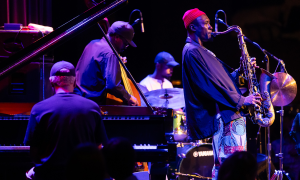
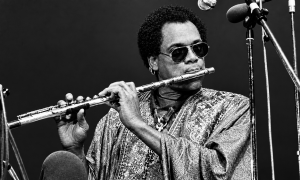
Mr. Allen began by inviting the audience to join with him in space; his voice was soft and calming, while laced with humor and spirit. Although an alto, flute and clarinet were displayed on a rack in front of him, Allen surprised many by bringing an electronic wind instrument (EWI) from behind his back. Used by some musicians in the context of usually vapid fusion efforts, I have never heard a more convincing performance on such an instrument. He spewed a bluster of octave skipping runs and, for a moment, the impression was distinctive for its allusions to amplified static communications received from space; the audience was aboard for an interplanetary musical exploration.
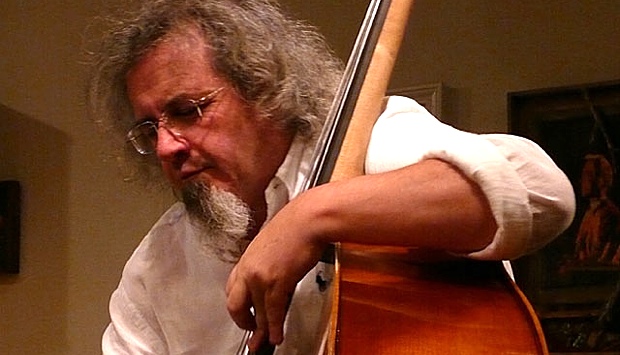
Mr. Grimes appeared a bit hesitant in his glances at the audience, as if he was still unused to the effusive welcome of audiences after an absence of nearly a quarter century. Nevertheless, his playing was absolutely commanding, removing the bass from the traditional role of anchor and support to the blistering pizzicatos of thematic initiation and complex response.
As each man has demonstrated throughout their careers, both can wander from free improvisation to melodic tonal centers. The evening contained all such possible musical maneuvers and left the audience completely fulfilled. The grace and perseverance of the musicians were effectively expressed throughout the evening, providing a current of hopefulness and exploration; one was left with the sense that many things are possible when the mind wanders beyond the expected into the realms of the unexplored.
FOLLOW Erik R. Quick
and get notified whenever a new article published.
Erik Quick is a practicing lawyer, but collects jazz records and memorabilia with a passion
Tags
PREVIOUS / NEXT

Become a Sustaining Member

Since 1995, All About Jazz has championed jazz as an art form and supported the musicians who create it. Over three decades, it has grown into one of the world's leading jazz resources, serving hundreds of thousands of readers, musicians, presenters and industry professionals each month.
Help Build the Future of All About Jazz
Your support helps us continue building All About Jazz for the next generation—expanding our editorial coverage, preserving jazz history, developing new community features and creating better ways to discover the music and the people behind it.
Become a sustaining member for as little as $20 per year and you'll immediately enjoy an ad-free experience along with access to subscriber features and future articles for a full year.
Together, we're not simply sustaining All About Jazz—we're building its future. Thank you for being part of the journey.