Home » Jazz Articles » Live Review » John Scofield Combo 73 at Miner Auditorium
John Scofield Combo 73 at Miner Auditorium
Courtesy Steven Roby
Miner Auditorium
San Francisco
November 7, 2025
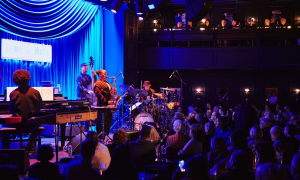
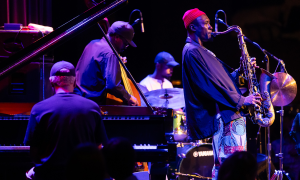
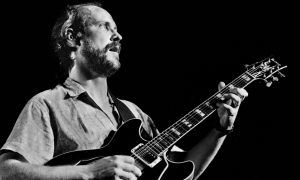
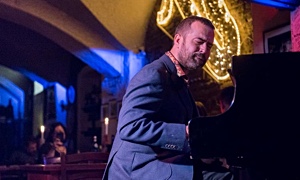
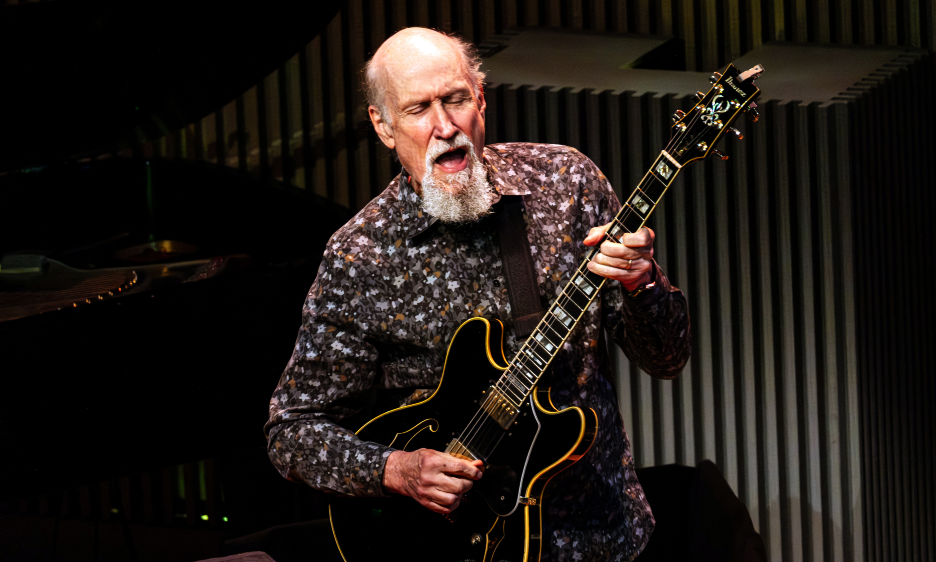
Grammy-winning guitarist John Scofield returned to Miner Auditorium for a three-night residency (November 6—8) alongside Combo 73, a lively quartet featuring pianist Gerald Clayton, bassist Vicente Archer, and drummer Bill Stewart. Their performance on the second night crackled with grit, fire, and instinctive rapport, thrilling the audience with their undeniable chemistry.
The night's action began swiftly. Known for his concise stage presence, Scofield kept his banter minimal and let his distinctive black and gold 1981 Ibanez AS-200 do most of the work. The quartet started with "Icons At The Fair," immediately showing their philosophy: a rich, four-part ensemble sound built on angular rhythms and fire. The piece was inspired by Herbie Hancock's arrangement of "Scarborough Fair," with Scofield creating a new melody over those classic chords. The arrangement had a dense, full-on bebop quality, with Scofield and Clayton taking turns piercing through the melody and rhythm, all supported by Archer's delicate, gamelan-like riff—a brilliant foundation for the blazing, modern swing.
The set moved effortlessly into another Scoriginal, "Swinganova," which immediately transformed the room's energy into a deep, swirling groove. For this lively Latin-fusion piece, Clayton expertly switched to the Hammond B3 organ, filling the harmonic space with rich, soulful tones that bubbled beneath Scofield's guitar lines. This change heightened the track's funk element, giving it classic soul-jazz weight. Anchoring this complex genre mix, Archer provided a steady and robust bass line. His mastery established a deep, unwavering foundation for the samba beat, enabling the whole ensemble to move with cross-genre unity and a strong groove.
The rhythmic precision on "Swinganova" was driven by Stewart, whose approach to drumming elevates every performance from mere timekeeping to melodic conversation. Stewart's playing—famous for its exceptional touch and feel—delivered a lively, intricate samba beat. Significantly, his distinctive cymbal "clicks" cut through the dense mix, emphasizing the sharpness of the rhythm and highlighting his ability to blend specific world-music rhythms with the improvisational openness of modern jazz. Stewart's versatile and intense drumming was the driving force behind the cross-genre fusion that followed.
The quartet sharply shifted from the set's rhythmic energy to highlight their impressive sensitivity with a stunning rendition of the classic ballad, "But Beautiful." This ten-minute musical exploration offered a vital view of the ensemble's cohesive strength. Scofield approached the Jimmy Van Heusen standard with dignity, allowing his 1981 Ibanez to deliver the lyrical melody with a warm, nearly unembellished tenor tone. His guitar's subtle cries were complemented by Clayton's gentle, flowing piano, while Stewart's hypnotic use of brushes and cymbals created the perfect atmospheric backdrop. As tiny dots of light circled the stage, the performance demonstrated the group's ability to stay connected and evoke deep emotional expression, even in its quietest and most lyrical moments.
Following the emotional break of "But Beautiful," the final part of the set reaffirmed the quartet's commitment to variety and collective creativity. Tracks like the lively "Combo Theme" and the detailed "New Waltzo" showcased the rich, high-quality new material that continues to flow from the guitarist. This was complemented by the inclusion of the Cole Porter standard, "Ev'rything I Love," which let the band explore familiar harmonic ground with a fresh, modern approach. Across all these forms—from intricate originals to classic covers—the quartet's energy remained consistently high. What truly united the evening was the quality of the musical conversation, proving that Scofield has successfully built a group whose collective imagination matches his own.
For the final scheduled piece, the quartet played "Boulez Saal," a piece commissioned for a duo concert with Clayton in Berlin. With a characteristic lack of ceremony, Scofield introduced the tune by saying, "One of the requirements for the job was that I provide a new song for that concert... so I wrote something, and we'd like to play that now. It's called 'Boulez Saal.'" This elegant original saw Stewart again providing exquisite brushwork, building a gentle foundation over which Scofield and Clayton traded lyrical, twangy phrases. The tune displayed a final expression of the group's collective artistry, mixing Scofield's signature dissonance with quiet sophistication. When the last note faded, the Miner Auditorium audience erupted in a full, sustained standing ovation, demanding the group's return for one last, unexpected moment of the night's magic.
As the quartet returned to the stage, Scofield offered one final number that captured the night's spirit of freedom and fire. Ignoring the pre-planned setlist given to the SFJAZZ livestream crew, the band instead launched into a fiery, untitled blues piece. It was a visceral, raw finale—a tribute to Scofield's roots and the band's immediate connection. The jam was loose, gritty, and driven by genuine emotion, marking the end of a remarkable performance that was both carefully planned and perfectly impulsive. When the instruments fell quiet, the energy remained high; concertgoers lingered in the lobby, sharing stories of past tours and the magic of that evening's show. John Scofield and Combo 73 delivered a powerful, unforgettable lesson in groove, chemistry, and the enduring strength of instinctive jazz.
Setlist
"Icons at the Fair," "Combo Theme," "New Waltzo," "Ev'rything I Love," "But Beautiful," "Swinganova," and "Boulez Saal." Encore: Untitled blues.
 FOLLOW Steven Roby
and get notified whenever a new article published.
FOLLOW Steven Roby
and get notified whenever a new article published.
San Francisco-based Steven Roby is a music journalist, best selling author, and host of the Backstage Bay Area.
About John Scofield

Tags
PREVIOUS / NEXT

John Scofield Concerts
Become a Sustaining Member

Since 1995, All About Jazz has championed jazz as an art form and supported the musicians who create it. Over three decades, it has grown into one of the world's leading jazz resources, serving hundreds of thousands of readers, musicians, presenters and industry professionals each month.
Help Build the Future of All About Jazz
Your support helps us continue building All About Jazz for the next generation—expanding our editorial coverage, preserving jazz history, developing new community features and creating better ways to discover the music and the people behind it.
Become a sustaining member for as little as $20 per year and you'll immediately enjoy an ad-free experience along with access to subscriber features and future articles for a full year.
Together, we're not simply sustaining All About Jazz—we're building its future. Thank you for being part of the journey.