Home » Jazz Articles » Live Review » I Percussionisti del Orchestra Sinfonica Nazionale, Flor...
I Percussionisti del Orchestra Sinfonica Nazionale, Florence, Italy
Saloncino del Teatro della Pergola
Florence, Italy
September 23, 2008
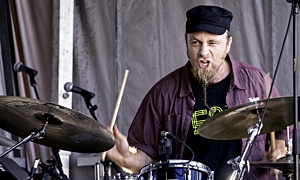
The stage is a jungle of percussive instruments: three imposing standing drums, four gongs, xylophones and vibraphones, glockenspiels, marimbas, congas, tamburellos, chimes, wind-shakers, Japanese gong bowls; and at the back—barely visible through all the metal, wood, stretched skin and bamboo—a traditional drum kit. It is as if Duke's legendary drummer Sonny Greer's Christmas wish-list had come true. It's also hard not to think of Edgar Varese: it wasn't until the French composer's pioneering work, at the beginning of the 1930s, and his historic Ionisation for thirteen percussionists that the oldest of musical instruments, in its myriad forms, was hauled out of the shadows of accompaniment and thrust into the naked spotlight of lead voice. At the Saloncino of Teatro della Pergola four percussionists, an off-shoot of the National Symphonic Orchestra of the Rai that has been exploring the possibilities of percussion since its birth in 1998, gave a powerful and irresistibly fascinating performance.
The program of contrasting material drew from the familiar Leonard Bernstein songbook as well as from 19th century classical pieces, pieces written specifically for xylophone or drum, and original compositions. The common thread was the natural coexistence of percussive instruments from different cultures and, above all, the timbrel possibilities of the instruments employed.
From Matthias Schmitt's beautiful "Ghanaia," with its gently swaying African rhythms, to (xylophonist) Joe Green's Joplinesque rag "Xylophonia," the pace and tone of the music varied nicely throughout the course of the concert. The mini Bernstein suite saw Claudio Romero take the drum stool and inject real swing into West Side Story's "Maria" and "America," unlike many classical takes on these show tunes. A highlight was the interpretation of "Somewhere": Maurizio Bianchini's sensitive playing on the vibraphone, accompanied by Carmelo Gullotto and Occhiena on marimba, turned an undeniably beautiful tune into an utterly haunting one.
The energy level jumped a notch or two on the Minoru Miki composition "Marimba Spiritual," a piece inspired by African famine, and which is part requiem and part resurrection in spirit. The Vittorio Monti piece "Csardas," a traditional Hungarian folk dance, saw Gullotto move between xylophone and vibraphone, executing some breathtakingly fast playing before easing into a lullaby tempo on glockenspiel. On "Xylophonia" it was Alberto Occhiena's turn to shine, racing up and down the keys at an exhilarating speed; at several times in the concert the playing with mallets was so ludicrously fast as to have a silent-movie comedic aspect to it.
Just as arresting as the displays of virtuosity on mallets was the execution on the pieces where the standing drums took center stage: the Romano-composed "Rebirth" featured the huge Japanese odaiko drum—at first alone, then bolstered by wonderful interplay on all three drums building towards a thundering climax with all three drummers lashing gongs in thrilling release. The Russel Peck composition "Lift Off" similarly saw fascinating dialogue between the three drums and brought to mind the experience of being inside a car-wash as the rhythms rose and fell in intensity, coming from one side and then from all sides at once, the sound intensifying and becoming all enveloping before the sudden silence of lift off. A powerful, evocative piece.
The crowd's enthusiasm for the music was answered by a couple of encores. The first, Rimsky-Korsakov's "Flight of the Bumblebee," saw the four percussionists return to the stage sporting flashing, red, green and blue glasses, but the light-hearted, lunatic approach could not detract from the musicianship, which raised smiles all round and brought a great ovation. The concert closed with an energetic mambo, with Occhiena and Gullotto distributing maracas and shakers to members of the audience. One lady wiggled her maraca with obvious vigor and delight despite looking old enough to have been a contemporary of Edgar Varese, when the composer was first shaking things up.
No wind, no brass, no strings and no electricity— just four percussionists whose fantasy carried the audience with them from Broadway to the barrios of Havana, from ecstatic gypsy celebration to African and Japanese landscapes, and in fact, to the limits of one's own imagination.
 FOLLOW Ian Patterson
and get notified whenever a new article published.
FOLLOW Ian Patterson
and get notified whenever a new article published.
Ian is dedicated to the promotion of jazz and all creative music all over the world, and to catching just a little piece of it for himself.
Tags
PREVIOUS / NEXT
Become a Sustaining Member

Since 1995, All About Jazz has championed jazz as an art form and supported the musicians who create it. Over three decades, it has grown into one of the world's leading jazz resources, serving hundreds of thousands of readers, musicians, presenters and industry professionals each month.
Help Build the Future of All About Jazz
Your support helps us continue building All About Jazz for the next generation—expanding our editorial coverage, preserving jazz history, developing new community features and creating better ways to discover the music and the people behind it.
Become a sustaining member for as little as $20 per year and you'll immediately enjoy an ad-free experience along with access to subscriber features and future articles for a full year.
Together, we're not simply sustaining All About Jazz—we're building its future. Thank you for being part of the journey.