Home » Jazz Articles » Album Review » Don Ellis: Haiku
Don Ellis: Haiku
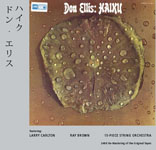
But it was not to be. Cardiomyopathy, a serious heart condition, led to his premature demise in 1978 at the age of 44. Haiku, recorded in 1973 for MPS, and reissued here with careful attention to sound and new liner notes by Ellis biographer Ken Orton, remains an anomaly in Ellis's discography. Eschewing the brighter brass sounds of his flagship orchestra—as well as the paradoxical conundrum of, on the one hand, exploring innovative original material and, on the other, reworking hits of the day into pandering and cringeworthy big band charts—Haiku finds Ellis in largely lyrical territory with a core quintet and varying configurations of a 12-piece string orchestra. Some tracks work better than others, but all point to a musical mind unencumbered by convention, even as he aimed, on other albums, for greater commercial success.
Surrounded by an ace group of Los Angeles players—the effortlessly swinging bassist Ray Brown, versatile drummer John Payne Guerin, and Ellis Orchestra keyboardist Milcho Leviev—Ellis splits guitar duties between the well-known Larry Carlton, the lesser-known but ubiquitous Tommy Tedesco, and even more obscure but also busy David Cohen. But Haiku's primary focus is on Ellis's plangent playing and writing. The ten relatively short scores, inspired by Japanese haiku (poetry written in three lines with a total of 17 syllables: 5-7-5), lean more toward the cinematic; at times impressionistic ("Water Jewel," which is reminiscent of the opening section of German bassist Eberhard Weber's classic "Colours of Chloë"), elsewhere more direct and propulsive ("Summer Rain").
Some tracks veer too close to the saccharine (the mid-tempo ballad "Mirror Pond of Stars" and over-lush "Two Autumns"), but for the most part the writing, despite its eminent accessibility, possesses greater depth under the covers. The orchestration on "Parting" leans toward a sentimental "jazz with strings," but it swings with authority, a rare feature for a Tedesco solo that combines bluesy bends with Wes Montgomery-inspired octaves.
A tad inconsistent, perhaps, but Haiku still possesses more charm than syrup; an alternate, lyrical, and more deeply introspective view of the usually more boisterous Ellis—signaling, perhaps, a new direction that, sadly, he'd not be around long enough to explore further.
 FOLLOW John Kelman
and get notified whenever a new article published.
FOLLOW John Kelman
and get notified whenever a new article published.
With the realization that there will always be more music coming at him than he can keep up with, John wonders why anyone would think that jazz is dead or dying.
Track Listing
Children; Blossoming; Water Jewel; Cherry Petals; Forest; Summer Rain; Two Autumns; Mirror Pond of Stars; Parting; Dew.
Personnel

Don Ellis
trumpetDon Ellis: trumpet; Milcho Leviev: keyboards; Larry Carlton: guitar (2, 7); David Cohen: guitar (1, 3, 6, 8); Tommy Tedesco: guitar (4, 9, 10); Ray Brown: bass; John Guerin: drums; Israel Baker: violin; Erno Neufeld: violin; Jacob Krachmalnik: violin; George Kast: violin; George Berres: violin; Gerald Vinci: violin; Shirley Cornell: violin; Marcia van Dyck: violin; Marvin Limonick: violin; Samuel Voghossian: viola (1-3, 5-8); Alfred Barr: viola (1-3, 5-8); Dan Neufeld: viola (1-3, 5-8); Allan Harshman: viola (4, 9, 10); David Schwarz: viola (4, 9, 10); Myra Kestenbaum: viola (4, 9, 10); Raphael Kramer: cello; Frederick Seykora: cello; Ronald Cooper: cello; Catherine Gotthofer: cello. The String Quartet: Israel Baker (violin), Erno Neufeld (violin), Allan Harshman (viola), Raphael Kramer (cello).
Album information
Title: Haiku | Year Released: 2010 | Record Label: Promising Music/MPS
About Don Ellis
Tags
PREVIOUS / NEXT


Become a Sustaining Member

Since 1995, All About Jazz has championed jazz as an art form and supported the musicians who create it. Over three decades, it has grown into one of the world's leading jazz resources, serving hundreds of thousands of readers, musicians, presenters and industry professionals each month.
Help Build the Future of All About Jazz
Your support helps us continue building All About Jazz for the next generation—expanding our editorial coverage, preserving jazz history, developing new community features and creating better ways to discover the music and the people behind it.
Become a sustaining member for as little as $20 per year and you'll immediately enjoy an ad-free experience along with access to subscriber features and future articles for a full year.
Together, we're not simply sustaining All About Jazz—we're building its future. Thank you for being part of the journey.