Home » Jazz Articles » Album Review » Art Pepper: Everything Happens to Me 1959 - Live at the Cellar
Art Pepper: Everything Happens to Me 1959 - Live at the Cellar
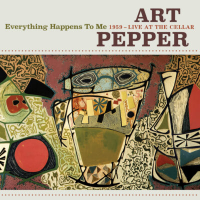
The performances captured here belong to a pivotal moment in Pepper's career. He had already recorded several landmark albums for Contemporary Records: Art Pepper Meets the Rhythm Section (1957), Modern Art (1957), and Art Pepper + Eleven (recorded 1959, released 1960), with Gettin' Together! following in 1960. Despite the spectacular critical reception of those records, Pepper struggled to find consistent work in Los Angeles, his career repeatedly disrupted by addiction and prison sentences. His playing in this period was lyrical, almost tender, combining intense swing with a compelling narrative drive—qualities that stand in contrast to the more frantic, death-haunted edge of his later work.
In 1959, Pepper played The Cellar, a jazz club at 222 East Broadway in Vancouver. Club manager Dave Quarin, himself a saxophonist, arranged for the performances to be recorded. These were live archive recordings rather than planned studio sessions, so the reels include announcements and occasional incomplete tracks.
The liner notes by writer Kirk Silsbee draw on interviews with Laurie Pepper and Quarin, who also supplied archival photographs, which lend the release particular significance for the history of Canadian jazz.
The Vancouver tapes were revisited and assembled into a substantial release: approximately four hours of previously unissued live material from those 1959 nights, presented across a four-CD (and digital) set. Because the source tapes document the sets as they unfolded, the producers chose to preserve continuity, retaining incomplete tracks rather than editing around tape failures. This commitment to documentary authenticity is central to the album's character.
The project was produced by Laurie Pepper—Art's widow and long-time curator of his estate and archives—together with Cheryl Pawelski for Omnivore Recordings. After reviewing all surviving tapes from The Cellar, they opted to issue essentially the complete body of material, refusing to omit partial tracks. This release is part of a broader effort, driven largely by Laurie, to document her husband's life and work—an effort that has also encompassed his autobiography Straight Life and a long series of archival releases drawing on recordings gathered from across the world, particularly from the European and Japanese tours she attended with him in his later years.
Restoration and mastering engineer Michael Graves faced considerable technical challenges: Microphone placement in the club had varied, and tape quality was inconsistent across the reels. His work focused on achieving coherence, reducing noise, and balancing the sound. The final presentation is in mono.
In the broader context of Pepper's output, the 1959 Cellar tapes sit between his crucial mid-to-late-1950s Contemporary Records studio work and his celebrated 1970s live recordings—among them the Village Vanguard sessions—offering a rawer, more intimate club-level view of his playing. They show Pepper fronting a local rhythm section rather than the Los Angeles studio elite, yet still displaying the lyrical phrasing, rhythmic drive, and emotional volatility that established him as a major post-bop alto saxophonist.
The rhythm section here is not of the same calibre as those on other recent multi-disc releases. On the Ronnie Scott's albums, Pepper was supported by his well-honed working band; on the Vanguard box, he played alongside hand-picked New York masters. That said, pianist Chris Gage contributes a number of intriguing solos, and the bass and drums, while unspectacular, provide a supportive framework that allows Pepper to soar.
On the first disc, Pepper races through "Cherokee," paying his debt to Charlie Parker, while fashioning his own variations on the Ray Noble tune, never straying too far from the melody. Also on the first disc is "Over the Rainbow," a song Pepper returned to throughout his career. His interpretation here is somber and reflective, yet notably self-possessed—the dynamics and intensity carefully controlled. The version on Disc 3 features a particularly engaging solo from Gage.
"Yardbird Suite" is delivered with a relaxed bounce. One of the great bop compositions, it appears twice across the set in slightly different arrangements, both at an easy tempo. Curiously, Parker himself rarely recorded the tune commercially. "Bernie's Tune," brought to prominence by Gerry Mulligan in the early 1950s, might seem an unlikely vehicle for Pepper given its unusual syncopation, but he decorates the piece with a fiery improvisation before it fades out.
Laurie Pepper, reflecting on the Cellar recordings, has said: "Usually I go for the emotion in those ballads of Art's—he's the best ballad player in the world—but on this collection, it's the funky swinging stuff that really sticks with me." She was likely thinking of the three versions of "Allen's Alley"—all of them fluent, fast, and lyrical even at speed.
To have four additional hours of improvisation from one of jazz's great voices, captured as he joyfully rose above his personal troubles, is a rare and considerable pleasure.
 FOLLOW Jack Kenny
and get notified whenever a new article published.
FOLLOW Jack Kenny
and get notified whenever a new article published.
Jack was turned on to jazz by a mixture of Stan Getz, Lee Konitz and Earl Bostic.
Track Listing
When You’re Smiling; Cherokee; Over The Rainbow; All The Things You Are; Indiana (Back Home In Indiana); Lover Man; Yardbird Suite; Sweet Georgia Brown; What Is This Thing Called Love?; Yardbird Suite; What’s New?; Holiday Flight; Stompin’ At The Savoy; Allen’s Alley; These Foolish Things (Remind Me Of You)*; Holiday Flight; Tangerine; The Way You Look Tonight; Everything Happens To Me; Bernie’s Tune; Surrender Dear; Over The Rainbow; Allen’s Alley; Brown Gold; Holiday Flight; Strike Up The Band; Somebody Loves Me; There Will Never Be Another You (Part 1); There Will Never Be Another You (Part 2); Allen’s Alley; Walkin’.*
Personnel

Additional Instrumentation
Note: Asterisk on titles indicate incomplete tracks.
Album information
Title: Everything Happens to Me 1959 - Live at the Cellar | Year Released: 2026 | Record Label: Omnivore Recordings
About Art Pepper
Tags
PREVIOUS / NEXT


Become a Sustaining Member

Since 1995, All About Jazz has championed jazz as an art form and supported the musicians who create it. Over three decades, it has grown into one of the world's leading jazz resources, serving hundreds of thousands of readers, musicians, presenters and industry professionals each month.
Help Build the Future of All About Jazz
Your support helps us continue building All About Jazz for the next generation—expanding our editorial coverage, preserving jazz history, developing new community features and creating better ways to discover the music and the people behind it.
Become a sustaining member for as little as $20 per year and you'll immediately enjoy an ad-free experience along with access to subscriber features and future articles for a full year.
Together, we're not simply sustaining All About Jazz—we're building its future. Thank you for being part of the journey.