Home » Jazz Articles » Album Review » Cecil Taylor: Fragments: The Complete 1969 Salle Pleyel Concerts
Cecil Taylor: Fragments: The Complete 1969 Salle Pleyel Concerts

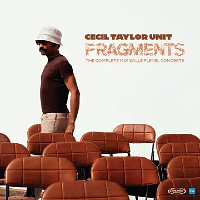
Even after fifty years, Taylor's music remains dense, unrelenting, forceful, and challenging. Time has not diminished its impact. The glorious vivacity is undimmed.
Taylor's piano style is defined by breakneck tempos and ferocious intensity. Harmonically, he abandons functional tonality, instead stacking dense clusters, crushed intervals, and ultra-wide voicings that generate a kind of atonal resonance. The piano functions simultaneously as harmonic backdrop and melodic protagonist, dissolving the conventional boundary between comping and soloing. The result is a style that is both radical and strangely disciplined—a percussive pinnacle of late-1960s free jazz.
The Paris concert is built around the extended, composed "Fragments of a Dedication to Duke Ellington." Taylor's improvisations are therefore not merely spontaneous eruptions, but elaborations of predetermined pitch-rhythmic cells and voicings, reassembled in new and often disorienting contexts.
At the heart of this release is the partnership between altoist Jimmy Lyons and Taylor, a collaboration that lasted from 1961 until Lyons's death in 1986. Lyons developed a style that both complemented and contrasted with Taylor's percussive, evolutionary approach.
Lyons played with the speed and logic of a bebop musician—and crucially, he thought with that same velocity. He could match Taylor's tempos and ferocious intensity without surrendering his own voice. His method was rhythmic fragmentation: what sounded like a single, surging bebop line would be broken at unexpected joints, gliding and slipping off the beat to weave through Taylor's percussive attacks.
Sam Rivers, who joined the Unit later, created a different kind of friction. Rather than mirroring Taylor's density note- for-note, Rivers leaned into his expansive tone, pushing against the intensity with guttural roars or long, sustained notes that anchored the frantic energy swirling around him. Rooted in blues and bebop despite his ease in pure free improvisation, Rivers tended to play horizontally, constructing sweeping, linear melodic phrases that cut across the ensemble's turbulence.
By 1969, Andrew Cyrille was treating the drum kit less as a rhythm machine and more as a timbral orchestra. He distributed energy across the entire kit—cymbals, toms, snare, bass drum—in direct response to the gestural and textural demands of Taylor's piano. His playing blended time strata, acceleration, and compression, supporting the ensemble's shifts from tight clusters to broader eruptions and enhancing the music's architectural flow without imposing a rigid meter.
In the context of the Paris concert's extended compositions, Cyrille's role was to shape the music's internal architecture—building density, releasing pressure, responding to energy rather than driving it from a fixed rhythmic position. Most fundamentally, he abandoned the conventional timekeeping function altogether, becoming a co-equal voice in a collective improvisation, and in doing so helped redefine the rhythmic language of modern jazz.
Phil Freeman offered a useful way into Taylor's music in his biography In the Brewing Luminous (Wolke Verlag): "To really appreciate any single piece of Cecil Taylor's music is to listen to it over and over. Let it hit you like a flood the first time. Wash yourself in the waves of the notes. Then come back—a day later, perhaps. Play it again, and this time listen as carefully as possible. Focus on his opening gambits, and trace their paths through what follows... If—when—you get lost, listen a third time. A fourth. A fifth. At some point, it will unfold before you like a flower, and the beauty of his conception will be fully audible."
As is customary with Feldman's releases, the package includes a richly illustrated booklet featuring rare concert photographs by Jean- Pierre Leloir, Jan Persson, and Christian Rose, alongside new liner notes by Phil Freeman and testimonies from Andrew Cyrille, Jack DeJohnette, Matthew Shipp, Karen Borca, and Monique Rivers.
Track Listing
Side A: Fragments of a Dedication to Duke Ellington, Evening Set Version, Part 1; Side B: Fragments of a Dedication to Duke Ellington, Evening Set Version, Part 2; Side C: Fragments of a Dedication to Duke Ellington, Afternoon Set Version, Part 1; Side D: Fragments of a Dedication to Duke Ellington, Afternoon Set Version, Part 2; Side E: Fragments of a Dedication to Duke Ellington, Afternoon Set Version, Part 1; Side F: Fragments of a Dedication to Duke Ellington, Afternoon Set Version, Part 2.
Personnel


Additional Instrumentation
Sam Rivers: soprano saxophone, flute.
Album information
Title: Fragments: The Complete 1969 Salle Pleyel Concerts | Year Released: 2026 | Record Label: Elemental Music
About Cecil Taylor
Tags
PREVIOUS / NEXT
Become a Sustaining Member

Since 1995, All About Jazz has championed jazz as an art form and supported the musicians who create it. Over three decades, it has grown into one of the world's leading jazz resources, serving hundreds of thousands of readers, musicians, presenters and industry professionals each month.
Help Build the Future of All About Jazz
Your support helps us continue building All About Jazz for the next generation—expanding our editorial coverage, preserving jazz history, developing new community features and creating better ways to discover the music and the people behind it.
Become a sustaining member for as little as $20 per year and you'll immediately enjoy an ad-free experience along with access to subscriber features and future articles for a full year.
Together, we're not simply sustaining All About Jazz—we're building its future. Thank you for being part of the journey.