Home » Jazz Articles » Charles Pillow
Jazz Articles about Charles Pillow
About Charles Pillow
Mike Holober and the Gotham Jazz Orchestra: Hiding Out

by Jack Bowers
Mike Holober has been Hiding Out rather openly for the past ten years or so, waiting for the proper time to gather together his world-class Gotham Jazz Orchestra and record for the first time since 2009's widely acclaimed album Quake (Sunnyside), in which his picturesque compositions and arrangements were compared favorably to those of Duke Ellington and Gil Evans, to name only two. In the interim, Holober has hardly been sitting on his hands, serving time as director of New ...
Continue ReadingMike Holober and the Gotham Jazz Orchestra: Hiding Out
by Dan Bilawsky
If musical polymath Mike Holober is hiding out, he's doing it in plain sight. Constantly in demand, his work as a pianist, conductor, arranger and composer has drawn plenty of attention. In the past 15 years alone he has served as the Artistic Director and Conductor of the Westchester Jazz Orchestra (from 2007-2013), the Associate Guest Conductor of the hr-Bigband (from 2011-2015), and the Associate Director of the BMI Jazz Composer's Workshop (from 2007-2015). In that same stretch of time, ...
Continue ReadingMike Holober and the Gotham Jazz Orchestra: Hiding Out
by Karl Ackermann
Mike Holober's background as a classical pianist and conductor is just one thing that sets Hiding Out apart from the current crop of big band releases. Holober has worked in a variety of settings from solo, duo, and quintet to large ensembles. Two previous recordings with his Gotham Jazz Orchestra were the critically acclaimed Thought Trains (Sons of Sound Records, 2004) and Quake (Sunnyside Records, 2009), comprised of covers and original Holober compositions. On the ambitious double-disc Hiding Out, Holober ...
Continue ReadingMake It Big!

by Patrick Burnette
The boys might not be the most ambitious podcasters on the planet, but sometimes even they think big. This fortnight's excursion is all about large and extra-large ensembles, from a band trying something new in the mid-fifties to a tribute group wrestling with the music of one of jazz's greatest composers to three -count 'em--brand new albums with fifteen or more musicians digging in. After that extra-long discussion of plus-size organizations, just a little time remains to discuss Pat's favorite ...
Continue ReadingCharles Pillow Large Ensemble: Electric Miles
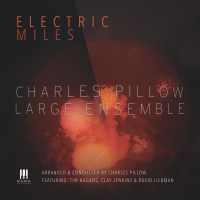
by Jerome Wilson
The electric music Miles Davis recorded from 1969 and into the 1970s was a game-changing event in jazz, a steamy, mysterious, ever-evolving soup of improvisation, rock, funk and electronics that launched numerous careers and inspired subsequent generations of musicians across genres. Its influence shows in the numbers of players who have since studied, dissected and interpreted this material in their own ways. Alto saxophonist Charles Pillow has adapted Davis' work for a full-scale big band but with mixed results.
Continue ReadingCharles Pillow Large Ensemble: Electric Miles
by Jack Bowers
So how does trumpeter Miles Davis' post-1969 “electric period" translate to a big-band format? About as well as could be expected, thanks to leader Charles Pillow's bright arrangements for his New York-based Large Ensemble. Davis' seminal Columbia albums from 1969-1972--In a Silent Way, Bitches Brew, Live at Fillmore East, Live-Evil, On the Corner--are considered by many to have ushered in the jazz / rock / fusion era, which could be a good thing or otherwise, depending on one's point of ...
Continue ReadingCharles Pillow Large Ensemble: Electric Miles
by Mark Corroto
You thought not, but you can put the genie back in the bottle. What we're talking about is the specter unleashed by Miles Davis with Bitches Brew (Columbia, 1970). Davis' expanded lineup for BB with ten-plus musicians, including the electric pianos of Joe Zawinul, Chick Corea, and Larry Young, Bennie Maupin playing bass clarinet, a young guitarist John McLaughlin, two bassists, percussion, and more percussion, and oh yeah, Wayne Shorter's saxophone was ever present. Charles Pillow did that with his ...
Continue ReadingAlbum Showcase



Trending
 Interview
Lou Marini: A Solo Career Starting At The Age Of 80
 History of Jazz
John Coltrane in Detroit: A Brief History
 Live Review
The Tension Is Where the Music Lives: Miles Davis at 100,...
 Live Review
Detroit Jazz Festival 2026: A Gathering in a Great Jazz City
 Radio & Podcasts
Sullivan Fortner, Jim Rotondi & Dena DeRose, Ardeshir,...
 Reanimating Conversations Past
Charlie Haden: Anatomy of a Jazz Classic
 Profile
The Discreet Charm of Tete Montoliu
Premium
VOTE!