Home » Jazz Articles » Album Review » Charles Pillow Large Ensemble: Electric Miles
Charles Pillow Large Ensemble: Electric Miles
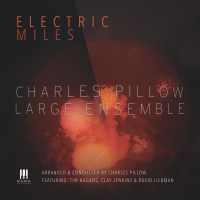
Davis' take on jazz-rock was an amorphous, slinky beast dependent on layers on keyboards, electric bass and prowling bass clarinet. In Pillow's versions the rhythm section, with electric piano and bass present, still try to achieve those creeping, dangerous grooves but it's overwhelmed by the brute force of massed reeds and horns that often attack the melodies. The ensemble passages of "Black Satin" and "Spanish Key" come off blocky and musclebound. Joe Zawinul's "Directions" starts off nicely with bubbling funk arising from Tim Hagans' trumpet, Chuck Bergeron's electric bass and Jared Schonig's drums, but brass fanfares continually disrupt what they try to do. Zawinul's classic "In A Silent Way" starts out with with a lovely, gradual reading of the theme realized by the entire band but eventually speeds up into a sweaty feature for Hagans, Schonig and pianist Julian Garvue that leaves the original theme and feeling far behind.
Other adaptions are more successful. Wayne Shorter's "Sanctuary" has a more subdued and open-ended feel. It balances the brass and reed line with measured grace and slowly works its way up to a full massed shout without breaking the contemplative mood of the composition. The slow-walking "Yesternow" really captures the sense of Davis' dark funk with bass moving at a slow, stalking pace while simmering electric piano and cool band harmonies set the table for fine solos by Pillow on alto flute, Clay Jenkins on trumpet and Davis alumnus David Liebman on liquid soprano sax.
The most consistently worthwhile part of the CD is the soloing. Hagans is reliably fiery in his trumpet playing and leader Pillow contributes a number of funky alto spots. Jenkins cuts through the thick gristle of "Black Satin" and "Spanish Key" like a blade of bright light, Michael Davis takes a couple of swaggering trombone solos on "Black Satin" and "Directions" and when David Liebman turns loose on "Black Satin" and "Yesternow," it's party time.
There are a lot of good things in Charles Pillow's tribute to Miles Davis' early electric phase but it is often hampered by a brassy heaviness that weighs it down. This disc is worth hearing but to hear this music played with real unpredictability and danger, you have to go back to Davis' original work on classics like Bitches Brew (Columbia, 1970) and On The Corner, Columbia, 1972).
 FOLLOW Jerome Wilson
and get notified whenever a new article published.
FOLLOW Jerome Wilson
and get notified whenever a new article published.
I'm a long time arts lover who always wants to hear something I haven't heard before.
Track Listing
Pharoah’s Dance; Bitches Brew; Black Satin; In A Silent Way; Directions; Sanctuary; Yesternow; Spanish Key.
Personnel

Charles Pillow
saxophoneCharles Pillow: arranger, alto saxophone, soprano saxophone, flute, alto flute; Colin Gordon: alto saxophone, soprano saxophone, flute; Luke Norris: tenor saxophone, clarinet; CJ Ziarniak: tenor saxophone; Karl Stabnau: bass clarinet; Michael Davis: trombone; Abe Nouri: trombone; Jack Courtright: trombone; Gabe Ramos: bass trombone; Tony Kadleck lead trumpet; Charlie Carr: trumpet; Clay Jenkins: trumpet; Tim Hagans: trumpet; Julian Garvue: electric piano; Chuck Bergeron: electric bass; Mike Forfia: acoustic bass (4, 6); Jared Schonig: drums; David Liebman: soprano saxophone (3, 7).
Album information
Title: Electric Miles | Year Released: 2018 | Record Label: MAMA Records
About Charles Pillow Large Ensemble
Tags
PREVIOUS / NEXT

Become a Sustaining Member

Since 1995, All About Jazz has championed jazz as an art form and supported the musicians who create it. Over three decades, it has grown into one of the world's leading jazz resources, serving hundreds of thousands of readers, musicians, presenters and industry professionals each month.
Help Build the Future of All About Jazz
Your support helps us continue building All About Jazz for the next generation—expanding our editorial coverage, preserving jazz history, developing new community features and creating better ways to discover the music and the people behind it.
Become a sustaining member for as little as $20 per year and you'll immediately enjoy an ad-free experience along with access to subscriber features and future articles for a full year.
Together, we're not simply sustaining All About Jazz—we're building its future. Thank you for being part of the journey.