Home » Jazz Articles » Album Review » Nicholas Payton / Butcher Brown: A Supreme Blue
Nicholas Payton / Butcher Brown: A Supreme Blue
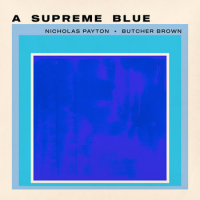
Nicholas Payton joins forces with the Richmond-based collective Butcher Brown on A Supreme Blue, a thoughtful and stylistically hybrid reimagining of Kind of Blue (Columbia, 1959) and A Love Supreme (Impulse, 1965). Rather than treating these canonical works as untouchable artifacts, the ensemble subjects them to a contemporary filter drawing on house, neo-soul, dub, hip-hop, and Southern jazz idioms. The intention is clear: to assert that the music of Davis and Coltrane remains fluid, adaptable, and alive in the present.
Payton, a New Orleans-born trumpeter, multi-instrumentalist, producer, and arranger, has long positioned himself at the intersection of tradition and forward-thinking experimentation. Over a career spanning more than three decades, he has moved comfortably between swing, funk, R&B, and the avant-garde, and here he extends that aesthetic into a concept-driven reinterpretation project.
A Supreme Blue is not a museum piece but a translation. It reframes two landmark statements through a contemporary sonic language that privileges groove, texture, and atmosphere. House rhythms, electric keyboards, and layered production reshape the modal and spiritual frameworks of the originals, rendering them less austere and more rhythmically grounded.
The ensemble plays a crucial role in this transformation. Payton (trumpet, Rhodes, vocoder) balances clean, incisive trumpet lines with an expanded electronic palette, adding a distinctly modern sheen. Drummer Corey Fonville anchors the project with grooves that recast modal jazz into dance-oriented frameworks. Bassist Andrew Randazzo alternates between acoustic depth and thick, synth-driven foundations. Marcus Tenney, on tenor saxophone, assumes the Coltrane role without imitation, retaining his own tonal identity. DJ Harrison (keys, melodica) supplies lush harmonic textures, while guitarist Morgan Burrs contributes a warm, soul-inflected presence that stabilizes the ensemble sound.
Reimagining Kind of Blue
"So What" undergoes a substantial transformation: the iconic call-and-response structure gives way to a syncopated, soul-funk groove. Payton's trumpet gestures toward Miles's phrasing but floats over Rhodes voicings and subtle electronic textures."Freddie Freeloader" retains its blues foundation yet leans decisively into Butcher Brown's aesthetic, emphasizing groove and tonal color over the original's relaxed swing.
On "Blue in Green," Payton stretches melodic lines into a more spacious, ambient setting, prioritizing atmosphere over harmonic delicacy.
"All Blues" reinterprets the familiar 6/8 pulse through a house-influenced rhythmic framework, shifting the track's center of gravity toward danceability.
"Flamenco Sketches" slows considerably, its modal character intact but reframed as a transitional piece that gestures toward the spiritual terrain of A Love Supreme.
Reimagining A Love Supreme
"Acknowledgement" marks a decisive shift: the famous four-note motif appears in synth-bass form, while Payton's vocoder intones the mantra with a strikingly contemporary resonance."Resolution" features a strong tenor statement from Tennishu, capturing the intensity and spiritual drive of Coltrane without resorting to pastiche. Fonville's drumming is particularly forceful here, propelling the track forward.
"Pursuance" is built around a tightly interlocking groove, with Randazzo's bass, Burrs's guitar, and Tennishu's saxophone forming a dense, kinetic core.
"Psalm" closes the album on a reflective note. Payton translates Coltrane's "spoken" prayer into trumpet lines that dissolve into ambient textures, echo, and sustained resonance.
The central challenge lies in the fundamental disparity between the source materials. Kind of Blue is defined by restraint, economy, and cool detachment, while A Love Supreme embodies fervor, intensity, and spiritual urgency. In this reimagining, both qualities are partially diluted. The cool subtlety of Davis's work is largely replaced by groove-driven warmth, while Coltrane's ecstatic intensity is tempered by production aesthetics that prioritize texture over transcendence.
As a result, the integrity of the original conceptual frameworks is inevitably compromised. The most productive way to approach A Supreme Blue is to hear it on its own terms—as a contemporary reinterpretation rather than a dialogue with the originals.
The liner notes, by Ashley Kahn—writer of authoritative studies on both Davis and Coltrane—provide useful contextual grounding for a project that is as ambitious as it is contentious.
 FOLLOW Jack Kenny
and get notified whenever a new article published.
FOLLOW Jack Kenny
and get notified whenever a new article published.
Jack was turned on to jazz by a mixture of Stan Getz, Lee Konitz and Earl Bostic.
Track Listing
So What; Freddie Freeloader; Blue in Green; All Blues; Flamenco Sketches; Acknowledgement; Resolution; Pursuance; Psalm.
Personnel

Nicholas Payton
trumpetMarcus Tenney
saxophone, tenorMorgan Burrs
guitarDJ Harrison
multi-instrumentalist
Corey Fonville
drumsAndrew Randazzo
bassAlbum information
Title: A Supreme Blue | Year Released: 2026 | Record Label: Concord Jazz
About Nicholas Payton
Tags
PREVIOUS / NEXT

Nicholas Payton Concerts
Become a Sustaining Member

Since 1995, All About Jazz has championed jazz as an art form and supported the musicians who create it. Over three decades, it has grown into one of the world's leading jazz resources, serving hundreds of thousands of readers, musicians, presenters and industry professionals each month.
Help Build the Future of All About Jazz
Your support helps us continue building All About Jazz for the next generation—expanding our editorial coverage, preserving jazz history, developing new community features and creating better ways to discover the music and the people behind it.
Become a sustaining member for as little as $20 per year and you'll immediately enjoy an ad-free experience along with access to subscriber features and future articles for a full year.
Together, we're not simply sustaining All About Jazz—we're building its future. Thank you for being part of the journey.