Home » Jazz Articles » Album Review » Kevin Kastning: Unreal City
Kevin Kastning: Unreal City
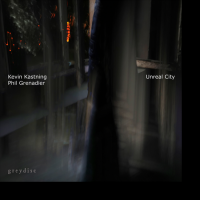
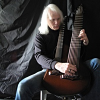
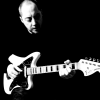
Kastning's expanded contraguitar family gives the recording its unusual acoustic terrain. The credited 36-string, 30-string, 24-string and 18-string instruments extend the guitar beyond familiar behavior, opening a register and color range that can suggest bass resonance, harp-like shimmer, brittle metallic overtones, prepared strings and dark chamber resonance. Rather than technical curiosities, these sounds function as materials of placement and proportion. A note may carry the force of a structural beam; a harmonic may feel like light catching on a broken surface; a low resonance may alter the perceived size of the space around Grenadier's horn.
Grenadier, on trumpet and flugelhorn, brings the album its most directly vocal element, though his playing rarely settles into conventional lyricism. His phrases often begin as breath, gather contour, then withdraw before becoming fully declarative. That restraint is crucial. He moves within Kastning's sound world rather than standing outside it as a soloist commenting from above. At different moments he appears as line, flare of brass color, or nearly spoken inflection. The relationship between the two players is less a dialogue of alternating statements than a continuous adjustment of weight, distance, and timbre.
The literary charge of the titles deepens the album without turning it into a program to be decoded. Unreal City recalls the fractured urban vision of T. S. Eliot's The Waste Land; "Those are pearls that were his eyes" has its earlier life in Shakespeare's The Tempest and its later modernist afterlife in Eliot; "Still point of the turning" points toward the paradox of motion around a still center associated with Eliot's Four Quartets. These echoes matter because they place instability, transformation, suspended time and altered memory around the music, while leaving the performances to determine their own form.
The album's "city" is acoustic rather than descriptive: a field of partial forms, shadowed corridors, sudden openings and receding surfaces. The four pieces do not move like chapters in a narrative. They resemble different zones within the same unsettled environment, each defined by its own duration, density and internal temperature. Kastning and Grenadier avoid scene-painting. Instead, they build a world through recurrence, interruption, decay and return.
"Those are pearls that were his eyes" turns the idea of transformation into an acoustic state. Kastning's lower strings darken the ground rather than securing it, while Grenadier enters with brief, searching figures that seem to measure the available air before occupying it. The piece has the force of an opening, but not because it announces a theme. It changes the listener's attentional scale. Melody, resonance and silence are placed on equal footing, and the music asks to be heard as much through what disappears as through what sounds.
"Still point of the turning" sharpens the album's treatment of time. The performance is active without becoming directional. Kastning's attacks disturb the surface, yet they do not organize themselves into pulse. The lower registers create a kind of undertow, while upper partials appear and vanish with a dry, unstable brightness. Grenadier's lines hover between song and signal. They have lyrical possibility, but the phrasing remains suspended, held back from release. What matters here is consequence: a string resonance changes the color of the next horn tone; a brass phrase leaves an interval of space that alters Kastning's next move.
"Never explaining; only revealing" gives the album its clearest aesthetic statement. At just over ten minutes, the piece turns duration into method. It does not develop through argument, exposition or dramatic escalation. Instead, Kastning and Grenadier allow small differences to accumulate until the music's form becomes perceptible from within. Kastning generates low-register mass, sharp upper partials and sudden fractures of articulation. Grenadier often lets pitch emerge gradually from breath, so that tone feels discovered rather than announced. The result is rigorous without becoming rigid. Nothing is overstated, yet very little feels incidental.
"Memory passage echo," the final and longest track, expands the album's logic into its broadest shape. It does not function as a closing statement in the usual sense. It behaves more like an acoustic memory system. Elements from earlier in the album seem to return, but altered by distance: low string weight, suspended horn tones, metallic afterimages, pauses that feel charged rather than empty. The title's sequence is revealing in itself. Memory moves through passage; passage returns as echo; echo changes the outline of what seemed original. Kastning and Grenadier make this process audible without forcing it into a thesis. The piece gradually recedes, leaving a changed sense of space rather than a resolved conclusion.
What gives Unreal City its seriousness is the way form arises from attention. The music does not depend on familiar signs of development: steady pulse, harmonic progression, thematic variation or soloistic climax. Its architecture is made from placement, response, duration and decay. Kastning and Grenadier are both masters of their materials, but their mastery is not asserted through display. It appears in judgment: knowing when to let a resonance stand alone, when to disturb it, when to leave a phrase unfinished, and when silence has become more eloquent than continuation.
That command gives the album its force. Unreal City is austere, but never empty; abstract, but never evasive. Kastning's contraguitars open an acoustic world that feels at once ancient, unstable and newly invented. Grenadier's trumpet and flugelhorn give that world breath, edge and human contour. Together, they make music in which every sound seems to change the space around it before vanishing. The album does not describe an unreal city. It builds one from resonance, restraint and disappearance, then leaves it standing in the ear: dark, exacting and still trembling after the final vibration has gone.
 FOLLOW Sue Yang
and get notified whenever a new article published.
FOLLOW Sue Yang
and get notified whenever a new article published.
Mental health therapist, jazz critic, educator, and founder of DeepListeningJazz
Track Listing
Those are pearls that were his eyes; Still point of the turning; Never explaining, only revealing; Memory passage echo.
Personnel
Kevin Kastning
guitar
Phil Grenadier
trumpetAlbum information
Title: Unreal City | Year Released: 2026 | Record Label: Greydisc Records
About Kevin Kastning
Tags
PREVIOUS / NEXT

Become a Sustaining Member

Since 1995, All About Jazz has championed jazz as an art form and supported the musicians who create it. Over three decades, it has grown into one of the world's leading jazz resources, serving hundreds of thousands of readers, musicians, presenters and industry professionals each month.
Help Build the Future of All About Jazz
Your support helps us continue building All About Jazz for the next generation—expanding our editorial coverage, preserving jazz history, developing new community features and creating better ways to discover the music and the people behind it.
Become a sustaining member for as little as $20 per year and you'll immediately enjoy an ad-free experience along with access to subscriber features and future articles for a full year.
Together, we're not simply sustaining All About Jazz—we're building its future. Thank you for being part of the journey.