Home » Jazz Articles » Live Review » Tribute to Peggy Lee: Jazz at the Hollywood Bowl 2004
Tribute to Peggy Lee: Jazz at the Hollywood Bowl 2004
So, there it is: bittersweet, but ultimately compelling. God willing, I'll still be coming back for more, for as many years as I have left
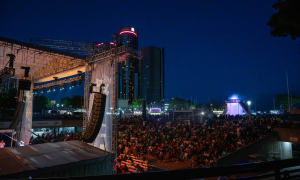
On the plus side, we have been fans of Peggy Lee since the '40s; her talent (especially as a song and lyric writer), focus, and unnerving directness set her apart from the others, while her interpretation of songs such as "Fever" and "Is That All There Is" were almost spookily intense. It was a gorgeous southern California evening, warm with just a slight breeze and wispy white clouds overhead. In addition, the evening marked our first opportunity to see the newly renovated Hollywood Bowl and to sample its heralded, markedly improved acoustics. Our first impression related to its increased size and presence: as close as we have felt to the stage in the past, we now feel even closer; the greater circumference of the arc of the bowl means that it occupies an even larger segment of our peripheral vision. The acoustics are a definite improvement, but I imagine the fans in the nosebleed seats would be even better judges of that. Large screens mounted to either side of the arc, and numerous remote-controlled video cameras, made possible close-up views of performers and orchestra, along with the frequent interposition of film footage, which gave the experience of the music of Peggy Lee an added immediacy and intimacy. Pianist and musical director Mike Renzi was long associated with Miss Lee, as was drummer Grady Tate; bassist Jay Leonhart and guitarist John Pisano rounded out the rhythm section, and the stage was blanketed with members of the "Hollywood Jazz Orchestra," as the program billed them; saxophones and brass to the right, strings to the left.
On the other hand, to our taste, the program was markedly over-produced by Richard Barone and Festival Productions, Inc., and generally as scripted, pop laden and glitzy as a Las Vegas show. Almost none of the many participants in the evening's tribute, paraded out one at a time for one song at a time, would we have gone to see perform individually. Whereas improvisation, along with swing, is one of the key elements of jazz, its presence was minimal, limited to occasional breaks by Renzi, Pisano, Leonhart, and a few superb soloists in the orchestra, such as trombonist Andy Martin and saxophonist Bob Sheppard.
Several years ago, Diane Reeves replaced John Clayton as Creative Chair for Jazz at the Bowl, and the Clayton Hamilton Jazz Orchestra was dismissed as resident big band. It seems obvious that the Los Angeles Philharmonic Association decided that, despite keeping "jazz" in the names of its two Wednesday night series, jazz alone was an inadequate draw to fill the Bowl to capacity. Since that time, programs and concerts in the series have been an amalgam of jazz, "smooth jazz," pop, R&B and swing performances. Nights within the two series continue to be appropriately allocated for Blues and Brazilian and Latin Jazz, but the rest of the time, it's often catch as catch can.
But, back to the Lee Tribute: the orchestra opened the evening with an overture of Lee songs, following which Barone introduced Nicki Lee Foster, daughter of Miss Lee and Dave Barbour, who spoke endearingly but frankly about her parents. Performers of songs composed by or associated with Miss Lee then included Nancy Sinatra ("Why Don't You Do Right," "He's a Tramp"), who still doesn't connect well with an audience; given her genetics, this is both remarkable and sad; Freddy Cole ("I Don't Know Enough About You," "You're My Thrill"), who seemed ill-at-ease with the formality of the setting; Jack Jones ("Well All Right, OK, You Win," "There'll Be Another Spring"), who sounded as good as he ever has but, unfortunately, no better; Petula Clark ("You've Gotta Have Heart," "Circle in the Sky") and Bea Arthur ("The Shining Sea," "Johnny Guitar"), who were both moving, but well past their primes. Jane Monheit ("Lover," "Things Are Swinging," "Sweet Happy Life") took a big hit on my personal appreciation list; she seemed determined to be noticed and remembered as the sexiest among this profusion of performers, and, by the time she had made four exits, the flip of her hair, and her coquettish glance over her shoulder at the audience, had become so stereotyped as to be embarrassing.
Lorraine Feather, daughter of fellow North Dakota songstress Jane Leslie and Leonard Feather, who had been introduced by Miss Lee ("It's a Good Day"), was delightfully fresh and talented, if unpolished. Jolie Jones, daughter of Quincy Jones ("Angels on Your Pillow"), was a talent I'd like to have heard more of, if she hadn't been largely overwhelmed and upstaged by the singing of Grady Tate. Maureen McGovern ("The Folks Who Live on the Hill," "Come Back to Me") sang in the rich warmth of her range; both were well presented. Nnenna Freelon ("Hallelujah, I Love Him So," "I'm Gonna Go Fishin'") could not have been more delightful; both songs were bright, fresh, and dynamic. Rita Coolidge was perfectly cast to sing "Black Coffee" and "Fever," and her performances were exciting and memorable in every way. Finally, the most pleasant surprise of the evening was Sheryl Lee Ralph, who was new to us. She was poured into a red sequined gown, under a red coat with royal purple lining (which she doffed suggestively and dropped to the stage), and, perched on what Bea Arthur would have called "f... me" high heeled shoes, she compelled attention as if a magnet. Her medley of "I'm a Woman" and "Hey Big Spender" was clearly the electrical high point of the show.
The concert ended with Miss Lee herself on the big screens singing "If That's All There Is," in all its wrenching intensity; I couldn't even comment on it five minutes later without choking up.
So, there it is: bittersweet, but ultimately compelling. God willing, I'll still be coming back for more, for as many years as I have left...
 FOLLOW J. Robert Bragonier
and get notified whenever a new article published.
FOLLOW J. Robert Bragonier
and get notified whenever a new article published.
Dr. Bragonier is a jazz educator and historian with a 60+ year love of jazz.
Tags
PREVIOUS / NEXT

Become a Sustaining Member

Since 1995, All About Jazz has championed jazz as an art form and supported the musicians who create it. Over three decades, it has grown into one of the world's leading jazz resources, serving hundreds of thousands of readers, musicians, presenters and industry professionals each month.
Help Build the Future of All About Jazz
Your support helps us continue building All About Jazz for the next generation—expanding our editorial coverage, preserving jazz history, developing new community features and creating better ways to discover the music and the people behind it.
Become a sustaining member for as little as $20 per year and you'll immediately enjoy an ad-free experience along with access to subscriber features and future articles for a full year.
Together, we're not simply sustaining All About Jazz—we're building its future. Thank you for being part of the journey.