Home » Jazz Articles » Album Review » The Who: The Who By Numbers
The Who: The Who By Numbers
To that point, the double compact disc set arranges its demos, alternate versions and outtakes in the same ten-cut sequence as the official longplayer's, thereby delineating the evolution of the material, the musicianship and the recording process. The intention of both the original and the reissue is eminently clear as they literally mirror each other.
Overseen by Jon and Layla Astley, the remastering of the 1975 studio album is particularly effective given the sparse nature of the arrangements. Completely bereft of the innovative synthesizer work of 1971's Who's Next (Track Records / Decca Records, 1971) and the density of horns, keyboards and sound effects on Quadrophenia (Track Records / MCA Records) from two years later, the stripped-down production of Glyn Johns is all the more spacious in its sonically upgraded form.
To that same straightforward end, the four members of the Who are accompanied by only one outside musician, the highly esteemed session man Nicky Hopkins. The keyboardist's reputation is based to a great degree on the kind of stark, scintillating piano playing so appropriate to the desolation of "Imagine A Man."
In fact, his temperate yet evocative work is so integral to "Imagine A Man—Pete Vocal (Early Mix)." It begs the question of what a difference his presence on stage might have made had he toured with the quartet in support of the album over the next year or so (he left a distinct impression in doing just that with Jefferson Airplane after recording Volunteers (RCA, 1969) with the rabble-rousing San Franciscans).
The existential angst that songwriter Pete Townshend describes in that latter number is the prevailing mindset of The Who By Numbers, the Who's seventh album. And that is no small observation, as the quartet's chief composer, in his 2012 autobiography Who I Am (Harper Collins, 2012), relates how he submitted a clutch of original compositions to lead vocalist Roger Daltrey, who subsequently picked the ones he thought he could sing best.
Not unlike the author's own fevered vocal on the overtly personal "However Much I Booze," Daltrey's forceful delivery on "Dreaming From The Waist" parallels the instrumental drive and drama of the guitarist aligned with drummer Keith Moon and bassist John Entwistle. The combustible rhythm section is heard to better and more explosive effect, however, on the two 1976 concert cuts from Swansea.
The insignificant "Squeeze Box" and a galvanic "Dreaming From The Waist" prominently feature the perpetual motion of both these idiosyncratic musicians, as well as Townshend's concentration on chords rather than solos. In this distinctive instrumental approach, each of the three leaves room for the others. In so doing, they reduce what might otherwise be overwhelming and/or heavy-handed sensory stimulation from the group (around this time designated the loudest band in the world by the Guinness Book of World Records).
Customarily limited in his input of originals to Who albums, Entwistle's material has nevertheless long been integral to the group's LPs and his sole contribution here is the sardonic "Success Story." And while his wry take on the illusions of fame almost but not quite serves as an antidote to the personal angst of Townshend's that permeates "How Many Friends," the man nicknamed 'The Ox' also adds a colorful touch to the otherwise stripped-down sound here with his doleful French horn on "Blue Red and Grey."
Performed otherwise alone by Townshend on ukulele, the Zen-like acceptance permeating that song—like the utter longing suffusing "They Are All In Love"—is certainly at odds with the bulk of its surroundings. The comparatively unadorned take on the formal release is far superior to the 'unedited version,' but then so is the "Acoustic Stripped Mix, 2026" of the aforementioned "Squeeze Box"; its wheezing accordion retains much of its novel appeal, which may very well account for how this non sequitur of a number became a surprisingly successful single release from The Who By Numbers.
The ten cuts comprising this deceptively unambitious Who album are bookended by recordings that sound more rather than less like the grand drama of the band at its most recognizable. Nevertheless, the treatise on the inexorable process of aging, "Slip Kid," sounds stunted, if ever so slightly so, as does the finale "In A Hand Or A Face."
And while it remains clear the Who's instrumental bond as a band is intact, the latter tune's ending—in a circular vocal repetition of the phrase "I am going 'round and 'round"—is more emblematic of this effort than the massive (and more than slightly portentous) guitar chords at its foundation.
What is most revelatory about hearing that demo, though, is how Townshend's playing to this purpose resembles that of his bandmates. His dramatic instrumental flourishes are unmistakable in their source references to Entwistle and Moon. In contrast, on "How Many Friends," the phrasing of his singing hardly approximates the nuance and range of Daltrey: Townshend has neither the voice nor the style of his bandmate.
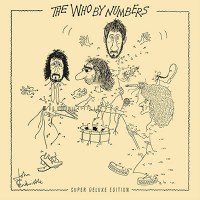
Intentionally or not, Entwistle's purposely rudimentary cover artwork on The Who By Numbers is really no more or less caricatured than the foursome's stage presence during this period of its career. It continued on until Moon's passing three years later, circa Who Are You (MCA, 1978). But the lighthearted nature of the drawing so vividly belies the true-to-life nature of the songs for which it offers a front that it becomes an indispensable piece of the storyline pervading the album.
 FOLLOW Doug Collette
and get notified whenever a new article published.
DC writes regularly about jazz and blues plus rock and roll, composing reviews of CDs, DVDs, live performances, books and films.
Track Listing
CD 1: Slip Kid; However Much I Booze; Squeeze Box; Dreaming From the Waist; Imagine a Man; Success Story; They Are All in Love; Blue, Red and Grey; How Many Friends; In a Hand or a Face. CD 2: Slip Kid; However Much I Booze; Squeeze Box; Control Myself; Imagine A Man; They Are All In Love; Blue Red And Grey; How Many Friends; Round And Round; Squeeze Box; Dreaming From The Waist.
Personnel

The Who
band / ensemble / orchestraRoger Daltrey
vocalsPete Townshend
guitarJohn Entiwistle
bass, electricKeith Moon
drums
Nicky Hopkins
pianoAdditional Instrumentation
Pete Townshend: keyboards, ukulele; lead and backing vocals; John Entwistle: bass, horns, backing vocals.
Album information
Title: The Who By Numbers | Year Released: 2026 | Record Label: Polydor Records
PREVIOUS / NEXT


About The Who
Tags
Become a Sustaining Member

Since 1995, All About Jazz has championed jazz as an art form and supported the musicians who create it. Over three decades, it has grown into one of the world's leading jazz resources, serving hundreds of thousands of readers, musicians, presenters and industry professionals each month.
Help Build the Future of All About Jazz
Your support helps us continue building All About Jazz for the next generation—expanding our editorial coverage, preserving jazz history, developing new community features and creating better ways to discover the music and the people behind it.
Become a sustaining member for as little as $20 per year and you'll immediately enjoy an ad-free experience along with access to subscriber features and future articles for a full year.
Together, we're not simply sustaining All About Jazz—we're building its future. Thank you for being part of the journey.