Home » Search Center » Results: Matthew Shipp
Results for "Matthew Shipp"
Matthew Shipp Trio: The Unidentifiable

by Karl Ackermann
With each successive project, the prolific Matthew Shipp takes the art form to seemingly unstainable heights and then persists in pushing the bar further along. Shipp began his recording career with a trio project, Circular Temple (Quinton Records, 1992) featuring William Parker and Whit Dickey, two artists that have retained close professional ties to the pianist/composer. ...
TEST with Roy Campbell: Live at The Hinton House

by Mike Jurkovic
More exquisite madness from Brooklyn's barn burning free jazz label 577 Records, home to the free and the brave. This time it's a hard core NY borough blowout recorded live in April 1999 that cantankerously and vividly chronicles the only known performance of the late, free/avant, Harlem/NoBro legend, trumpeterRoy Campbell. Unrestrained, Campbell raises the ...
Ivo Perelman / Matthew Shipp: Amalgam

by John Sharpe
Amalgam constitutes the seventeenth disc, spread across ten albums from the near symbiotic union of Brooklyn-based Brazilian tenor saxophonist Ivo Perelman and American pianist Matthew Shipp. And that doesn't even touch on Perelman's many trio and quartet dates which include Shipp. So it's fair to say that they know each other's unique styles fairly well by ...
Heavy Rotation For A Pandemic Summer

by Mark Corroto
In the summer of 2020 one result of the COVID-19 isolation, and artists inability to tour and perform is that they have time to deal with projects halted by this pandemic. Musicians, producers, and engineers have mixed, mastered and released an abundance of music. Many of the titles have been, and will be covered by our ...
Ivo Perelman with Arcado String Trio: Deep Resonance

by Troy Dostert
Throughout his long and prolific recording career, Ivo Perelman has recorded with a large number of free improvisation's leading lights. Pianist Matthew Shipp stands at the top of the pile, with over two dozen joint appearances; Joe Morris, Gerald Cleaver, Whit Dickey, William Parker, and many others help comprise the long list of associates he's maintained ...
Darrifourcq, Hermia & Ceccaldi... and Cheeseburgers

by Maurice Hogue
There are some very creative folks hanging about this week, headed by one of the more unique recordings of the year so far—Kaijū Eats Cheeseburgers—by the uncategorizable trio from France led by drummer/percussionist Sylvain Darrifourcq with saxophonist Manuel Hermia and cellist Valentin Ceccaldi. It's very different but very exciting stuff. Also new from Europe and more ...
The Renewal of AACM: Nicole Mitchell, Mike Reed, Tomeka Reid, Matana Roberts

by Russell Perry
In 100 one-hour programs, the series Jazz at 100 told the story of recorded jazz. It established the foundations upon which the broadly diverse music of today is built. This is the first hour of the successor series which aims to give voice to the current jazz scene and appreciates its countless creators. In ...
Whit Dickey, Sara Serpa & Stanley J. Zappa

by Maurice Hogue
This first July show features the debut of a new record label with a focus on improvisation: Tau Forms. The artistic director is drummer Whit Dickey, and it happens that his new Expanded Light is one of first two releases by the label; the other comes from pianist Matthew Shipp. Good luck to Tao Forms! I ...
Okuden Quartet: Mat Walerian/Matthew Shipp/William Parker/Hamid Drake: Every Dog Has His Day But It Doesn't Matter Because Fat Cat Is Getting Fatter

by Karl Ackermann
A student of eastern philosophy and Japanese culture, reed player/composer Mat Walerian coined the Okuden series name from a Japanese word meaning “inner teachings." Walerian had studied piano at six and taught himself saxophone while in his teens. He expanded his self-taught regime to include clarinet and flute in 2008-9. Walerian has sporadically taken lessons from ...
Jeff Cosgrove/John Medeski/Jeff Lederer: History Gets Ahead of the Story
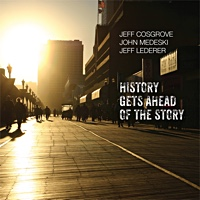
by Troy Dostert
As he has been one of the most influential and prolific musicians in the jazz avant-garde since the 1980s, it is surprising that bassist William Parker hasn't gotten more credit as a composer. Perhaps due in part to the sheer volume of his recordings--including every imaginable context, from solo bass to small/medium-sized groups to big-band outings--it ...
Album Showcase


Trending
 In Tribute To...
John Coltrane At 100: A Global Perspective
 Jazz Raconteurs
Julius Hemphill: Marty Ehrlich and Tim Berne Remember a...
 In Tribute To...
Points of View: Celebrating Dave Holland
 History of Jazz
John Coltrane in Detroit: A Brief History
 Live Review
Detroit Jazz Festival 2026: A Gathering in a Great Jazz City
 Profile
Sequoia Snyder: Growing in the Light of the Masters
 Interview
Jasur Khalilov: From Falak to Fusion
VOTE!