Home » Search Center » Results: Howard McGhee
Results for "Howard McGhee"
Tina Brooks Quintet: The Complete Recordings

by Chris May
Mosaic Records' spring 2020 release The Complete Hank Mobley Blue Note Sessions 1963-70, the second of the label's box sets devoted to the copiously recorded (and rightly so) Hank Mobley, prompts thoughts of another of Blue Note's singular hard-bop tenor saxophone stylists. Unlike Mobley, Tina Brooks was woefully under-recorded, making just four albums under his own ...
About Howard McGhee
Results for pages tagged "Howard McGhee"...
Howard McGhee

Born:
McGhee was born in Tulsa, Oklahoma, but grew up in Detroit. He first learned to play the clarinet and tenor sax, then switched to trumpet. From 1936 to 1940 he travelled around playing in territory bands. In 1941 he led his own band at Detroit's Club Congo. After a short stint with Lionel Hampton he joined Andy Kirk, with whom he made his first recording, his own McGhee Special. During the AFM ban, he spent a year with Charlie Barnet, but returned to Kirk in 1943. In 1944, jobs in the bands of Georgie Auld and Count Basie were followed by his joining the Coleman Hawkin's quintet for half a year in Los Angeles
Bird's Trumpets
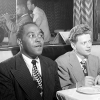
by Matt Lavelle
Looking closely at all the trumpet players that played with Thelonious Monk in a piece I wrote in March 2018, I decided to continue the focus, and explore the trumpet players that played with Charlie Parker. As challenging as the trumpet is to play, playing Bebop raised the technical bar. Playing with Charlie Parker at fast ...
Jazz on Central Avenue - Bebop in Los Angeles (1945 - 1948)

by Russell Perry
Most of the pioneering bebop musicians we have featured in the past several programs were based in New York—Bird, Dizzy, Monk, Bud Powell, Coleman Hawkins, Fats Navarro, J.J. Johnson, Max Roach. While New York may have dominated the modern music scene, it wasn't the only scene. The wartime economy in southern California brought an influx of ...
Big Ten Inch Record

by Patrick Burnette
As the great Sigmund Freud said, sometimes an EP is just an EP. In this case, actually, it's six EP's, as the boys look at that chimera of the early LP era, the ten-inch long-playing record, focusing on releases from the early to mid-nineteen fifties on Blue Note and Fantasy, along with a Resonance Records' Record ...
2018: The Year in Jazz

by Ken Franckling
The year 2018 was a busy one for the jazz world. The genre's version of the #MeToo movement resulted in a new Code of Conduct and other efforts to make the music workplace more equitable. International Jazz Day brought its biggest stage to St. Petersburg, Russia. The Thelonious Monk Institute of Jazz, which ran a high-profile ...
Charlie Parker: Now's The Time

by Karl Ackermann
In the pantheon of jazz saxophonists, Charlie Parker has been among the most transformational of artists, despite not living nearly long enough to fulfill his potential. Parker's lifetime, as a principal architect of bebop, and a self-destructive force, has been documented ad nauseam but his music continues to significantly influence new generations. Since Parker's death in ...
Blue Highways and Sweet Music: The Territory Bands, Part II

by Karl Ackermann
Part 1 | Part 2 Part 1 of Blue Highways and Sweet Music: The Territory Bands looked at the roots, drivers and challenges of the travelling groups who brought jazz music to the non-urban areas of the Southern Plains, through one-night-stands, in often impromptu venues. A black phenomenon, often misappropriated by white musicians, promoters, ...
Benjamin Boone: The Poetry of Jazz

by Mark Corroto
Benjamin Boone's The Poetry Of Jazz could easily have been titled The Jazz of Poetry because of the almost interchangeable nature of the terms. The composer/saxophonist's vision to put music to the U.S. Poet Laureate Philip Levine's prose is a reminder to listeners that jazz was birthed by the common man, and is not to be ...
Benjamin Boone: The Poetry of Jazz
by Mark Corroto
Benjamin Boone's The Poetry Of Jazz could easily have been titled The Jazz of Poetry because of the almost interchangeable nature of the terms. The composer/saxophonist's vision to put music to the U.S. Poet Laureate Philip Levine's prose is a reminder to listeners that jazz was birthed by the common man, and is not to be ...
Album Showcase



Trending
 Interview
Lou Marini: A Solo Career Starting At The Age Of 80
 Jazz Raconteurs
Julius Hemphill: Marty Ehrlich and Tim Berne Remember a...
 History of Jazz
John Coltrane in Detroit: A Brief History
 Live Review
Detroit Jazz Festival 2026: A Gathering in a Great Jazz City
 Radio & Podcasts
Sullivan Fortner, Jim Rotondi & Dena DeRose, Ardeshir,...
 Reanimating Conversations Past
Charlie Haden: Anatomy of a Jazz Classic
 Interview
Jasur Khalilov: From Falak to Fusion
VOTE!