Home » Jazz Articles » Back Roads Beat » Refugees find harmony on Norway's northern edge at Varan...
Refugees find harmony on Norway's northern edge at Varangerfestivalen 2007

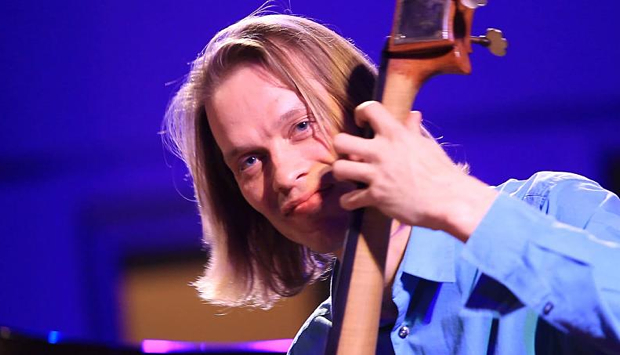
 Vocalist Aili Ikonen fronted most of the songs in either Finnish or English, maintaining a clean presence from alto lyrics to an aggressive and varied range of high-pitch scats. "Basically the best vocalist we've had by a fair amount," is how my notes read, no small thing given the much-promoted appearances of Boine and Hukkelberg. Pianist Antti Kujanpää was mostly dense and harmonic during the opening songs, then branched out with harp-like strums directly on the strings, satirically dramatic operatic sweeps and other sound/texture explorations. Bassist Jori Huhtala was the quietest presence, but hardly short on accomplishment with full-board, rapid-finger plucking of non-standard progressions and pronounced cadences from shuffling to stuttering. Drummer Hanne Pulli supplied a foundation for of full-kit workouts, but generally in subsets allowing heightened focus of her techniques on each.
The final element elevating the performance to exceptional was all this occurred in conversations throughout the body of the songs as well as extended solos. Combined with the wide variety of moods in the compositions, virtually every offering seemed to expose a new element of the band's abilities. Still, the most audience-pleasing moment was probably one of the least challenging, a melodic temper-tantrum Ikonen introduced as "You know when you have a really, really bad day? This is it."
What followed was several minutes of chaotic discordance, controlled-volume screams and pounding instrumental exchanges, all at a speed and turbulence suggesting someone was trying to jump-start a bad day by mixing instant coffee, Jolt cola and Alka Seltzer.
"I've never heard a bad day better than this," one listener told the band afterward.
The players said afterward they weren't bothered coming so far to play one gig in a partially filled room with about 60 people.
"It's not about the amount of people," Ikonen said. "I think it's enough if you look at the audience and see them appreciating it."
Lack of people wasn't an issue on the main stage, where Sivert Høyem & The Volunteers were rocking the house. Their playing was expectedly wall-shaking loud, but decent with intelligible vocals and guitars that actually sounded like instruments instead of effects-driven noise (I'm not anti-rock, just anti-noise). A similar setting late-night techno concert by Ralph Myerz and The Jack Herren Band ensured the festival closed on an energetic note.
Listeners looking for a more jazz-worthy, sedate and communal ending were down the street at the Varbrudd hall, where the Vadso Storband performed the festival's lone big band concert. The mostly local ensemble of musicians performed standards that were well-arranged, if not complexly so, spending much of the time focusing on subsets instead of a consistent group blare. The best of the solos tended toward brisk swing with modest range and intelligent line-at-a-time structure.
But the most soulful event of the day was the gospel concert with Hawkins, Boutté and the refugees.
The church, a minor hilltop landmark, was packed to standing-room capacity when I arrived at the scheduled start. My camera and press pass got me close to the stage for a few minutes early on. The rest of the time I watched from the entryway, not a terrible thing since there was no problem hearing and see the action on stage while observing the totality of devotion some in the pews had to the musicians, worship or both.
Hawkins and Boutté took plenty of liberties with a long list of favorites like "I'll Fly Away" and "I Love The Lord." Many featured progressive or fusion-oriented arrangements, although a respectful number of traditional gospel and Dixie were in the mix. Chorus-heavy hymns were followed by a lone singer and an instrument or two. Unlike Britney or Madonna (pick your generation), Hawkins and Boutté could move spontaneously and sing at the same time.
Critiquing it strictly on musical quality, it was a good rather than mind-blowing. The choir, intriguing as their makeup was, were skillful but limited in the ability to expand beyond basic backings because of their short time together. The genuine spirit of unity, however, meant an atmosphere where even stragglers could feel the sort of rooting interest a parent has at their kid's recital.
 Most of the participants gathered a few hours later for the farewell dinner at the Rica, a casual meal interrupted throughout with spontaneous speeches and toasts.
"Seven countries got together and made beautiful music," said Akoiwala, the Liberian who helped form the choir. "We showed the world how we can all work together."
With that he led to room in a final song. Rather than an ancient classic or tribute from his homeland, he opted for something in English so simple everyone, despite the wide variety of nationalities, responded to his call to join the chorus:
"The more we are together, the happier we'll be."
Tags
PREVIOUS / NEXT


Become a Sustaining Member

Since 1995, All About Jazz has championed jazz as an art form and supported the musicians who create it. Over three decades, it has grown into one of the world's leading jazz resources, serving hundreds of thousands of readers, musicians, presenters and industry professionals each month.
Help Build the Future of All About Jazz
Your support helps us continue building All About Jazz for the next generation—expanding our editorial coverage, preserving jazz history, developing new community features and creating better ways to discover the music and the people behind it.
Become a sustaining member for as little as $20 per year and you'll immediately enjoy an ad-free experience along with access to subscriber features and future articles for a full year.
Together, we're not simply sustaining All About Jazz—we're building its future. Thank you for being part of the journey.