Home » Jazz Articles » Live Review » Pharaoh Sanders at SFJAZZ
Pharaoh Sanders at SFJAZZ

SFJAZZ
San Francisco, CA
January 9, 2014
Pharoah Sanders is hardly a stranger to San Francisco. Residing just across the Bay Bridge in Oakland, the 74-year-old saxophonist has performed in the city on numerous occasions, including a solo gig at Grace Cathedral for SFJAZZ some years back. For this performance, SFJAZZ brought him back for a four-night gig, this time at its own hall and in the company of three seasoned musicians.
Born Ferrell Sanders in Little Rock, Arkansas, Sanders moved to Oakland after high school. In 1962 he joined the renowned Sun Ra's Arkestra. Sun Ra—famous for his Egyptian-style costuming and wild sound—christened him "Pharoah," a natural moniker given the band's eclectic "ancient Egypt" bent and Sanders' spiritual sound. His most famous gig was his long-term association with saxophonist and composer John Coltrane.
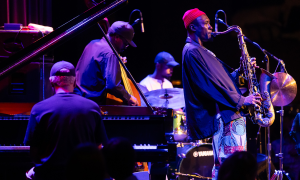
At SFJAZZ, Sanders—clad in his customary cap, white shirt and gray trousers—launched into an extended version of his classic "You've Got to Have Freedom," a title expressing both the sentiments of the free jazz movement he has helped to godfather as well as his own personal struggle to make a living and gain acceptance as a radical artist.
To achieve his tonal, sometimes cacophonous and screeching tenor sound, Sanders uses a mix of techniques including split-reed, multiphonics and overblowing. Finishing, Sanders stepped back and sat down in the shadows to the back of the stage while bassist Nat Reeves continued with a regal bass solo before Sanders returned to solo again, bringing the tune to a conclusion as he tapped the keys without blowing.
For the second tune, Sanders executed a lovely flowing and lyrical solo, eliciting a "yeah" from an audience member. Then he stepped off to the side to perform a classic Pharoah shuffle and then sat down as Reeves soloed, accompanied with some light work on the brushes by Joe Farnsworth before the rest of the band joined in. More glowing, radiant tenor from Sanders followed.
The inimitable classic "The Creator Has A Master Plan" ended the first of the evening's two 45-minute sets. It commenced with a lovely intro by Sanders. Then Farnsworth showed his chops by laying a tambourine on his snare and tapping it with his stick as well as swirling the stick around on the surface of this frame drum. The number segued into a piano and sax duet before then called the band, dubbed each of the three as "the great" and taking time to solo between each name. He yodeled, shimmied and invoked a call of response by chanting "the power of God" and then a nonsense phrase, "gug gug gig gug," before leading the exit from the stage for the break.
After half an hour, the band took the stage again to launch into the "Giant Steps," a Coltrane classic. Following a glowing Sanders intro, longtime pianist William Henderson soloed, a lovely solo evoking the spirit of McCoy Tyner, Coltrane's pianist. An evocative bass solo followed as Reeves worked his fingers up and down the strings as Sanders gazed on intently. Farnsworth then took on his drum kit, bearing down with his sticks before Sanders stepped back in to conclude.
Next up was the Arthur Altman composition "All or Nothing at All." Sanders soloed, then the three musicians communed. then Farnsworth soloed regally, bearing down on his cymbals and then juxtaposing two of his drumsticks at right angles and tapping. Sanders looked on reflectively and then returned to conclude with a fluid solo which has just a bit of a lilt to it. An ethereal version of the Coltrane classic "Naima" followed, then a rollicking version of "Save Our Children" brought the house to its feet, as Sanders once more led a call-and-response yodel—"Oh ye ye yan," while pointing the mike in the direction of the audience. "All we need is inspiration," were the last words Sanders uttered as the lights went on and the band filed off the stage. Sanders had provided plenty of that.
About Pharoah Sanders

Tags
PREVIOUS / NEXT
Become a Sustaining Member

Since 1995, All About Jazz has championed jazz as an art form and supported the musicians who create it. Over three decades, it has grown into one of the world's leading jazz resources, serving hundreds of thousands of readers, musicians, presenters and industry professionals each month.
Help Build the Future of All About Jazz
Your support helps us continue building All About Jazz for the next generation—expanding our editorial coverage, preserving jazz history, developing new community features and creating better ways to discover the music and the people behind it.
Become a sustaining member for as little as $20 per year and you'll immediately enjoy an ad-free experience along with access to subscriber features and future articles for a full year.
Together, we're not simply sustaining All About Jazz—we're building its future. Thank you for being part of the journey.
Near

San Francisco Concerts