Home » Jazz Articles » Book Review » On Highway 61: Music, Race, and the Evolution of Cultura...
On Highway 61: Music, Race, and the Evolution of Cultural Freedom By Dennis McNally
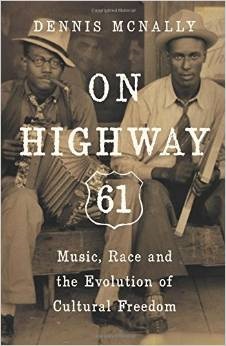 On Highway 61: Music, Race, and the Evolution of Cultural Freedom
 Dennis McNally
384 Pages
ISBN: #978-1619024496
Counterpoint
2014
Since Samuel Charters The Country Blues (Reinhart) in 1959, beginning, effectively, the serious reportage of American Folk Music, in particular the blues, there have been two far-reaching trilogies that address American Folk Music against the larger backdrop of race and culture. The first is Peter Guralnick's Feel Like Going Home: Portraits in Blues, Country, and Rock 'n' Roll (Harper& Row, 1971); Lost Highway: Journeys & Arrivals of American Musicians (Harper & Row, 1979), and Sweet Soul Music: Rhythm and Blues and the Southern Dream of Freedom (Harper & Row, 1986).
The second prominent trilogy is by Greil Marcus and includes: Mystery Train: Images of America in Rock 'n' Roll Music (Plume, 1975), Lipstick Traces: A Secret History of the 20th Century (Harvard University Press, 1989), and The Old, Weird America: The World of Bob Dylan's Basement Tapes (Picador, 2011). While Guralnick's set retains remnants of the period's romantic exuberance, Marcus' is often unfocused and impenetrable. Both sets are necessary reading to properly understand the length of America musical history through rock and roll becoming the popular music in the 1950s and '60s.
A third, and to date, most inclusive trilogy has just been completed in On Highway 61: Music, Race, and the Evolution of Cultural Freedom by Dennis McNally. On Highway 61 joins his books, Desolate Angel: Jack, the Beats and America (Book Sales, 1981) and A Long Strange Trip: The Inside History of the Grateful Dead (Broadway, 2002). McNally has spent a life time chronicling the Grateful Dead, for whom he was the authorized biographer of Kerouac the band. He holds a Ph.D. in history from the University of Massachusetts, a fact amply apparent in his superb research but thankfully lacking in his almost conversational writing (read that as: "a user friendly historian").
The main focus of McNally's studies is the American counter-culture as defined by the ideals of the Transcendentalists Henry David Thoreau and Ralph Waldo Emerson. McNally places these characters at the center of the Abolitionist movement of the 19th Century expounding what had to be the most counter-cultural thinking of the period. It makes me wonder, how shortchanged I was studying Thoreau and Emerson in high school (Catholic school at that) and how their then-radical writings were minimized to more style than content. Heaven forbid that a Catholic school should promote Unitarian thinking.
Beginning with Jack Kerouac and the Beats, McNally addresses the most counter-cultural aspects of the post-ear 1950s. In On Highway 61: Music, Race, and the Evolution of Cultural Freedom, McNally draws a thread through music and American Culture starting before the Civil War through the emergence of Bob Bylan. The thread metaphor may be extended to that ribbon of water that nearly bisects the country: the Mississippi River and its Highway 61. With great facility, McNally details in an attractive and easily readable style all of the music spring forth from this rich cultural area, beginning in the Caribbean to New Orleans, Greenville, Tutwiler, Memphis, St Louis, Hannibal, to Chicago and ultimately to Dylan's, Hibbing, Minnesota.
Weaving little known facts about a host of musical luminaries shaping all American music that came after, the author seasons the discussion with the richness of race in America and in particular, the American South. He emphasizes that what America is today is because of African American culture interacting with and changing White Anglo Saxon Protestant America and how this interaction and change has made us all better, at least in the ideal. McNally may have almost been too ambitious in his reach over the subject matter, but his premise never thins and always remains centered in the egalitarian positions posited by the opening characters David Thoreau and Ralph Waldo Emerson, Mark Twain, Walt Whitman and all that came after them. Woody Guthrie's guitar said "This Machine Kills Fascists." So does this far-reaching book.
 FOLLOW C. Michael Bailey
and get notified whenever a new article published.
FOLLOW C. Michael Bailey
and get notified whenever a new article published.
I'm Sanctified and Southern Fried / Mama tried and daddy cried / I tell the truth 'cept when I've lied / And like my huevos on the side.
About Mamie Smith

Tags
PREVIOUS / NEXT

Become a Sustaining Member

Since 1995, All About Jazz has championed jazz as an art form and supported the musicians who create it. Over three decades, it has grown into one of the world's leading jazz resources, serving hundreds of thousands of readers, musicians, presenters and industry professionals each month.
Help Build the Future of All About Jazz
Your support helps us continue building All About Jazz for the next generation—expanding our editorial coverage, preserving jazz history, developing new community features and creating better ways to discover the music and the people behind it.
Become a sustaining member for as little as $20 per year and you'll immediately enjoy an ad-free experience along with access to subscriber features and future articles for a full year.
Together, we're not simply sustaining All About Jazz—we're building its future. Thank you for being part of the journey.