Home » Jazz Articles » Album Review » Scott Dubois Quintet featuring David Liebman: Monsoon
Scott Dubois Quintet featuring David Liebman: Monsoon

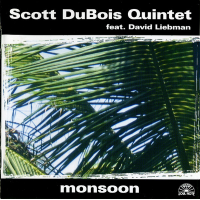
It's difficult to pin down exactly what is missing. Dubois the writer clearly has an impressive command of harmony, rhythmic invention and melodic intrigue. On the opening "Lost Silence," a challenging 11/8 figure provides the backdrop for a plaintive double-horn theme from Liebman and Loren Stillman that echoes a broader world view. "Rain on Rain" begins with Dubois' round-toned electric guitar and Liebman's wooden flute evoking images of India before, once again, a two-horn frontline establishes a haunting theme over rubato musings from Dubois, bassist Thomas Morgan and drummer Mark Ferber. "She Brought Life," on the other hand, finds Dubois and Morgan playing an elliptical theme over which the horns layer a contrapuntal alternative, again with a nod towards a more Eastern sensibility.
As a player Dubois has an appealing approach made all the more intriguing through his use of classical guitar as his main instrument. He's clearly a distinctive player, with little to be found of the usual guitar influences. There's nary a Jim Hall or Wes Montgomery to be found in his electric playing and, while there are few guitarists, including Ralph Towner, who make a case for the classical guitar as a strong jazz instrument, Dubois manages to avoid those trappings as well. For a younger player, he has completely skipped the generation of John Abercrombies, John Scofields and Bill Frisells. The result is a personal style that incorporates little of the more expected jazz tradition and, instead, looks to ethnic and contemporary classical music as its inspiration.
But as imaginative and inventive as Dubois and his quintet are, with Liebman his usual expressionistic, albeit somewhat more subdued, self, the compositions feel more like exercise than catharsis. There are clearly compelling moments, but for the most part the recording feels too considered, and despite the mystery and emotion Liebman's tenor solo on the impressionistic "End." With the potential for some heated exchanges between the players, nothing ever seems to rise above a slow simmer. And that's a shame, because everyone is clearly capable. Stillman, in particular, who has his own début on Soul Note, is a player worth watching.
But at the end of the day, clever invention doesn't substitute for emotional depth, and Dubois needs to find a way to connect his formidable skills with his inner core. Only then will he truly succeed at creating music that touches the spirit.
Track Listing
Lost Silence; Rain on Rain; She Brought Life; End; Monsoon; Acceptance Suite: I. Peace of Mind; II. Fallen; III. Recapture; Float; Spilled Colors.
Personnel

Scott DuBois
guitar
Dave Liebman
saxophone
Loren Stillman
saxophone, alto
Thomas Morgan
bass, acoustic
Mark Ferber
drums
Jason Rigby
saxophoneScott Dubois: electric and acoustic guitars; David Liebman: tenor and soprano saxophones, Indian flute (1, 2, 4,9); Loren Stillman: alto and soprano saxophones; Jason Rigby: tenor and soprano saxophones (3, 5, 6-7, 10); Thomas Morgan: bass; Mark Ferber: drums.
Album information
Title: Monsoon | Year Released: 2004 | Record Label: Soul Note
About Scott DuBois
Tags
PREVIOUS / NEXT

Become a Sustaining Member

Since 1995, All About Jazz has championed jazz as an art form and supported the musicians who create it. Over three decades, it has grown into one of the world's leading jazz resources, serving hundreds of thousands of readers, musicians, presenters and industry professionals each month.
Help Build the Future of All About Jazz
Your support helps us continue building All About Jazz for the next generation—expanding our editorial coverage, preserving jazz history, developing new community features and creating better ways to discover the music and the people behind it.
Become a sustaining member for as little as $20 per year and you'll immediately enjoy an ad-free experience along with access to subscriber features and future articles for a full year.
Together, we're not simply sustaining All About Jazz—we're building its future. Thank you for being part of the journey.