Home » Jazz Articles » Festivals Talking » Moers Festival Interviews: Julien Desprez
Moers Festival Interviews: Julien Desprez
In Berlin, 2018, Desprez played an atmospheric duo set with cornetist Rob Mazurek and was also part of the then-debuting trio Abacaxi with bassist Jean-Francois Riffaud and drummer Max Andrzejewski. Distressed metallic contusions deified the abrupt. Everyone nursed a sonic impediment. The players manually controlled the bright white flicker show lighting, speeding at full power, juddering, jolting and spasming as they demanded total attention down to every detail. The next year, Abacaxi came to Moers, still stuttering with punk-funk complexity, loaded with extreme textures, and with Desprez adopting a tap-dancing approach to his sound/light effects pedals.
In Mechelen, 2019, Desprez initiated tolling, markedly metallic doom themes with overloaded pedal clouds, using his axe to deliver radically different sounds within each outburst, chopping, thumping, or picking fast runs in the "traditional" rock-fusion fashion.
At the opening day of the Moers Festival, May 21st, 2021, Desprez will play completely solo inside the Eventhalle, harking back to his old 2014 EP release Acapulco and using that as a pouncing point to rebirth as Acapulco Redux. It will represent the prime essence of his sound and vision approach, honed over the last seven years and a symbiotic grafting of fractured, percussive guitar strafes and hyper-speed-triggered white light spurts. It will be part-gig, part-performance art, and even part-dance.
One reason Desprez was previously "hidden" could be that he was inhabiting other realms where music is an element but not an end, being involved with dance pieces, gallery installations, and performance art happenings. That experience helped guide Desprez's path toward a vision of equality between sonics, lighting, staging, movement and environment.
"I came to the lights, releasing Acapulco," Desprez explains. "Then, after two years of performing it with a really different audience, I got a lot of feedback about my body motion while I was playing, and I then thought, 'how can I push this further?' It seemed interesting to take all of the stage as an experimental space to perform, and not only with the space of the sound."
Each practical guitar-playing gesture becomes meaningful, especially with Desprez's percussive touch and his feet sparking pedals and matching sounds to lights as if they have truly become a hybrid entity. Given the accelerated rate of his delivery, the jarring cuts and sudden switches, he has to virtually tap dance across his floor gear with arms and legs in continual action. Each motion becomes the expressive root of this expanded visual presentation. "I changed my way of playing, starting to use my feet, so I had to work more like a drummer or a Hammond organ player. Today, for me, the guitar is just a path. I think more of it as a controller, a relationship, like a computer but with my guitar. I have all these gestures, and I need them to play. I just try to push further this side of my playing."
Though the performance of Acapulco Redux involves improvisation, Desprez has a map of the work's structure. "I have a kind of shape. I have to be able to give the same feeling every time, but between these points, I'm improvising. As I'm playing with sound, body, light and space and to be able to connect everything, at the beginning I had to write the piece, to be able to think about everything, and be comfortable."
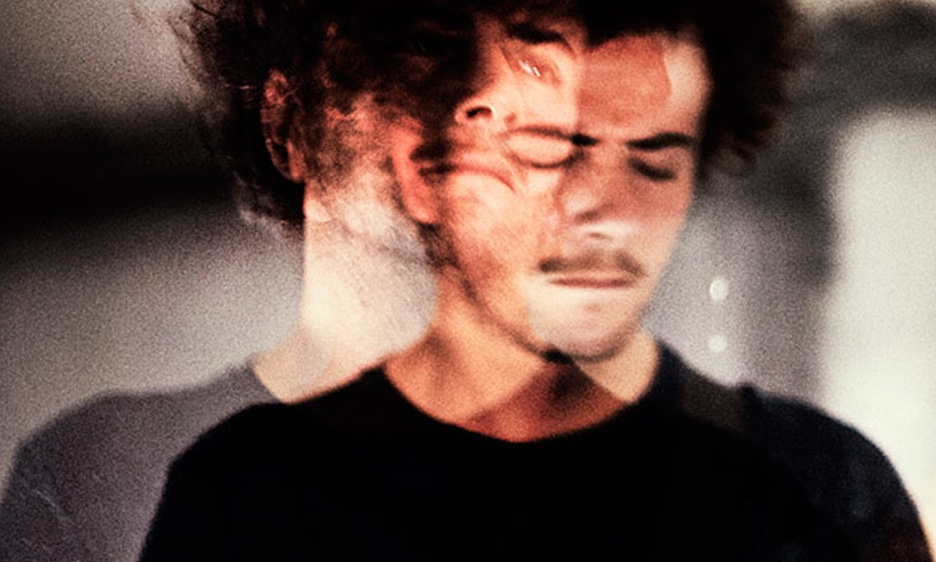
Desprez mostly uses sharp white light during his performances rather than any colour variations. "Basically, it's in black and white, I use a white guitar, I dress in black and it's more photographic. As the lights are so powerful, I can begin to play with the eyes of the audience, their afterimages."
Desprez whams from hard black to sudden extreme whiteout, so eyes can't re-focus fast enough. He plays with that condition in the manner of stroboscopic stutters that malform reality into a jerk-motion existence. New sounds mean new light durations and relationships. Sometimes all of his movement are discernible. At others, it's a flashing jerk, a fleeting slice of white eyeball. The tap-like moves have made Desprez consider his body balance and how the weight is distributed, particularly while both his feet are so often leaving the ground. In this case, he wanted to move away from any comfort of familiarity.
If pressed to pick one artist who might be a strong influence on the Desprez sound, it would have to be the Brazilian guitarist Arto Lindsay, who forged his reputation in New York City as a member of DNA and The Lounge Lizards. Desprez has actually performed with Lindsay on several occasions during multiple visits to Brazil. They appeared at the Novas Frequências festival in Rio and then again up north in Salvador, Bahia. Desprez was studying the indigenous dance form Coco, which has helped develop his own concept of effects pedal stomping.
"The fragmentation is here to sustain the tension, and never let it down," concludes Desprez.
Now that virus restrictions are easing in Europe, there are summer gigs already lined up for Abacaxi in France and Italy to promote their recent Mainstream Desire, an EP that's almost as long as an LP. It's released by Desprez's Collectif Coax, which has now been together for 12 years. The various lockdowns have actually strengthened this group of artists since they've all been stranded together in Paris for much of the last year.
 FOLLOW Martin Longley
and get notified whenever a new article published.
FOLLOW Martin Longley
and get notified whenever a new article published.
Martin Longley also writes for Jazzwise, Songlines, Downbeat, We Jazz, Qwest TV, The New York City Jazz Record & The Brooklyn Rail
About Julien Desprez

Tags
PREVIOUS / NEXT


Become a Sustaining Member

Since 1995, All About Jazz has championed jazz as an art form and supported the musicians who create it. Over three decades, it has grown into one of the world's leading jazz resources, serving hundreds of thousands of readers, musicians, presenters and industry professionals each month.
Help Build the Future of All About Jazz
Your support helps us continue building All About Jazz for the next generation—expanding our editorial coverage, preserving jazz history, developing new community features and creating better ways to discover the music and the people behind it.
Become a sustaining member for as little as $20 per year and you'll immediately enjoy an ad-free experience along with access to subscriber features and future articles for a full year.
Together, we're not simply sustaining All About Jazz—we're building its future. Thank you for being part of the journey.